
Poh Ern Shih Temple
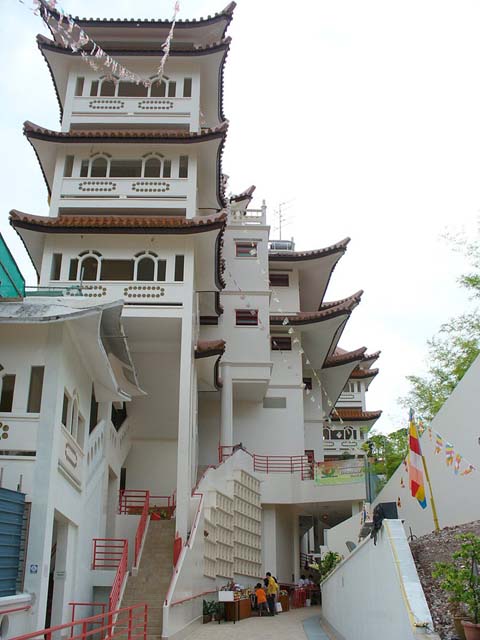
Poh Ern Shih Temple, meaning 'Temple of Thanksgiving,' is a significant Buddhist site in Singapore built to commemorate those lost in the 1942 Battle of Pasir Panjang. It stands as a memorial and a place of worship, notable for its innovative eco-friendly and elderly-friendly architectural features and its role in promoting Buddhist teachings through various programs.
Key Facts
- ›Established in 1954 by philanthropist Lee Choon Seng as a memorial to victims of the Battle of Pasir Panjang.
- ›The first abbot, Venerable Sumangalo, was an American Theravada monk, marking the first time a Westerner held such a position in Singapore.
- ›The temple was rebuilt starting in 2003, incorporating advanced eco-friendly and elderly-friendly design elements.
- ›Features include solar energy systems, wind generators, and rainwater harvesting for irrigation and electricity generation.
- ›It partners with the Buddhist Fellowship to offer Dharma talks, Sutta discussions, and meditation courses.
- ›Dedicated to Ksitigarbha Bodhisattva, it is one of the few Mahayana temples in Singapore with this focus.
Important Relationships
- Buddhist Fellowship
- Lee Choon Seng
- Venerable Sumangalo
- Pitt Chin Hui
- Kong Meng San Phor Kark See Temple
- Second Lieutenant Adnan Bin Saidi
Eco-Friendly Design, Elderly-Friendly Design, Solar Energy Systems, Wind Generators, Rainwater Harvesting System, Ksitigarbha Bodhisattva Statues, Guanyin Meditation Hall, 7-Storey Stupa
Battle of Pasir Panjang, Founding of the Temple, Appointment of Venerable Sumangalo As Abbot, Reconstruction and Modernization Project
Classical Features, Modern
About Poh Ern Shih Temple
Poh Ern Shih Temple, whose name translates to 'Temple of Thanksgiving' in Chinese, is a significant Buddhist landmark situated on a hilltop along Chwee Chian Road in Singapore. Its establishment in 1954 was driven by a profound purpose: to serve as a memorial to the fallen soldiers and civilians who lost their lives during the intense Battle of Pasir Panjang in 1942.
History and Foundation
The temple's construction was initiated by philanthropist Lee Choon Seng, a respected figure in Singapore's Chinese community and a co-founder of the Oversea-Chinese Banking Corporation (OCBC). Lee Choon Seng, who was also involved in establishing the Singapore Buddhist Lodge, envisioned Poh Ern Shih as a place to honor the sacrifices made during a tumultuous period in Singapore's history. He dedicated the temple to the Ksitigarbha Bodhisattva, making it one of the fewer Mahayana temples in Singapore with this specific devotion.
A notable chapter in the temple's history is the tenure of its first abbot, Venerable Sumangalo. An American Theravada monk, Sumangalo was the first Westerner to be appointed as the abbot of a Buddhist temple in Singapore, a distinction he held from 1959. During his time, he also assisted Pitt Chin Hui in translating the Ksitigarbha Bodhisattva Sutra into English.
Architectural Innovation and Sustainability
Following a comprehensive redevelopment project that commenced in 2003, Poh Ern Shih Temple was transformed into a modern facility. The rebuilt temple is distinguished by its integration of both eco-friendly and elderly-friendly architectural designs, setting a precedent for religious buildings in the country. The design prioritizes accessibility with features like gentle driveways and level flooring throughout its six stories. Environmentally conscious elements include extensive solar energy arrays for heating water and powering night lighting, wind generators for electricity, and a sophisticated rainwater harvesting system used for irrigation and generating electricity through micro-hydroelectric generators.
Community Engagement and Modern Role
Today, Poh Ern Shih Temple actively engages with the Buddhist community. It collaborates with the Buddhist Fellowship, a non-sectarian organization, to conduct a range of programs. These include Dharma talks, Sutta discussions, and meditation courses, offered in both Chinese and English, catering to a contemporary audience. The temple's accessibility, free admission, and daily opening hours make it a welcoming space for visitors and devotees alike, continuing its legacy as a place of remembrance, spiritual practice, and community outreach.
Source: Wikipedia ↗
Frequently Asked Questions
What is the historical significance of Poh Ern Shih Temple?
Poh Ern Shih Temple was built on the site of the Battle of Pasir Panjang in 1954. It serves as a memorial to both civilians and soldiers, Allied and Japanese, who perished during the 1942 conflict.
Who was the founder of Poh Ern Shih Temple?
The temple was founded by philanthropist Lee Choon Seng. He was a prominent figure in Singapore's Chinese community and a co-founder of the Oversea-Chinese Banking Corporation (OCBC).
What makes the architecture of Poh Ern Shih Temple unique?
The temple underwent a major reconstruction, completed in phases by 2008, and is recognized for its pioneering eco-friendly and elderly-friendly features. This includes extensive use of solar energy, wind power, and rainwater harvesting systems.
What kind of programs are offered at Poh Ern Shih Temple?
In partnership with the Buddhist Fellowship, the temple hosts various programs such as Dharma talks, Sutta discussions, and meditation courses. These are conducted in both English and Chinese.
Who was Venerable Sumangalo and what was his connection to the temple?
Venerable Sumangalo, an American Theravada monk, served as the first abbot of Poh Ern Shih Temple. His appointment in 1959 marked the first time a Westerner held such a position in a Buddhist temple in Singapore.
Is Poh Ern Shih Temple accessible to the public?
Yes, Poh Ern Shih Temple is open to the public daily, and admission is free. Its design prioritizes accessibility for the elderly and those using wheelchairs.
Related Buddhist Temples

Kong Meng San Phor Kark See Monastery
Kong Meng San Phor Kark See Monastery, also known as Bright Hill Temple, is Singapore's largest Mahayana Buddhist temple, founded in 1921 by Venerable Zhuan Dao. It serves as a significant center for Buddhist propagation, monastic lodging, and community services, including operating one of Singapore's private crematoria and a nursing home.

Amitabha Buddhist Centre
Amitabha Buddhist Centre is a Mahayana Buddhist institution located in Geylang, Singapore, affiliated with the Foundation for the Preservation of the Mahayana Tradition (FPMT). It was established following visits by Lama Thubten Yeshe and Lama Thubten Zopa Rinpoche, and has grown from meeting in various venues to a permanent, seven-storey Tibetan-style structure completed in 2006. The center is known for its role in propagating Mahayana Buddhism in Singapore and for hosting visits from recognized reincarnate lamas.
Tzu Chi Singapore
Tzu Chi Singapore is the Singapore branch of the Tzu Chi Buddhist organization, founded in September 1993. It advocates for Buddhist and humanitarian causes, offering services such as free clinics, health checkups, and regular recycling drives. The organization is also known for its localized monthly journal and its youth wing, the Tzu Chi Collegiate Association Singapore.