
Kong Meng San Phor Kark See Monastery
Kong Meng San Phor Kark See Monastery, also known as Bright Hill Temple, is Singapore's largest Mahayana Buddhist temple, founded in 1921 by Venerable Zhuan Dao. It serves as a significant center for Buddhist propagation, monastic lodging, and community services, including operating one of Singapore's private crematoria and a nursing home.
Key Facts
- ›Founded in 1921 by Venerable Zhuan Dao, it is Singapore's first traditional Chinese monastery.
- ›It is the largest Mahayana Buddhist temple in Singapore.
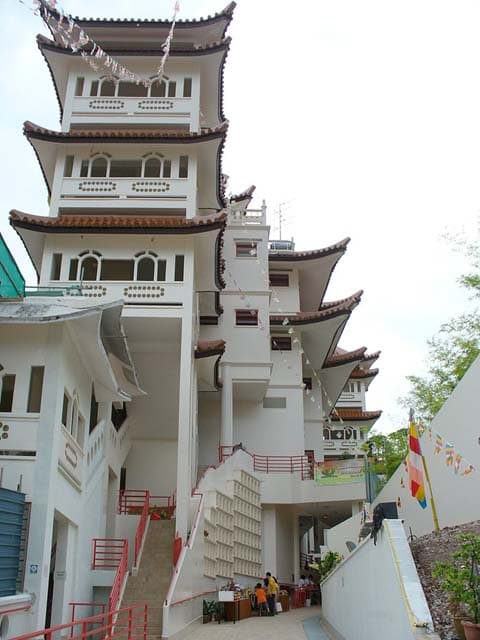
- ›The monastery complex spans an area equivalent to ten football fields and includes numerous prayer halls and a Pagoda of 10,000 Buddhas.
- ›It operates Evergreen Bright Hill Home, a non-profit nursing home for the elderly.
- ›In 2006, it became the parent organization of the Buddhist College of Singapore, the nation's first Buddhist college offering a bachelor's degree.
- ›Facilities include stupas, prayer halls, a crematorium, a columbarium, and one of Asia's largest bronze Buddha statues.

Important Relationships
- Venerable Zhuan Dao
- Tay Woo Seng
- Aw Boon Haw
- Aw Boon Par
- Venerable Hong Choon
- Venerable Seck Hong Choon
- Venerable Yen Pei
- Venerable Long Gen
- Venerable Sui Kim
- Venerable Kwang Sheng
- Buddhist College of Singapore
- Evergreen Bright Hill Home
Pagoda of 10,000 Buddhas, Outdoor Statue of Guanyin, Bronze Buddha Statue, Bodhi Tree, Crematorium and Columbarium
- Founded In 1921 By Venerable Zhuan Dao.
- Venerable Hong Choon Became Chief Abbot In 1947, Leading Significant Expansion.
- Evergreen Bright Hill Home Opened In 1983.
- Buddhist College of Singapore Established In 2006.
- Organized A Charity Show In 2008 To Raise Funds For Sichuan Earthquake Reconstruction.
Traditional Chinese
About Kong Meng San Phor Kark See Monastery
Kong Meng San Phor Kark See Monastery, known more commonly as Bright Hill Temple, stands as a prominent Buddhist institution in Singapore. Established in 1921 by Venerable Zhuan Dao, it holds the distinction of being the first traditional Chinese monastery built in Singapore and is recognized as the largest Mahayana Buddhist temple in the country. Its mission extends beyond religious observance, encompassing the propagation of Buddhism, the provision of lodging for monks, and significant community welfare initiatives.
History and Development
The monastery's origins trace back to land donated by the Chinese businessman Tay Woo Seng in the Thomson Road area. Initially a modest two-storey building, it underwent substantial expansion over the decades, fueled by donations from philanthropists such as Aw Boon Haw and Aw Boon Par. Under the leadership of Venerable Hong Choon, who became Chief Abbot in 1947, the complex grew to cover an area as large as ten football fields, incorporating the impressive Pagoda of 10,000 Buddhas and numerous prayer halls. This period also saw the development of the monastery as a dedicated place for Buddhist practice.
Community Services and Education
Beyond its religious functions, Kong Meng San Phor Kark See Monastery is deeply involved in social welfare. In 1983, with substantial donations, it opened Evergreen Bright Hill Home, a non-profit nursing home dedicated to providing care for the elderly, irrespective of their background. The monastery also operates one of Singapore's two private crematoria and columbaria. A significant educational milestone was the establishment of the Buddhist College of Singapore in 2006, the nation's first Buddhist college offering a bachelor's degree in Buddhism, which moved into its own purpose-built S$35 million facility in 2016.
Notable Features and Activities
The monastery's grounds feature a wealth of religious architecture and art, including various stupas, prayer halls, bell and drum towers, and an outdoor statue of Guanyin. A particularly striking feature is the large bronze Buddha statue housed in the Hall of No Form, measuring 13.8 meters in height and weighing 55 tons. Another notable element is the Bodhi tree, a sapling descended from the sacred tree in Anuradhapura, Sri Lanka. The monastery actively celebrates Buddhist festivals such as Vesak Day and Qingming Festival, and engages the community through initiatives like the KMSPKS Youth group and publications like the English-language magazine "Gum."
Source: Wikipedia ↗
Frequently Asked Questions
When was Kong Meng San Phor Kark See Monastery founded?
The temple was founded between 1920 and 1921 by Venerable Zhuan Dao. It was established on land donated by Chinese businessman Tay Woo Seng.
What is the significance of Bright Hill Temple?
It is the largest Mahayana Buddhist temple in Singapore and plays a crucial role in propagating Buddhism, providing lodging for monks, and offering community services such as a nursing home and a crematorium.
What are some notable features of the monastery?
Key features include the Pagoda of 10,000 Buddhas, an outdoor statue of Guanyin, and one of Asia's largest bronze Buddha statues. It also houses a Bodhi tree sapling from Sri Lanka.
What educational institutions are associated with the temple?
Kong Meng San Phor Kark See Monastery is the parent organization of the Buddhist College of Singapore, which offers a four-year bachelor's degree in Buddhism.
Does the monastery offer services for the community?
Yes, it operates Evergreen Bright Hill Home, a non-profit nursing home, and also runs one of Singapore's private crematoria and columbaria.
Related Buddhist Temples
Poh Ern Shih Temple
Poh Ern Shih Temple, meaning 'Temple of Thanksgiving,' is a significant Buddhist site in Singapore built to commemorate those lost in the 1942 Battle of Pasir Panjang. It stands as a memorial and a place of worship, notable for its innovative eco-friendly and elderly-friendly architectural features and its role in promoting Buddhist teachings through various programs.

Amitabha Buddhist Centre
Amitabha Buddhist Centre is a Mahayana Buddhist institution located in Geylang, Singapore, affiliated with the Foundation for the Preservation of the Mahayana Tradition (FPMT). It was established following visits by Lama Thubten Yeshe and Lama Thubten Zopa Rinpoche, and has grown from meeting in various venues to a permanent, seven-storey Tibetan-style structure completed in 2006. The center is known for its role in propagating Mahayana Buddhism in Singapore and for hosting visits from recognized reincarnate lamas.
Tzu Chi Singapore
Tzu Chi Singapore is the Singapore branch of the Tzu Chi Buddhist organization, founded in September 1993. It advocates for Buddhist and humanitarian causes, offering services such as free clinics, health checkups, and regular recycling drives. The organization is also known for its localized monthly journal and its youth wing, the Tzu Chi Collegiate Association Singapore.