
Galmaduwa Raja Maha Vihara, Ampara
Galmaduwa Raja Maha Vihara is an ancient Buddhist temple located in Galmaduwa, Sri Lanka, believed to have been constructed during the reign of King Saddha Tissa. It was rediscovered and re-established as a modern Vihara complex following the Gal Oya development program, and is formally recognized as an archaeological site by the Sri Lankan government.
Key Facts
- ›The temple is believed to have been constructed during the reign of King Saddha Tissa (137 BC – 119 BC).
- ›It was rediscovered and re-established as a modern Vihara complex after the Gal Oya development program.
- ›The temple has been formally recognized as an archaeological site by the Sri Lankan government.
- ›Although many buildings are recent constructions, ancient structures like granite pillars and Sandakada pahana are still present.
- ›The ancient Dagoba is in a dilapidated state, resembling a small earth mound.

Important Relationships
- King Saddha Tissa
Granite Pillars, Sandakada Pahana, Korawak Gal, Chatra Stones, Foundations of Ancient Buildings
- Rediscovery and Re-Establishment Following the Gal Oya Development Program.
About Galmaduwa Raja Maha Vihara, Ampara
Galmaduwa Raja Maha Vihara
Galmaduwa Raja Maha Vihara is an ancient Buddhist temple situated in Galmaduwa, Sri Lanka. Its origins are traced back to the reign of King Saddha Tissa, who ruled from 137 BC to 119 BC, making it a site of considerable historical depth. The temple's existence was largely forgotten until the Gal Oya development program in the Ampara region led to the rediscovery of its ruined complex.
Following its discovery, the site was re-established and developed into a modern Vihara complex. While many of the structures seen today are recent additions, the premises still bear remnants of its ancient past. Visitors can observe ancient granite pillars, a Sandakada pahana (moonstone), Korawak gal (balustrades), Chatra stones, and the foundations of former buildings. The ancient Dagoba, a significant stupa structure, has unfortunately fallen into disrepair and now resembles a small mound of earth.
Galmaduwa Raja Maha Vihara holds official recognition as an archaeological site in Sri Lanka, a designation formalized by the government on December 26, 2014, through Gazette number 1895. This recognition underscores its importance as a historical and cultural heritage site, preserving a link to the island's ancient Buddhist traditions amidst its modern redevelopment.
Source: Wikipedia ↗
Frequently Asked Questions
When was Galmaduwa Raja Maha Vihara built?
It is believed that the temple complex was constructed during the reign of King Saddha Tissa, who ruled from 137 BC to 119 BC.
Where is Galmaduwa Raja Maha Vihara located?
The temple is situated in Galmaduwa, Sri Lanka, on the Hingurana – Ampara road, approximately 6 km (3.7 mi) from Hingurana.
What is the current status of the ancient structures at the temple?
While many of the buildings at Galmaduwa Raja Maha Vihara are recent constructions, ancient structures such as granite pillars, Sandakada pahana, Korawak gal, and Chatra stones can still be found within the premises. The ancient Dagoba, however, is largely dilapidated.
Has the temple been officially recognized as an archaeological site?
Yes, Galmaduwa Raja Maha Vihara has been formally recognized by the Government of Sri Lanka as an archaeological site. This designation was declared on December 26, 2014, through government Gazette number 1895.
Related Buddhist Temples
Muhudu Maha Viharaya
Muhudu Maha Viharaya is an ancient Buddhist temple located in Pottuvil, Ampara District, Eastern Province of Sri Lanka. Believed to have been constructed over 2000 years ago by King Kavan Tissa of Ruhuna, it is situated near a prominent beach and is a significant historical site with numerous ruins.

Samanabedda cave temple
Samanabedda cave temple is an ancient Buddhist site located in Uhana, Ampara District, Sri Lanka. Formally recognized as an archaeological site by the Sri Lankan government, it is traditionally believed to have been established during the reign of King Saddha Tissa.
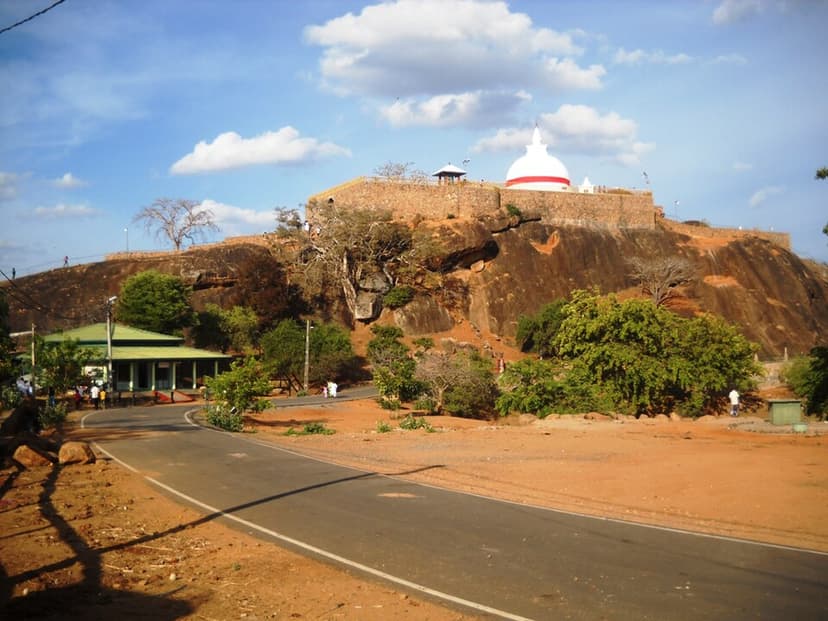
Sithulpawwa Rajamaha Viharaya
Sithulpawwa Rajamaha Viharaya is an ancient Buddhist monastery located in Hambantota District, South Eastern Sri Lanka, renowned as a significant center for Buddhist worship and education. Believed to have been established in the 2nd century B.C. by King Kavantissa, the monastery's name, "Chiththala Pabbatha," translates to "the hill of the quiet mind," reflecting its spiritual significance.