
Fuyan Temple
Fuyan Temple is a significant Buddhist temple located on Mount Heng in China's Hunan province. Originally named Bore Chan Temple, its construction began in the 6th century, and it received imperial patronage and name recognition from Song Dynasty Emperor Taizong. Designated a National Key Buddhist Temple in 1983, it remains an important site for Buddhist practice and cultural heritage.
Key Facts
- ›Founded in 567 by Nanyue Huisi during the six Dynasties period, originally as Bore Chan Temple.
- ›Received Buddhist scriptures from Emperor Taizong of Tang during the Zhenguan period.
- ›Renamed Fuyan Temple by Emperor Taizong of Song during the Taiping Xingguo period.
- ›Reconstructed by local government in 1870 during the Qing Dynasty.
- ›Designated a National Key Buddhist Temple in Han Chinese Area in 1983.
- ›Features over 10 buildings, including the Mahavira Hall and the Hall of Holy Emperor of Mount Heng, and four ancient ginkgo trees, one of which is 1400 years old.

Important Relationships
- Nanyue Huisi
- Emperor Taizong of Tang
- Nanyue Huairang
- Emperor Taizong of Song
Hall of Holy Emperor of Mount Heng, Mahavira Hall, Four Old Ginkgo Trees
- Initiation of Construction In 567
- Receipt of Buddhist Scriptures From Emperor Taizong of Tang During the Zhenguan Period
- Renaming To Fuyan Temple By Emperor Taizong of Song
- Reconstruction In 1870
- Designation As A National Key Buddhist Temple In 1983
About Fuyan Temple
Fuyan Temple, originally known as Bore Chan Temple or Bore Temple, is a significant Buddhist temple situated on Mount Heng in the Nanyue District of Hengyang, Hunan, China. Its construction was initiated in 567 by the Buddhist monk Nanyue Huisi during the Six Dynasties period, establishing it as a site of considerable historical and religious importance.
Historical Significance and Imperial Patronage
The temple's historical trajectory is marked by royal endorsement and development. During the Tang Dynasty's Zhenguan period (627-649), Emperor Taizong of Tang bestowed 50 volumes of Buddhist scriptures upon the temple. Later, in the Song Dynasty, Emperor Taizong, during the Taiping Xingguo period, inscribed and honored the temple with the name "Fuyan Temple," a designation that has persisted to the present day. Further restoration efforts were undertaken by the local government in 1870 during the Qing Dynasty.
In recognition of its historical and cultural value, Fuyan Temple was designated a National Key Buddhist Temple in the Han Chinese Area in 1983. This status underscores its role as a vital center for Buddhist heritage in the region.
Architectural Features and Notable Elements
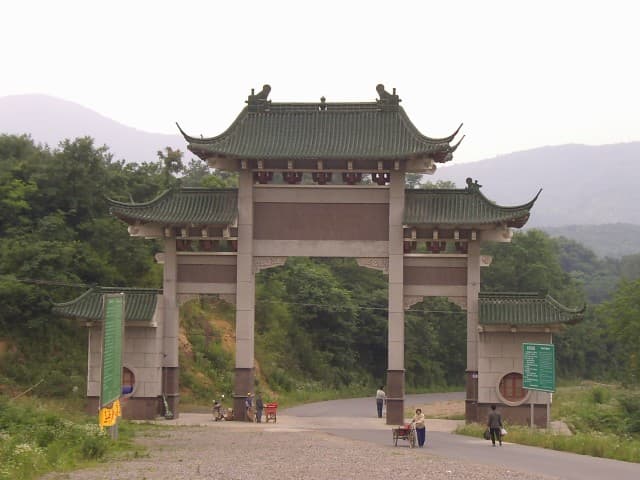
Fuyan Temple boasts a complex of over 10 buildings and halls, many of which are well-preserved. Among these are the shanmen (mountain gate), the Hall of Holy Emperor of Mount Heng, the Mahavira Hall, the Abbot's Room, the Fatang, the Zushi Dian, the Zangjing Ge (Scripture Depository), the Meditation Hall, and the Huayan Pavilion. The Mahavira Hall serves as the temple's fourth hall and enshrines statues of the Horizontal Three-Life Buddha: Shijiamouni in the center, with Amituofo to the right and Yaoshi to the left, flanked by eighteen Arhats. The Hall of Holy Emperor of Mount Heng is dedicated to the worship of the Holy Emperor of Mount Heng (岳神).
Adding to its natural and historical charm, Fuyan Temple is home to four ancient ginkgo trees, with one estimated to be 1400 years old, a testament to the temple's long-standing presence.
Source: Wikipedia ↗
Frequently Asked Questions
When was Fuyan Temple founded?
The construction of Fuyan Temple was initiated in 567 during the Six Dynasties period by Nanyue Huisi. It was originally known as Bore Chan Temple.
What is the significance of the name Fuyan Temple?
During the Song Dynasty, Emperor Taizong inscribed and honored the name 'Fuyan Temple' during the Taiping Xingguo period. This name has been retained and is its current designation.
What are some notable architectural features of Fuyan Temple?
Fuyan Temple comprises more than 10 buildings and halls. Key well-preserved structures include the shanmen, the Hall of Holy Emperor of Mount Heng, and the Mahavira Hall. The temple also boasts four ancient ginkgo trees.
What is enshrined in the Mahavira Hall?
The Mahavira Hall enshrines statues of the Horizontal Three-Life Buddha, which include Shijiamouni in the center, Amituofo to the right, and Yaoshi to the left. Eighteen Arhats are positioned on both sides of these central figures.
Has Fuyan Temple received imperial recognition?
Yes, Fuyan Temple received Buddhist scriptures from Emperor Taizong of Tang during the Zhenguan period. Later, Emperor Taizong of Song bestowed the temple's current name, Fuyan Temple.
What is the current status of Fuyan Temple?
Fuyan Temple was designated a National Key Buddhist Temple in Han Chinese Area in 1983, indicating its significant cultural and religious status. It remains a place with preserved historical architecture and active religious significance.
Related Buddhist Temples

Daxingguo Temple
Daxingguo Temple is a renowned Chinese Buddhist temple located in Kaifeng, Henan province, China, historically significant for its role in the development of Chinese Buddhism. It reached its zenith during the Song dynasty, serving as a royal temple, a major monastic center, and an international hub for cultural exchange, though it suffered destruction and subsequent reconstructions.

Jidu Temple
Jidu Temple is an ancient religious site located in Jiyuan, Henan province, China, constructed in 582 during the Sui dynasty. It served as a significant location for imperial sacrifices to the Immortal of the Ji River, one of the "Sidu" Immortals, with the practice continuing through successive dynasties until the Qing dynasty. The temple is recognized as one of the greatest ancient building complexes in Henan and is an Important Relic under National Protection.
Longchang Temple
Longchang Temple, originally established as Qianhua Temple in 502 CE, is a significant Buddhist monastery located on Mount Baohua in Jiangsu, China. It holds a prominent position within the Chinese Buddhist Vinaya tradition and is distinguished by its unique Copper Hall and Beamless Halls, as well as ancient ginkgo trees.