
St George's Basilica
St. George's Basilica, located within Prague Castle, is the oldest surviving church building in the complex and a significant early example of Romanesque architecture in the Czech Republic. Founded in 920 by Vratislaus I of Bohemia and consecrated in 921, it played a pivotal role in the early spread of Christianity in Bohemia and served as a spiritual center for the Czech state.
Key Facts
- ›Founded in 920 by Vratislaus I of Bohemia and consecrated in 921.
- ›Primarily Romanesque in style, with Gothic and Baroque additions.
- ›Suffered significant damage from fire in 1142 and again in 1541, undergoing subsequent repairs and renovations.
- ›Houses the mausoleum of members of the Přemyslid dynasty and relics of many saints, including Ludmila of Bohemia and Vratislaus I.
- ›Part of the Prague Castle complex, it has served as a convent church, a spiritual center, and currently functions as a concert hall and exhibition space housing the 19th century Bohemian Art Collection of National Gallery Prague.

Romanesque, Gothic, Baroque
Relics of Many Saints
Benedictine
Francesco Caratti
About St George's Basilica
St. George's Basilica
St. George's Basilica, known in Czech as Bazilika sv. Jiří, stands as the oldest surviving church building within the Prague Castle complex, located in Prague, Czech Republic. Its foundation in 920 by Vratislaus I of Bohemia and consecration in 921 mark it as a significant early monument to Christianity in the region. Primarily constructed in the Romanesque style, the basilica has been a witness to centuries of history, serving as a spiritual center for the Czech state and part of the nation's political capital.
Historical Development and Architectural Evolution
The basilica's construction was initiated by Vratislaus I, and upon his death in 921, it was completed but not yet consecrated. Wenceslaus I saw the project through, and later buried his grandmother, Ludmila of Bohemia, within its walls. At the dawn of Christianity's spread in Bohemia, the collegiate church was a central institution until the establishment of the Archdiocese of Prague in 973. The Benedictine St. George's Convent was erected adjacent to the basilica in 976, with the basilica serving as its church. The original structure featured a three-nave design, complete with a choir, a tribune for the nuns, and a crypt.
The basilica and its associated convent faced severe damage from a fire during a siege in 1142. Repairs between 1145 and 1151 not only restored the structure but also saw the addition of two towers: the smaller northern tower, nicknamed "Eve," and the larger southern tower, nicknamed "Adam." While the core structure retains its Romanesque character from the post-1142 restoration, later centuries brought further modifications. The chapel of Santa Ludmilla was renovated in the Gothic style between 1364 and 1378. The monastery endured devastation during the Hussite Wars in the 15th century and was rebuilt. The early 16th century saw the construction of a new southern portal, and another fire in 1541 necessitated further rebuilding. The late 17th century introduced a Baroque façade, likely under Francesco Caratti, and the chapel of St. John of Nepomuk was added between 1717 and 1722.
Religious Significance and Later Use
St. George's Basilica is dedicated to Saint George. It houses the mausoleum of members of the Přemyslid dynasty and holds the relics of numerous saints. The abbess of the St. George's Convent held the significant right to crown the Bohemian queen consort. In the 1780s, Emperor Joseph II's dissolution of monastic orders led to the basilica and monastery being repurposed for army use, a period during which their condition deteriorated.
Contemporary Role
Declared a national cultural monument in 1962, the basilica was subsequently converted into a concert hall and later an exhibition space. Today, it houses the 19th century Bohemian Art Collection of the National Gallery Prague and continues to be used as a venue for concerts. Holy Mass is still celebrated at St. George's Basilica every Saturday evening.
Source: Wikipedia ↗
Frequently Asked Questions
When was St. George's Basilica founded?
St. George's Basilica was founded by Vratislaus I of Bohemia in 920. Its consecration took place in 921.
What is the primary architectural style of St. George's Basilica?
The basilica is primarily Romanesque in style. However, it has undergone various renovations and additions, including Gothic elements in the chapel of Santa Ludmilla and a Baroque façade.
What important figures are buried in St. George's Basilica?
The mausoleum within St. George's Basilica holds the tombs of members of the Přemyslid dynasty. Notable burials include Ludmila of Bohemia and Vratislaus I, Duke of Bohemia.
Has St. George's Basilica always been used for religious purposes?
Historically, it served as a convent church and a spiritual center. After the monastic orders were disbanded in the 1780s, it was repurposed for military use. More recently, it has been converted into a concert hall and exhibition space.
What significant events have affected St. George's Basilica?
The basilica has been damaged by fire multiple times, notably in 1142 during a siege and again in 1541. These events necessitated significant repairs and reconstructions.
Related Basilicas
Basilica of St George Martyr
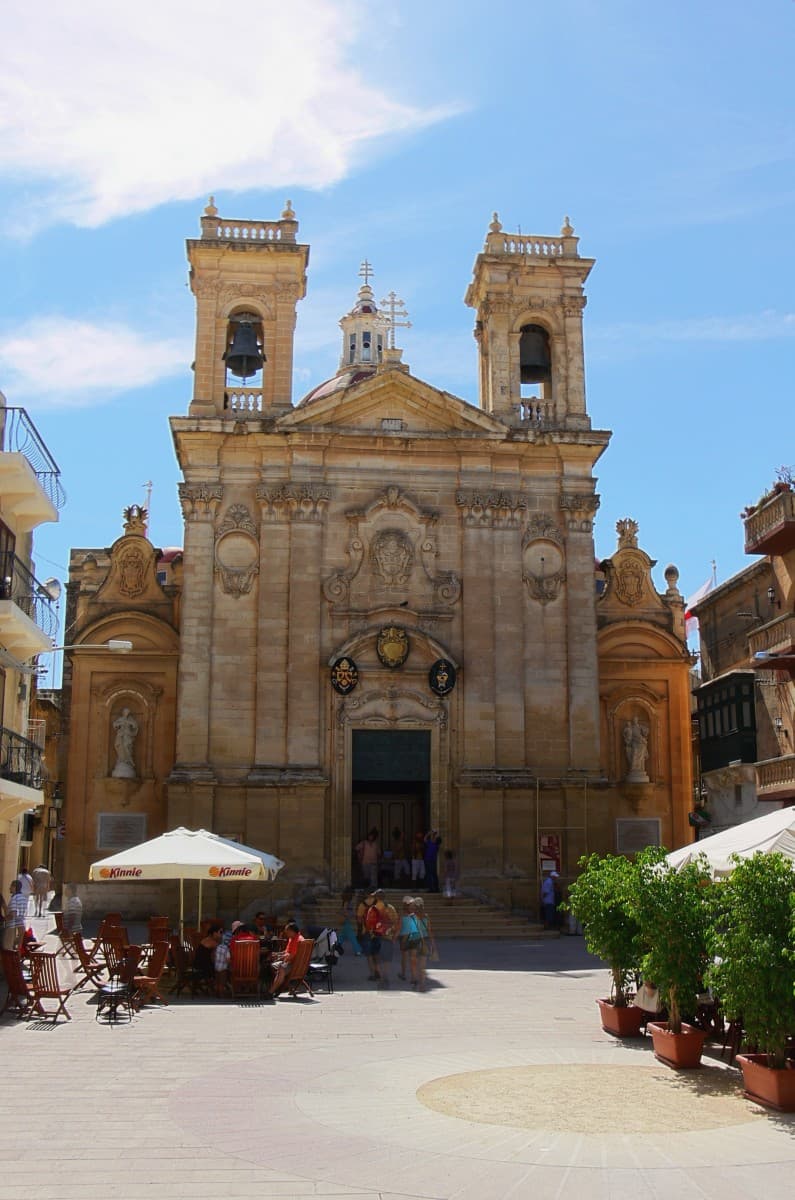
The Basilica of St George Martyr, also known as San Ġorġ, is a historic Baroque church located in Gozo, Malta. Originally a Roman pagan temple converted to a Christian church in the 4th century, it has undergone numerous reconstructions, with the present basilica built between 1672 and 1678. It is significant for its rich artistic heritage, including works by Mattia Preti, and its historical role as the last church on Gozo to celebrate the Byzantine Rite.

Basilica of St James
The Basilica of St. James, located in Prague's Old Town, is a significant religious site with a history dating back to the 13th century. Originally a Gothic church built for the Franciscans, it was destroyed by fire and subsequently rebuilt in the Baroque style. Today, it houses notable artworks and relics, including the Madonna Pietatis and the tomb of Count Vratislav of Mitrovice, and holds the honorary title of minor basilica.
Basilica of St Ludmila
The Basilica of St. Ludmila is a neo-Gothic Catholic church located in Prague, Czech Republic, built between 1888 and 1892. It is named in honor of Saint Ludmila of Bohemia and is characterized by its prominent twin towers and rich interior decorations by notable Czech artists. The basilica was elevated to the status of basilica minor by Pope Francis in 2022.