
Basilica of St George Martyr
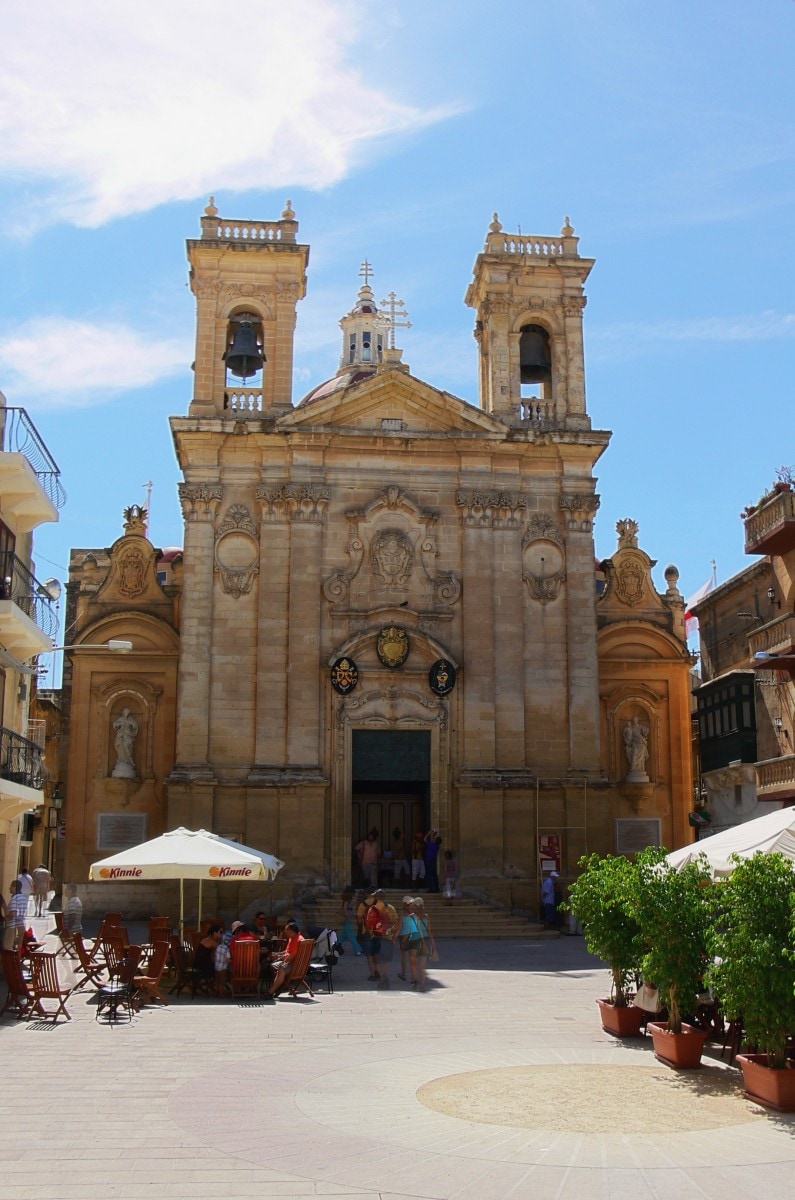
The Basilica of St George Martyr, also known as San Ġorġ, is a historic Baroque church located in Gozo, Malta. Originally a Roman pagan temple converted to a Christian church in the 4th century, it has undergone numerous reconstructions, with the present basilica built between 1672 and 1678. It is significant for its rich artistic heritage, including works by Mattia Preti, and its historical role as the last church on Gozo to celebrate the Byzantine Rite.
Key Facts
- ›The basilica's origins trace back to the 4th century when a Roman pagan temple was converted into a Christian church dedicated to Saint George.
- ›The current basilica was constructed between 1672 and 1678 and consecrated in 1755.
- ›It was officially recognized as a Minor Basilica by Pope Pius XII on September 6, 1958.
- ›The interior is renowned for its exquisite proportion and harmony, being entirely covered with marble and gold stucco, earning it the nickname 'the golden church' of Gozo.
- ›The basilica houses significant artworks, including the main altarpiece depicting St George and the dragon by Mattia Preti.
- ›It also serves as the main parish church for the Anglican community of Gozo.
Baroque
Saint George
Corpse of St Clement
Franciscan Sisters of the Heart of Jesus
Vittorio Cassar, Salvatore Bondi
About Basilica of St George Martyr
The Basilica of St George Martyr, known locally as San Ġorġ, is a historically significant Baroque church located in the heart of Victoria, on the island of Gozo, Malta. Its origins are ancient, with the parish originating in Byzantine times from the 4th century, when the site of the present church, a former Roman pagan temple, was converted into a Christian church dedicated to Saint George.
History and Construction
The church has been rebuilt numerous times throughout the Middle Ages due to population growth and damage. The current basilica was constructed between 1672 and 1678, with its foundation stone laid on August 7, 1672, and was consecrated on September 21, 1755. The present church's design was planned by Vittorio Cassar. The façade underwent a major architectural modification in 1818 after damage from an earthquake, with designs by Salvatore Bondi. In the 1930s, the church was enlarged with new naves and side chapels, and the dome was reconstructed between 1939 and 1940.
Religious Significance and Designation
St George's was a functioning parish church by around 1250 and was listed as a parish where indulgences could be obtained in 1450. For centuries, until 1575, the liturgy was celebrated in the Byzantine Rite, making it the last church on Gozo to do so. In 1511, it was declared the sole parish church of Gozo. On September 6, 1958, the church was honored with the title of Basilica by Pope Pius XII, receiving associated privileges. On December 8, 1975, it was established as a Pontifical Collegiate church. The basilica also serves as the main parish church for the Anglican community of Gozo.
Artistic and Architectural Features
The interior of the basilica is celebrated for its exquisite architectural proportion and harmony, entirely covered in marble and gold stucco, earning it the moniker "the golden church" of Gozo. It houses significant works of art, most notably two paintings by the famous painter Mattia Preti: the main altarpiece depicting St George triumphing over the dragon, and another depicting the Holy Souls. The basilica features 11 side chapels, each adorned with various artistic elements, including paintings by artists such as Stefano Erardi, Giuseppe Cali, and baroque altars.
Notable Features and Events
Other notable features include a bronze and gold gilded canopy over the high altar, created in 1967 and inspired by Bernini's work in St. Peter's Basilica. The titular statue of St. George, sculpted in wood by Pietru Pawl Azzopardi in 1839, is a significant attraction. A medieval ciborium, dating from the 12th century, was discovered in the walls in 1816 and is now housed in the Gozo Cathedral Museum. The basilica also boasts a modern Byzantine-style chapel, completed in 2005, designed to foster awareness of the universal Church's Eastern and Western traditions. The basilica is a vibrant center of worship, hosting daily services and major events such as the Feast of St George and the Victoria International Arts Festival. It also houses the "Heart of Gozo: Il-Hagar" museum, which displays historical and artistic artifacts.
Source: Wikipedia ↗
Frequently Asked Questions
What is the Basilica of St George Martyr?
The Basilica of St George Martyr, also known as San Ġorġ, is a historic Baroque church in Gozo, Malta. It has a rich history dating back to the 4th century and is a significant religious and cultural landmark.
When was the current basilica built?
The present church was constructed between 1672 and 1678. Its foundation stone was laid on August 7, 1672, and it was completed in 1678.
What is the significance of the title 'Basilica'?
The church was honored with the title of Basilica on September 6, 1958, by Pope Pius XII. This title grants the church certain privileges, such as precedence before other churches and the right to use specific papal symbols.
What notable artworks are housed in the basilica?
The basilica is known as 'the golden church' of Gozo due to its marble and gold stucco interior. It features two important paintings by Mattia Preti: the main altarpiece of St George with the dragon and a painting of the Holy Souls. Many other works by renowned artists are also present.
Does the basilica have any connection to the Byzantine Rite?
Yes, for a period until 1575, the liturgy in St George's parish church was celebrated in the Byzantine Rite. It was the last church on the island to observe this rite before transitioning to the Roman rite.
What is the Basilica of St George Martyr's connection to the Anglican community?
The basilica also serves as the main parish church for the Anglican community of Gozo. This community was established in the basilica on April 23, 2005, and frequently participates in services there.
Related Basilicas
Basilica of SS Peter and Paul
The Basilica of SS Peter and Paul is a Roman Catholic minor basilica and parish church situated in Nadur, Gozo, Malta. Its construction spanned over a century, with significant embellishments in the early 20th century reflecting Italian Renaissance design, making it one of the most beautiful churches on the island.
Basilica of St Fidelis
The Basilica of St. Fidelis, also known as the Cathedral of the Plains, is a Romanesque-style Catholic parish church located in Victoria, Kansas. It was constructed between 1908 and 1911 and was elevated to the status of a minor basilica in 2014. Its impressive architecture and prominent location have made it a significant landmark in western Kansas.
Basilica of the Assumption of Our Lady
The Basilica of the Assumption of Our Lady, commonly known as the Rotunda of Mosta, is a significant Roman Catholic church in Mosta, Malta. Its neoclassical design, inspired by the Pantheon in Rome, features one of the world's largest unsupported domes. The basilica is renowned for surviving a World War II aerial bombing that miraculously failed to detonate inside the church.