
Primatial Cathedral Basilica of the Immaculate Conception
The Primatial Cathedral Basilica of the Immaculate Conception and Saint Peter of Bogotá, commonly known as the Metropolitan Cathedral Basilica of Bogotá, is a significant Neoclassical cathedral located in Bogotá, Colombia. It serves as the seat of the Metropolitan Archbishop of Bogotá and Primate of Colombia, a title bestowed by Pope Leo XIII. Recognized as a National Monument, it stands as a testament to the city's rich religious and architectural history, with its current structure dating from the early 19th century.
Key Facts
- ›The current cathedral was designed by Domingo de Petrés and constructed between 1807 and 1823.
- ›It occupies the site of three previous churches that served as cathedrals for Bogotá.
- ›The cathedral was declared a Monumento Nacional (National Monument) on August 11, 1975.
- ›It holds the honorary title of Primate of Colombia, granted by Pope Leo XIII.
- ›The building features a Classical basilica plan in the form of a Latin cross, with five naves and sixteen chapels.
- ›The cathedral houses the largest pipe organ in Colombia, originally built by Aquilino Amezua and restored by Gerhard Grenzing S.A.

Neoclassical
Capuchin
Domingo De PetréS, NicoláS LeóN
About Primatial Cathedral Basilica of the Immaculate Conception
Metropolitan Cathedral Basilica of Bogotá
The Metropolitan and Primate Cathedral Basilica of the Immaculate Conception and Saint Peter of Bogotá, more commonly known as the Metropolitan Cathedral Basilica of Bogotá, is a significant religious edifice located in the heart of Colombia's capital, Bogotá. It is the principal church of the Metropolitan Archdiocese of Bogotá and holds the distinguished honorary title of Primate of Colombia, a recognition bestowed by Pope Leo XIII in 1902. The cathedral's current Neoclassical structure was designed by the Capuchin friar Domingo de Petrés and was constructed between 1807 and 1823, replacing three earlier churches that had previously served as the city's cathedral.
History and Construction
The history of the cathedral on this site dates back to August 6, 1538, when the first Mass was celebrated in a modest chapel. Subsequent constructions followed, with a more substantial church initiated in 1553. This structure collapsed on the eve of its inauguration in 1560, despite significant investment. A new cathedral began construction in 1572, featuring three naves and four chapels, but was also significantly damaged by an earthquake in 1785, leading to its partial demolition in 1805. The foundation for the present cathedral was laid in 1807 under Domingo de Petrés, who was deeply influenced by the Neoclassical architectural trends of the era. Although Petrés died in 1811, the interior construction was completed, and the remaining works were finished by Nicolás León, culminating in the consecration of the cathedral in 1823.
Architectural Significance and Features
The Metropolitan Cathedral Basilica of Bogotá is characterized by its Classical basilica plan, shaped as a Latin cross, and covers an area of 5,300 square meters. It comprises five naves—a central nave and two side naves of equal height, alongside two additional naves dedicated to chapels. The interior includes a main altar, sixteen chapels, a choir, and two sacristies. A lantern and dome are situated at the intersection of the transept and crossing. The exterior facade is adorned with Corinthian and Ionic pilasters, and sculptures by Juan de Cabrera, depicting Saint Peter, Saint Paul, and the Immaculate Conception. The towers, rebuilt after an 1827 earthquake, stand 52 meters high. The cathedral also boasts the largest pipe organ in Colombia, a significant instrument restored between 2013 and 2016 by Gerhard Grenzing S.A.
Urban Context and Recognition
Located in the Plaza de Bolívar, the historic center of Bogotá, the cathedral is an integral part of the city's civic and religious landscape. It is surrounded by significant buildings, including the Chapel del Sagrario, the Archbishop's Palace, and various governmental structures, underscoring its central role in Colombian national life. Due to its historical importance, architectural merit, and cultural value, the Metropolitan Cathedral Basilica of Bogotá was officially declared a National Monument by decree 1,584 on August 11, 1975.
Source: Wikipedia ↗
Frequently Asked Questions
When was the Metropolitan Cathedral Basilica of Bogotá built?
The current structure was built between 1807 and 1823. This site has hosted cathedrals for the city since the 16th century, with previous constructions on the same location.
What is the architectural style of the Metropolitan Cathedral Basilica of Bogotá?
The cathedral is primarily built in the Neoclassical style, influenced by its architect Domingo de Petrés. It features a classical basilica plan in the form of a Latin cross.
What is the significance of the Metropolitan Cathedral Basilica of Bogotá?
It is the seat of the Metropolitan Archbishop of Bogotá and holds the honorary title of Primate of Colombia, recognizing its historical and religious importance. It is also designated as a National Monument due to its architectural and cultural value.
What notable features can be found inside the Metropolitan Cathedral Basilica of Bogotá?
The cathedral has a Latin cross plan with five naves and sixteen chapels, including the Chapel of San Pedro and the Chapel of Santa Isabel de Hungría. It also houses the largest pipe organ in Colombia.
Who designed the Metropolitan Cathedral Basilica of Bogotá?
The design of the current cathedral is attributed to Domingo de Petrés, a Capuchin friar and architect influenced by the Neoclassical style. Construction was completed under Nicolás León after Petrés' death.
Related Basilicas

Basilica of the Lord of Monserrate
The Basilica of the Lord of Monserrate is a significant Catholic shrine located in Bogotá, Colombia. Perched at an altitude of 3,152 meters (10,341 feet) above sea level, it offers panoramic views of the city and serves as a spiritual destination for pilgrims and visitors.

Basilica of Our Lady of Candelaria
The Basilica of Our Lady of Candelaria, popularly known as La Candelaria Church, is a historic Roman Catholic church in Medellín, Colombia, dedicated to the Virgin Mary under the invocation of Our Lady of Candelaria. Renowned as the city's oldest church, it served as the cathedral for the Archdiocese of Medellín for over six decades and holds the distinction of being a National Monument of Colombia.
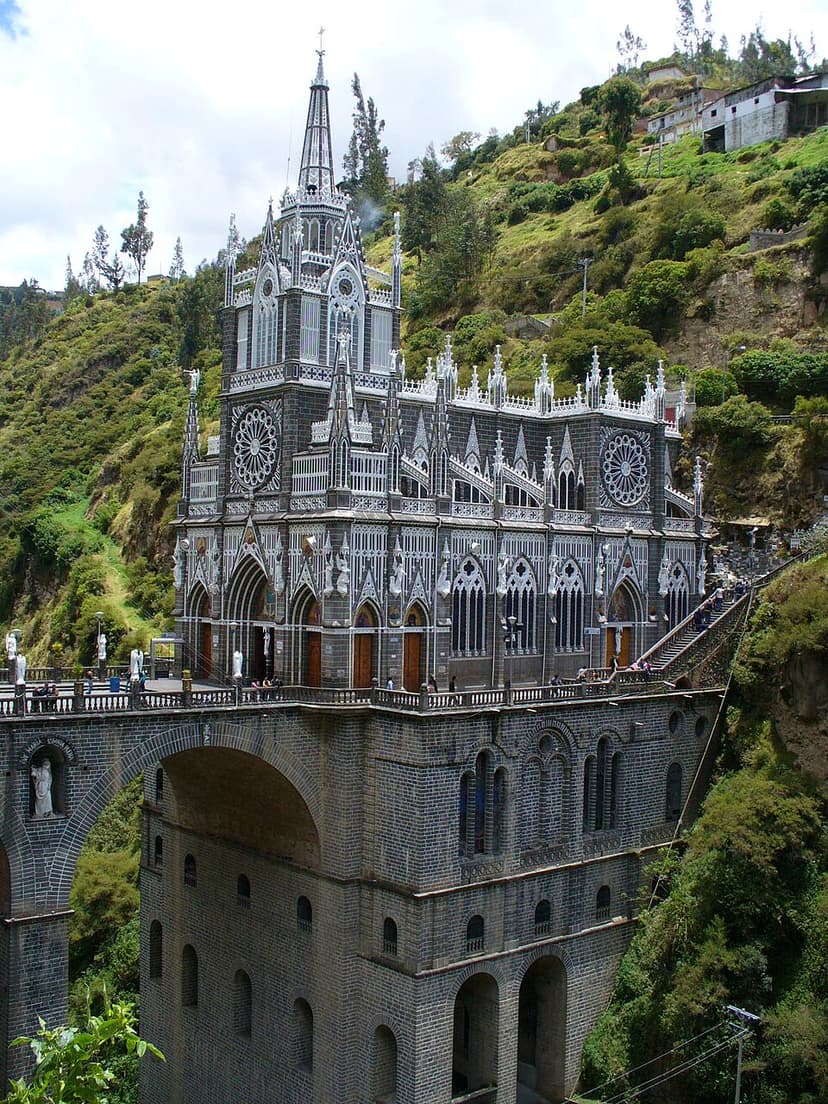
Shrine Basilica of Our Lady of Las Lajas
The Shrine Basilica of Our Lady of Las Lajas is a Catholic minor basilica situated in a dramatic canyon setting along the Guáitara River in Ipiales, Colombia. It is a significant Marian shrine, drawing pilgrims from Colombia and Ecuador, and is renowned for its neo-gothic architecture and legends of a miraculous apparition of the Virgin Mary. The image of the Madonna and Child on the rock wall is believed by believers to be of divine origin.