
Co-Cathedral Basilica of St Stephen the King (St Stephen's Basilica)
Hungary·Budapest·Roman Catholic Archdiocese of Esztergom-Budapest
St. Stephen's Basilica is a prominent Roman Catholic basilica in Budapest, Hungary, named in honor of Stephen, the first King of Hungary. It serves as the co-cathedral of the Archdiocese of Esztergom-Budapest and is recognized as one of Hungary's largest churches and a significant historical landmark within Budapest's UNESCO World Heritage Site Buffer Zone. The basilica is notable for housing the mummified right hand of Saint Stephen.
Key Facts
- ›Construction began in 1851 and was completed in 1905, spanning fifty-four years.
- ›The basilica's architecture is primarily neo-classical, with later modifications in a neo-Renaissance style.
- ›It is one of the two tallest buildings in Budapest, reaching a height of 96 meters, symbolizing the equal importance of spiritual and worldly thinking.
- ›The basilica houses the mummified right hand of Saint Stephen, the first King of Hungary, in a reliquary.
- ›It was awarded the title of basilica minor by Pope Pius XI in 1931.
- ›The church suffered significant damage during World War II but has since been restored.

Neo-Classical, Neo-Renaissance
Stephen I of Hungary
Mummified Right Hand of Saint Stephen
JóZsef Hild, MiklóS Ybl, JóZsef Kauser
About Co-Cathedral Basilica of St Stephen the King (St Stephen's Basilica)
St. Stephen's Basilica
St. Stephen's Basilica, officially the Co-Cathedral Basilica of St Stephen the King, is a magnificent Roman Catholic basilica located in Budapest, Hungary. It holds significant religious and historical importance, serving as the co-cathedral of the Roman Catholic Archdiocese of Esztergom-Budapest and housing the revered mummified right hand of Saint Stephen, the first King of Hungary.
History and Construction
The basilica's history is intertwined with the development of the Lipótváros Parish, which began fundraising for a church in the late 1810s. The devastating flood of 1838 prompted further donations from residents who had found refuge on the site. Initially planned to be named after Saint Leopold, the dedication was later changed to honor Saint Stephen I of Hungary. Construction commenced in 1851, designed by József Hild in a neo-classical style. However, a significant setback occurred in 1858 when the dome collapsed, necessitating a complete rebuild. Upon Hild's death, Miklós Ybl took over the project, modifying the plans to a neo-Renaissance style. The basilica was finally completed in 1905 by József Kauser. Pope Pius XI bestowed upon it the title of basilica minor in 1931. Despite suffering damage during World War II, the basilica was restored and continues to be a vital spiritual center.
Architecture and Design
St. Stephen's Basilica is an architectural marvel, standing as one of the two tallest buildings in Budapest at 96 meters, a height that symbolically equates worldly and spiritual importance. The basilica features a Greek cross ground plan. Its exterior is characterized by neo-classical and neo-Renaissance elements, with intricate details such as the mosaic tympanum over the main entrance depicting "Our Lord on the Throne with Angels." The inscription "Ego Sum Via, Veritas et Vita" (I am the way, the truth and the life) adorns the main facade. The interior is equally impressive, featuring mosaics by renowned artists like Bertalan Székely and Károly Lotz, as well as sculptures and bronze reliefs that highlight key stages of Saint Stephen's life. The basilica also boasts significant artistic contributions in its glasswork by Miksa Róth and its pipe organ, crafted by József Angster.
Present Day Significance
Today, St. Stephen's Basilica is the largest church in Budapest and a major tourist attraction, drawing visitors with its grandeur and historical significance. The dome offers panoramic views of the city, accessible by elevator or a climb of 364 steps. The square in front of the basilica hosts a popular Christmas market during the Advent season, and its facade is illuminated with special light paintings. The basilica also plays an active role in the musical community, hosting regular organ concerts and performances by its own choir, which travels internationally. Its imposing presence makes it a key landmark within Budapest's UNESCO World Heritage Site Buffer Zone.
Source: Wikipedia ↗
Frequently Asked Questions
What is St. Stephen's Basilica named after?
St. Stephen's Basilica is named in honor of Stephen, the first King of Hungary (c. 975–1038). His mummified right hand is housed within the basilica.
When was St. Stephen's Basilica built?
Construction of the basilica commenced in 1851 and was completed in 1905. The project spanned fifty-four years, with final work completed by József Kauser.
What is the architectural style of St. Stephen's Basilica?
The basilica was initially designed in a neo-classical style by József Hild. After a dome collapse, Miklós Ybl modified the plans to incorporate more neo-Renaissance elements.
Is St. Stephen's Basilica a UNESCO World Heritage Site?
St. Stephen's Basilica is a significant historical landmark within Budapest's UNESCO World Heritage Site Buffer Zone, though it is not a standalone World Heritage Site itself.
What important relics are kept in St. Stephen's Basilica?
The most significant relic housed in the basilica is the mummified right hand of Saint Stephen, the first King of Hungary. This relic is kept in a reliquary.
What is the significance of St. Stephen's Basilica in Budapest?
It is the largest church in Budapest and the third largest church building in present-day Hungary. It also serves as the co-cathedral of the Roman Catholic Archdiocese of Esztergom-Budapest and is a major tourist attraction.
Related Basilicas
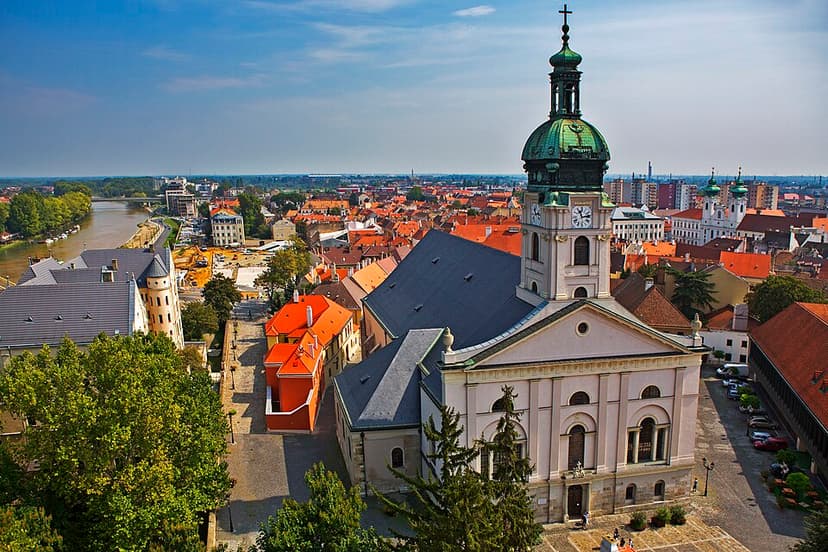
Cathedral of the Assumption
The Cathedral Basilica of the Assumption of Our Lady, also known as Győr Cathedral, is the principal Catholic church and seat of the Diocese of Győr in Hungary. Originally an 11th-century Romanesque structure, it was rebuilt and significantly altered in Baroque and later styles, undergoing its last restoration in the late 20th century. It is renowned for housing the skull relic of King Saint Ladislaus I, a significant artifact for Hungarians.

Primatial Cathedral Basilica of the Blessed Virgin Mary taken into Heaven and St Adalbert
The Primatial Cathedral Basilica of the Blessed Virgin Mary taken into Heaven and St Adalbert, commonly known as the Basilica of Esztergom, is the largest church in Hungary and the mother church of the Archdiocese of Esztergom-Budapest. It is a significant ecclesiastic site, serving as the seat of the Catholic Church in Hungary, and is dedicated to the Assumption of Saint Mary and Saint Adalbert. Its construction history spans centuries, with the current edifice beginning in the early 19th century on the site of earlier cathedrals dating back to the 11th century.

Cathedral of St Peter and St Paul
The Sts. Peter and Paul's Cathedral Basilica, also known as Pécs Cathedral, is the seat of the Catholic Diocese of Pécs in Hungary. Its foundations trace back to the Roman period, with significant rebuilding and modifications occurring throughout history, including Romanesque, Gothic, and major neo-Romanesque reconstructions.