
Cathedral of the Assumption
Hungary·Győr·Diocese of Győr
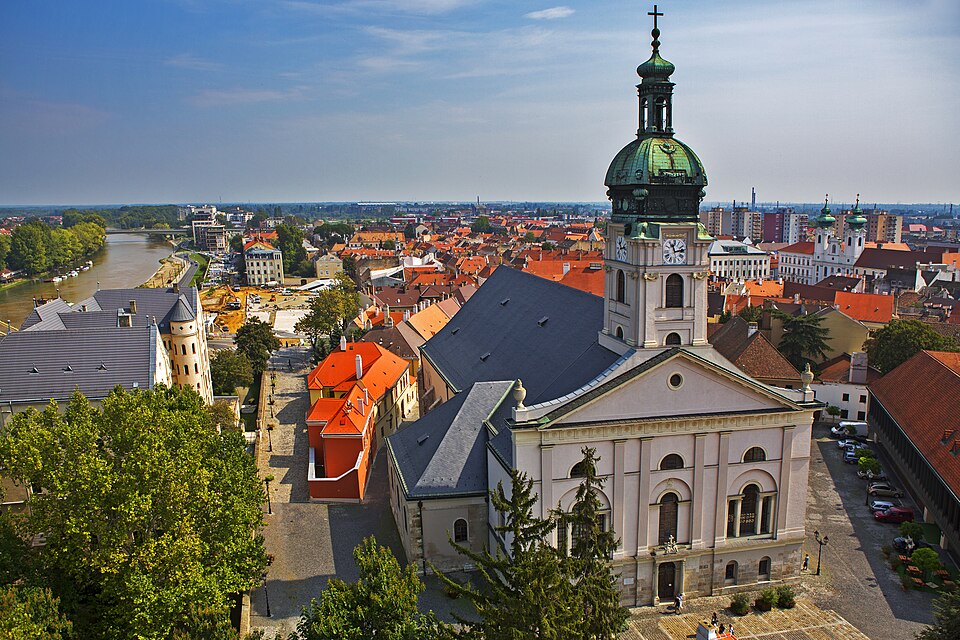
The Cathedral Basilica of the Assumption of Our Lady, also known as Győr Cathedral, is the principal Catholic church and seat of the Diocese of Győr in Hungary. Originally an 11th-century Romanesque structure, it was rebuilt and significantly altered in Baroque and later styles, undergoing its last restoration in the late 20th century. It is renowned for housing the skull relic of King Saint Ladislaus I, a significant artifact for Hungarians.
Key Facts
- ›The cathedral's origins trace back to an early 11th-century Romanesque church.
- ›It was destroyed by the Mongols and subsequently rebuilt between the 13th and 15th centuries.
- ›The interior was redesigned in an early Baroque style between 1635 and 1650 by Giovanni Battista Rava.
- ›The tower was completed in 1680, and overall construction continued until the 1770s.
- ›The cathedral was granted the status of a minor basilica by Pope John Paul II in 1997.
- ›It houses the skull relic of King Saint Ladislaus I, a highly important relic for Hungarians.
Romanesque, Baroque, Neoclassical
Skull Relic of King Saint Ladislaus I
Giovanni Battista Rava, Melchior Hefele
About Cathedral of the Assumption
Győr Cathedral Basilica of the Assumption of Our Lady
The Cathedral Basilica of the Assumption of Our Lady, commonly referred to as Győr Cathedral, stands as the principal Catholic church and the ecclesiastical seat of the Diocese of Győr in Győr, Hungary. Its history is long and complex, originating as an 11th-century Romanesque church. This early structure was tragically destroyed by the Mongols, prompting a substantial rebuilding effort that spanned from the 13th to the 15th centuries.
Following the expulsion of the Turks, the cathedral underwent a significant interior redesign between 1635 and 1650, guided by the Italian master Giovanni Battista Rava in an early Baroque style. The completion of its tower in 1680 marked another phase, with construction continuing intermittently until the 1770s. The most recent large-scale restoration took place between 1968 and 1972. In recognition of its importance, the cathedral was elevated to the status of a minor basilica by Pope John Paul II in 1997.
Architectural and Artistic Features
The cathedral's interior showcases a blend of historical styles. The pulpit, a notable artistic piece, dates from the 1770s, a period when significant Baroque elements were introduced under Bishop Count Ferenc Zichy. Although its specific architect and sculptor are unrecorded, it is attributed to Melchior Hefele. This classicizing late Baroque structure features red marble and is supported by a Doric column. The pulpit itself is shell-shaped, adorned with gilt wooden carvings, and features a wrought-iron railing from 1783, which bears the craftsman's initials and date. The abat-voix is decorated with painted woodwork and allegorical statues.
The Herma of King Saint Ladislaus
Among the most significant treasures housed within Győr Cathedral is the Herma of King Saint Ladislaus. This reliquary contains the skull of the revered Hungarian king, Saint Ladislaus I, who played a crucial role in consolidating Hungarian state power and strengthening Christianity in the country. Canonized in 1192, relics were prepared from his remains. Historical analysis suggests that the face depicted on the Herma is likely that of King Béla III, as Ladislaus had been deceased for nearly a century by the time of his canonization, making Béla III a fitting model from the same royal family.
The wooden herm containing the skull was damaged by fire in 1406, but the skull itself remained intact. It was later placed into the current Herma during the reign of King Sigismund. The relic faced further peril in the 16th century when it had to be moved from Várad to escape devastation. By the early 17th century, after passing through various cities including Prague, Bratislava, and Veszprém, it found its permanent home in the Cathedral of Győr.
Source: Wikipedia ↗
Frequently Asked Questions
What is the historical significance of Győr Cathedral?
Győr Cathedral's history spans over a millennium, beginning as an 11th-century Romanesque church. It has been rebuilt multiple times after destruction, notably by the Mongols, and has been a central religious site for the Diocese of Győr.
What is the architectural style of Győr Cathedral?
While its foundations are Romanesque, Győr Cathedral features significant early Baroque elements from a 17th-century redesign by Giovanni Battista Rava. Later additions, such as the pulpit, exhibit classicizing late Baroque and Neoclassical influences.
What important relics are housed in Győr Cathedral?
The cathedral is particularly known for preserving the skull relic of King Saint Ladislaus I of Hungary. This relic is considered one of the most important for Hungarians and has a complex history of preservation and relocation.
When was Győr Cathedral designated as a minor basilica?
The Cathedral Basilica of the Assumption of Our Lady was awarded the status of a minor basilica by Pope John Paul II in 1997.
Who designed the pulpit in Győr Cathedral?
The architect and sculptor of the pulpit remain unknown, but it is attributed to Melchior Hefele. It was created in the 1770s during the period when Bishop Count Ferenc Zichy oversaw the addition of important Baroque features.
Related Basilicas

Basilica of Our Lady of Hanswijk
The Basilica of Our Lady of Hanswijk, located in Mechelen, Belgium, is a significant Roman Catholic basilica and a renowned pilgrimage site. It houses a historic statue of Our Lady, venerated following a reported miracle. The basilica is notable for its Italian-style facade, cupola designed by Lucas Faydherbe, and richly decorated Baroque interior.

Basilica of Our Lady, Ludźmierz
The Sanctuary of Our Lady of Ludźmierz is a significant religious site in Ludźmierz, Poland, deeply connected to the Góral people of the Tatra Mountains. It houses the revered statue of Our Lady of Ludźmierz, also known as the Shepherdess of Podhale, and holds historical importance as the oldest Catholic parish in the region, with roots tracing back to the 13th century.

Dominican Church (Maria Rotunda Basilica)
The Dominican Church, also known as the Church of St. Maria Rotunda, is an early Baroque minor basilica located in Vienna, Austria. It is the third church to stand on this site, with its current structure dating from the 17th century and representing a significant introduction of Italian Baroque style to Vienna. The basilica is notable for its impressive facade, ornate interior frescoes, and its dedication to the Virgin Mary.