
Cathedral of the Assumption of Mary (Euphrasian Basilica)
Croatia·Poreč·Poreč-Pula
The Euphrasian Basilica, officially the Cathedral Basilica of the Assumption of Mary, is a Roman Catholic basilica located in Poreč, Croatia. It is a significant example of early Byzantine architecture in the Mediterranean and is renowned for its exceptionally well-preserved mosaics. The basilica is the cathedral of the Diocese of Poreč-Pula and has been a UNESCO World Heritage Site since 1997.
Key Facts
- ›The basilica is built on the site of an earlier 4th-century church, with its floor mosaic still preserved.
- ›The current basilica was constructed in the 6th century under Bishop Euphrasius, utilizing parts of the older structure and imported marble.
- ›It is considered the earliest example of a triple-apsed church in Western Europe.
- ›The basilica is famous for its 6th-century Byzantine mosaics with gold grounds, including depictions of Christ, Mary, apostles, and martyrs.
- ›It houses relics of Saint Maurus and Saint Eleutherius in a votive chapel.
- ›The episcopal complex includes a baptistery, bell tower, atrium, and bishop's palace.

Byzantine, Early Christian, Gothic
Mary, Saint Maurus
Relics of Saint Maurus, Relics of Saint Eleutherius
About Cathedral of the Assumption of Mary (Euphrasian Basilica)
The Euphrasian Basilica
The Euphrasian Basilica, officially the Cathedral Basilica of the Assumption of Mary, stands as a paramount example of early Byzantine architecture in the Mediterranean. Located in the Istrian town of Poreč, Croatia, this Roman Catholic basilica is renowned for its exceptionally well-preserved state and its stunning mosaics, which have earned it a place on the UNESCO World Heritage List since 1997. It serves as the cathedral for the Roman Catholic Diocese of Poreč-Pula and is considered one of the best-preserved early Christian churches globally.
History and Construction
The site of the Euphrasian Basilica has a long religious history, with the earliest basilica dedicated to Saint Maurus of Parentium dating back to the second half of the 4th century. This original structure, built upon a Roman house, featured floor mosaics, a fragment of which is still preserved. By the same century, it had been expanded into a church with a nave and one aisle. The present basilica, dedicated to Mary, was constructed in the 6th century under Bishop Euphrasius, commencing in 553. It was built on the foundations of the older, dilapidated church, incorporating parts of its structure and utilizing marble blocks imported from the Sea of Marmara. The construction, executed by Byzantine masters for its wall mosaics and local artisans for the floor mosaics, took approximately ten years. Bishop Euphrasius himself is depicted in one of the apse mosaics, holding a model of the church.
Architectural Features and Mosaics
The Euphrasian Basilica is part of a larger episcopal complex that includes a 6th-century octagonal baptistery, a 16th-century bell tower, a colonnaded atrium, and the Bishop's Palace. Architecturally, the basilica is distinguished as the earliest example of a triple-apsed church in Western Europe, a departure from the straight walls typically used for sacred buildings at the time. The nave and aisles are separated by eighteen elegant Greek marble colonnades adorned with richly sculpted Byzantine and Romanesque capitals featuring animal depictions and the monogram of Saint Euphrasius.
The basilica's most celebrated aspect is its collection of 6th-century mosaics, predominantly set against gold backgrounds. These mosaics adorn the triumphal arch and the apse, depicting Christ with the apostles, Mary and Child on a heavenly throne, angels, Bishop Euphrasius, local saints, and various martyrs. Notable scenes include the Annunciation and the Visitation, rendered with remarkable detail and color. The lower part of the apse is decorated with stone slabs encrusted with mother-of-pearl, featuring intricate designs.
Later Additions and Significance
While the basilica has largely retained its original form, subsequent events such as fires and earthquakes have necessitated restorations. Following an earthquake in 1440, the southern wall of the nave was rebuilt in the Gothic style, with new windows installed. The apse is crowned by a marble ciborium constructed in 1277, inspired by that of St. Mark's in Venice, supported by columns from the earlier 6th-century ciborium. The church also houses sacred objects and artworks from the Palaeo-Christian, Byzantine, and medieval periods. The votive chapel contains the relics of Saint Maurus and Saint Eleutherius, further enhancing the basilica's religious importance.
Source: Wikipedia ↗
Frequently Asked Questions
What is the Euphrasian Basilica?
The Euphrasian Basilica, also known as the Cathedral Basilica of the Assumption of Mary, is a Roman Catholic basilica in Poreč, Croatia. It is an outstanding example of early Byzantine architecture and is celebrated for its preserved mosaics.
When was the Euphrasian Basilica built?
The present basilica was built in the 6th century, beginning in 553, during the tenure of Bishop Euphrasius. It was constructed on the site of an older, dilapidated basilica from the 4th century.
What makes the Euphrasian Basilica architecturally significant?
It is notable for being the earliest example of a triple-apsed church in Western Europe. The complex also showcases excellent examples of early Byzantine architecture, particularly in its atrium and columns.
What are the most important features inside the basilica?
The basilica's most striking features are its 6th-century mosaics, which cover the apse and triumphal arch with vibrant gold grounds. These mosaics depict biblical scenes, Christ, Mary, the apostles, and local saints.
Does the basilica contain any relics?
Yes, a votive chapel adjacent to the sacristy houses the relics of Saint Maurus and Saint Eleutherius. Saint Maurus was the first bishop of Poreč.
Is the Euphrasian Basilica a UNESCO World Heritage Site?
Yes, the Euphrasian Basilica and its episcopal complex have been inscribed on the UNESCO World Heritage List since 1997 due to their exceptional value and preservation.
Related Basilicas

Cathedral of St James
The Cathedral of St. James in Šibenik, Croatia, is a significant architectural monument of the Renaissance and a UNESCO World Heritage Site. Constructed entirely of stone between 1431 and 1536, it is renowned for its innovative construction techniques, monumental stone dome, and the unique frieze of carved human heads encircling its apses, which are believed to be individual portraits of people from Dalmatia at the time.

Basilica of Our Lady of Voćin
The Basilica of Our Lady of Voćin, originally the Church of the Visitation of the Blessed Virgin Mary, is a Catholic church in Voćin, Croatia. It has a long history of destruction and rebuilding, serving as a Franciscan monastery church before being consecrated to the Visitation of the Blessed Virgin Mary in the 18th century. It was designated a minor basilica in 2022.
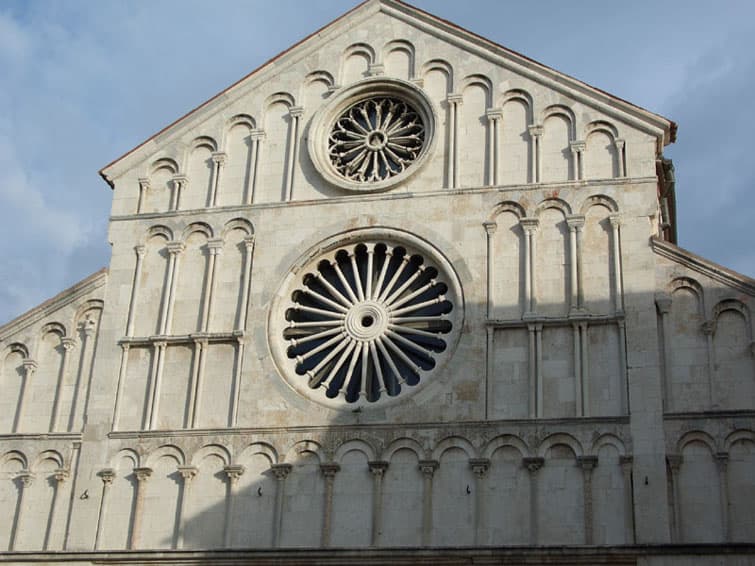
Cathedral of St Anastasia
The Cathedral of St. Anastasia is the largest church in Dalmatia and the seat of the Archdiocese of Zadar, Croatia. Its origins trace back to a 4th-5th century basilica, with the present Romanesque structure largely built in the 12th and 13th centuries. It is significant for housing the relics of Saint Anastasia of Sirmium and for its rich architectural history, including a notable bell tower.