
Cathedral of St Anastasia
Croatia·Zadar·Archdiocese of Zadar
The Cathedral of St. Anastasia is the largest church in Dalmatia and the seat of the Archdiocese of Zadar, Croatia. Its origins trace back to a 4th-5th century basilica, with the present Romanesque structure largely built in the 12th and 13th centuries. It is significant for housing the relics of Saint Anastasia of Sirmium and for its rich architectural history, including a notable bell tower.
Key Facts
- ›The site was originally a Christian basilica from the 4th and 5th centuries.
- ›The current three-nave building was primarily constructed in the Romanesque style during the 12th and 13th centuries.
- ›The cathedral houses the ashes of Saint Anastasia of Sirmium, brought from Emperor Nikephoros I.
- ›It was reconsecrated by Pope Alexander III in 1177 and again on May 27, 1285, after significant repairs.
- ›The bell tower was built in two stages, with the upper floors designed by English architect Thomas Graham Jackson.
- ›The cathedral is on UNESCO's Tentative List of World Heritage Sites.
Romanesque, Gothic
Saint Anastasia of Sirmium, Saint Peter
Ashes of Saint Anastasia of Sirmium
Thomas Graham Jackson
About Cathedral of St Anastasia
Cathedral of St. Anastasia
The Cathedral of St. Anastasia (Croatian: Katedrala sv. Stošije) stands as the Roman Catholic cathedral of Zadar, Croatia, and is the largest church in the entire Dalmatian region. It serves as the seat of the Archdiocese of Zadar. The historical significance of the site is profound, with origins tracing back to a Christian basilica established in the 4th and 5th centuries. The majority of the currently existing three-nave structure was erected in the Romanesque style during the 12th and 13th centuries.
History and Construction
The earliest recorded bishop of Zadar, Felix, attended church councils in the late 4th century, indicating the presence of an early Christian community. Initially dedicated to St. Peter, the basilica's patronage shifted during the time of Bishop Donatus. He received the ashes of Saint Anastasia of Sirmium from Emperor Nikephoros I, leading to the cathedral taking her as its patron. Donatus commissioned a sarcophagus for these sacred remains, which are still preserved within the cathedral today.
The church underwent substantial reconstruction in the 11th and 12th centuries, culminating in its reconsecration by Pope Alexander III in 1177. However, the cathedral suffered significant damage during the siege of Zadar by Venetians and Crusaders in 1202. The entire 13th century was dedicated to extensive repairs and rebuilding. The new structure, designed in a style reminiscent of the Santa Maria della Piazza church in Ancona, was completed and reconsecrated on May 27, 1285, though final construction concluded in 1324.
The bell tower was constructed in two distinct phases. The ground and first floors were built in 1452. The completion of the upper floors occurred much later, between 1890 and 1894, under the design of English architect and art historian Thomas Graham Jackson. This tower features four sides decorated with double mullioned windows and is topped by an octagonal pyramid with a rotating angel statue.
Architectural and Artistic Features
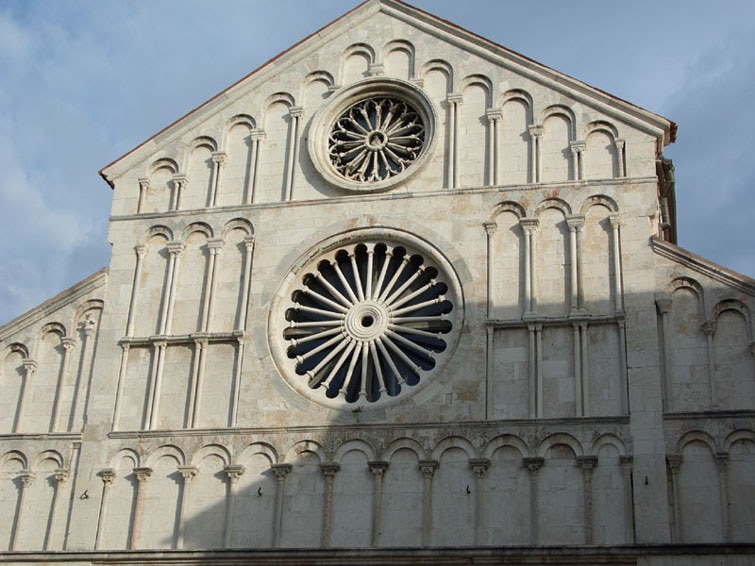
The façade, finished in 1324, is characterized by two orders. The lower order is more massive, featuring three portals, with the central one adorned by a bas-relief of the Madonna and Child with Saints Crisogonus and Anastasia. The upper order culminates in a triangular pediment and displays four tiers of Lombard bands, incorporating a large Romanesque rose window and a smaller Gothic one. Symbolic statues of a lion and a bull, representing Saints Mark and Luke, flank the façade's edges.
The interior comprises a nave and two aisles, with the nave being significantly larger than the aisles. These are separated by alternating stone pillars and pylons. The presbytery is elevated, with a 12th-century crypt located beneath it. Within the presbytery are Gothic-style choir stalls crafted by 15th-century master Matej Morozan. The main altar is surmounted by an early Gothic ciborium from 1322.
The southern aisle contains a marble altar for relics and the Altar of the Blessed Sacrament, a 1718 work by sculptor A. Viviani. This altar is richly decorated with columns and statues, including a Pietà above the tabernacle. The apse at the end of the nave houses a marble sarcophagus containing the relics of St. Anastasia, inscribed by Bishop Donat.
Other Significant Elements
Adjacent to the cathedral is a hexagonal baptistery dating back to the 6th century. Although the original baptistery was destroyed in bombing raids in 1943, it was meticulously restored in 1989.
The sacristy, also known as the Chapel of St. Barbara, includes walls and an apse that are among the oldest parts of the cathedral. A floor mosaic depicting two deer, dating from the early 5th century, is also a significant ancient feature.
The church's museum of art holds the Zadar Polyptych, an early work by the Venetian painter Vittore Carpaccio.
The Cathedral of St. Anastasia has been submitted to UNESCO's Tentative List of World Heritage Sites, highlighting its global cultural and historical importance.
Source: Wikipedia ↗
Frequently Asked Questions
What is the history of the Cathedral of St. Anastasia?
The cathedral's origins lie in a Christian basilica from the 4th and 5th centuries. The present Romanesque structure was largely built in the 12th and 13th centuries, with later additions and repairs, including its bell tower.
What are the key architectural features of the Cathedral of St. Anastasia?
The façade, completed in 1324, features two orders with three portals, a bas-relief of the Madonna and Child, a triangular pediment, and Lombard bands. The interior consists of a nave and two aisles, with a 12th-century crypt beneath the presbytery.
Are there any notable relics or artworks in the Cathedral of St. Anastasia?
Yes, the cathedral houses the sarcophagus with the relics of St. Anastasia. It also features fragments of medieval frescoes, choir stalls in Gothic style, and the Zadar Polyptych by Vittore Carpaccio in its art museum.
When was the Cathedral of St. Anastasia reconsecrated?
The cathedral was reconsecrated by Pope Alexander III in 1177. It underwent significant repairs after being damaged during a siege in 1202 and was reconsecrated again on May 27, 1285.
Is the Cathedral of St. Anastasia a UNESCO World Heritage Site?
The site of the Cathedral of St. Anastasia has been submitted to UNESCO's Tentative List of World Heritage Sites, indicating its potential for future designation.
Related Basilicas

Basilica of Our Lady of Voćin
The Basilica of Our Lady of Voćin, originally the Church of the Visitation of the Blessed Virgin Mary, is a Catholic church in Voćin, Croatia. It has a long history of destruction and rebuilding, serving as a Franciscan monastery church before being consecrated to the Visitation of the Blessed Virgin Mary in the 18th century. It was designated a minor basilica in 2022.

Cathedral of St James
The Cathedral of St. James in Šibenik, Croatia, is a significant architectural monument of the Renaissance and a UNESCO World Heritage Site. Constructed entirely of stone between 1431 and 1536, it is renowned for its innovative construction techniques, monumental stone dome, and the unique frieze of carved human heads encircling its apses, which are believed to be individual portraits of people from Dalmatia at the time.

Cathedral of the Assumption of Mary (Euphrasian Basilica)
The Euphrasian Basilica, officially the Cathedral Basilica of the Assumption of Mary, is a Roman Catholic basilica located in Poreč, Croatia. It is a significant example of early Byzantine architecture in the Mediterranean and is renowned for its exceptionally well-preserved mosaics. The basilica is the cathedral of the Diocese of Poreč-Pula and has been a UNESCO World Heritage Site since 1997.