
Cathedral Basilica of St Stephen the King
Hungary·Székesfehérvár·Szekesfehervar
The Basilica of the Assumption of the Blessed Virgin Mary in Székesfehérvár, Hungary, was a pivotal site for the Kingdom of Hungary, serving as the coronation church for its monarchs from 1000 to 1527. It also housed the Hungarian crown jewels and was the burial place for numerous royals. Although destroyed by fire in 1601, its historical significance as the primary church of the rulers of Hungary remains profound.
Key Facts
- ›Served as the coronation site for 37 Hungarian kings and 39 queens.
- ›From 1000 to 1527, it was the principal church for the rulers of Hungary.
- ›Housed the Hungarian crown jewels, treasury, and archives.
- ›15 Hungarian monarchs and many royal family members were buried within its walls.
- ›Suffered extensive damage from a fire in 1601.
- ›Its ruins were later demolished and materials used for other constructions.

Holy Crown of Hungary, Royal Throne
About Cathedral Basilica of St Stephen the King
The Basilica of the Assumption of the Blessed Virgin Mary
The Basilica of the Assumption of the Blessed Virgin Mary, located in Székesfehérvár (historically Alba Regia), Hungary, holds a place of immense historical importance as the principal church of the rulers of Hungary during the Middle Ages. Constructed in the late 1010s by Saint Stephen I, the first King of Hungary, its primary function evolved into serving as the coronation site for Hungarian monarchs from the year 1000 until 1527.
Historical Significance and Royal Functions
Beyond its role in royal inaugurations, the basilica was a repository for the regalia of the Kingdom of Hungary, including the crown jewels, the royal throne, the treasury, and crucial archives. This concentration of symbolic and material power underscored its central position in the kingdom's identity and governance. The basilica also served as a final resting place for royalty, with 15 Hungarian monarchs and numerous royal family members interred within its walls.
Decline and Legacy
The basilica's prominence began to wane following the Ottoman occupation of Székesfehérvár in 1543. The coronation ceremonies were relocated, and the sacred building was repurposed for the storage of gunpowder. In 1601, a fire caused extensive damage, leading to its eventual destruction. The ruins were later demolished, with their materials being utilized in the construction of a new episcopal residence and the reconstruction of another church, which eventually became the Cathedral Basilica of Székesfehérvár in 1777. Although no longer standing, the site remains significant, with St. Stephen's Mausoleum erected behind the basilica's ruined apse in the late 1930s.
Source: Wikipedia ↗
Frequently Asked Questions
When was the Basilica of the Assumption of the Blessed Virgin Mary built?
The basilica was constructed in the late 1010s by Saint Stephen I, the first King of Hungary. It was built on the site of Székesfehérvár, also known in Latin as Alba Regia.
What was the historical significance of this basilica?
It was the most significant place in the Kingdom of Hungary during the Middle Ages, acting as the coronation church for Hungarian monarchs and housing the crown jewels, throne, treasury, and archives.
How many monarchs were crowned and buried in the basilica?
A total of 37 kings and 39 queens were crowned in the basilica. Additionally, 15 monarchs were buried within its precincts.
What happened to the basilica after the Ottoman occupation?
After the Ottomans occupied Székesfehérvár in 1543, coronations moved elsewhere, and the basilica was used to store gunpowder. It was extensively damaged by a fire in 1601 and its ruins were later demolished.
What replaced the Basilica of the Assumption of the Blessed Virgin Mary?
The basilica was replaced by the Cathedral Basilica of Székesfehérvár in 1777, built on the site of its former grounds and incorporating some of its materials.
Related Basilicas

Basilica of the Assumption, Zirc Abbey
Zirc Abbey, also known as Basilica of the Assumption, Zirc Abbey, is a significant Cistercian monastery located in Zirc, Hungary. Its history spans over eight centuries, marked by periods of prosperity, decline, and re-establishment, making it a resilient center of religious life and monastic tradition.

Cathedral of St Peter and St Paul
The Sts. Peter and Paul's Cathedral Basilica, also known as Pécs Cathedral, is the seat of the Catholic Diocese of Pécs in Hungary. Its foundations trace back to the Roman period, with significant rebuilding and modifications occurring throughout history, including Romanesque, Gothic, and major neo-Romanesque reconstructions.
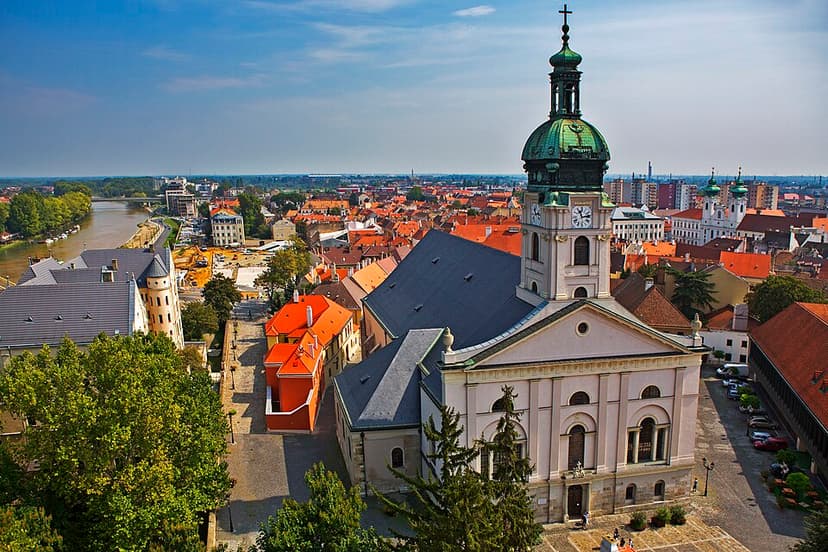
Cathedral of the Assumption
The Cathedral Basilica of the Assumption of Our Lady, also known as Győr Cathedral, is the principal Catholic church and seat of the Diocese of Győr in Hungary. Originally an 11th-century Romanesque structure, it was rebuilt and significantly altered in Baroque and later styles, undergoing its last restoration in the late 20th century. It is renowned for housing the skull relic of King Saint Ladislaus I, a significant artifact for Hungarians.