
Basilica Shrine of Our Lady of Knock, Queen of Ireland
Ireland·Knock·Tuam
The Basilica Shrine of Our Lady of Knock, Queen of Ireland, is a significant Roman Catholic pilgrimage site in County Mayo, Ireland. It gained prominence after a claimed apparition of the Virgin Mary, Saint Joseph, Saint John the Evangelist, angels, and Jesus Christ in 1879. This event transformed the village of Knock into a major national and international shrine, attracting pilgrims seeking cures and spiritual solace.
Key Facts
- ›The shrine's origin is the claimed apparition of the Virgin Mary and other figures on August 21, 1879, at the south gable of the Church of Saint John the Baptist.
- ›Witnesses described the apparition as life-size figures, with the Virgin Mary in prayer, Saint Joseph to her right, and Saint John the Evangelist to her left, accompanied by an altar with a lamb and angels.
- ›Two ecclesiastical commissions of inquiry, in 1879 and 1936, investigated the apparition, with the 1879 commission deeming the witnesses' testimony trustworthy and satisfactory.
- ›The site became a major pilgrimage destination, fueled by railway expansion and media coverage, and incorporated traditional Irish practices with other devotions.
- ›Several Popes have visited or acknowledged the shrine, including Pope John Paul II, who celebrated Mass and designated the shrine church as a basilica in 1979.
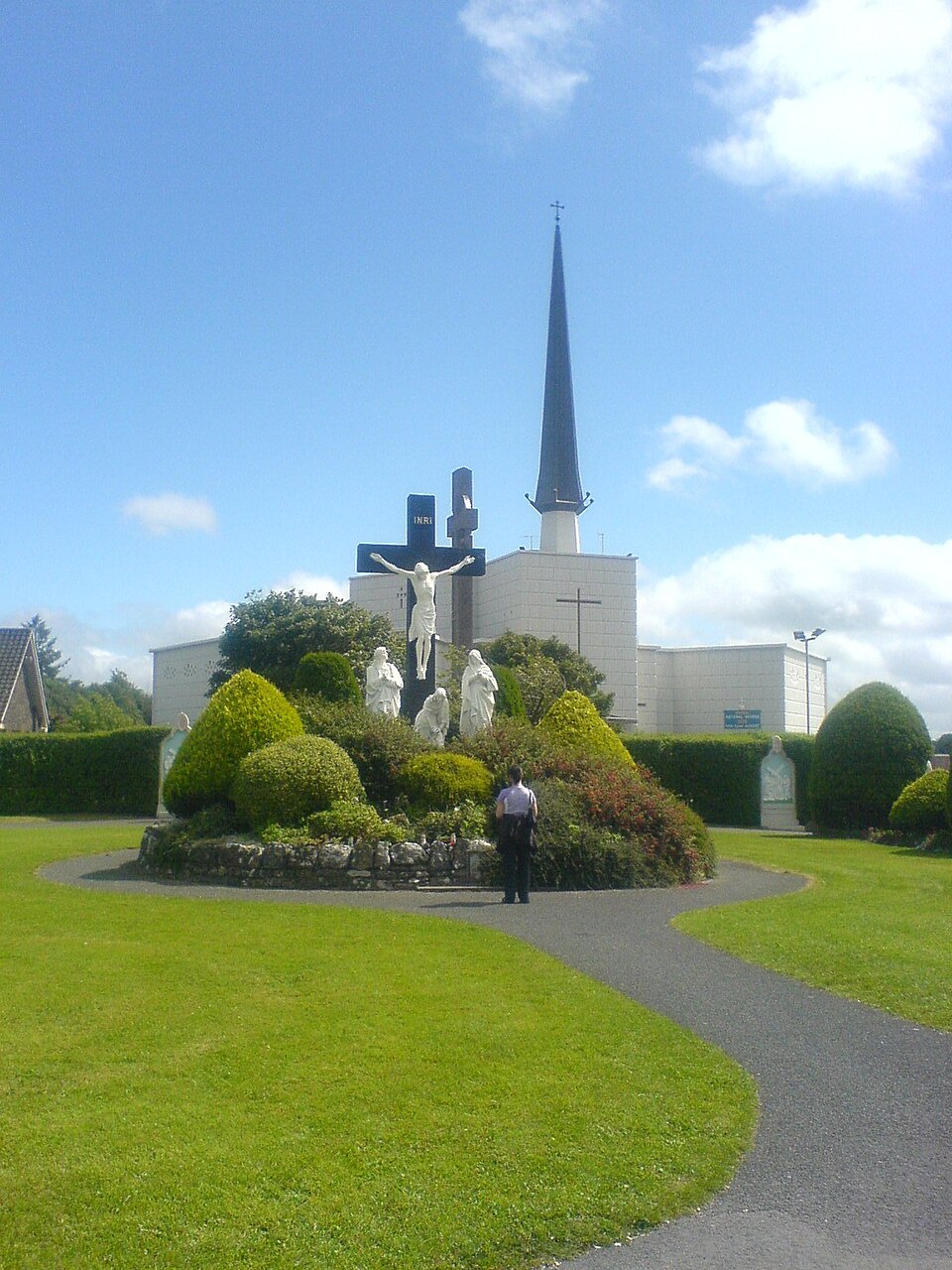
- ›The modern complex includes multiple churches, a museum, and various services for pilgrims, with many leaving crutches and sticks as evidence of claimed cures.
Modern
Virgin Mary, Saint Joseph, Saint John the Evangelist
About Basilica Shrine of Our Lady of Knock, Queen of Ireland
The Basilica Shrine of Our Lady of Knock, commonly known as Knock Shrine, is a prominent Roman Catholic pilgrimage site and Ireland's national shrine. Located in the village of Knock, County Mayo, its significance stems from a series of claimed apparitions that occurred on the evening of August 21, 1879.
The Apparition of 1879
On a rainy evening, several villagers reported witnessing an apparition at the south gable of the Church of Saint John the Baptist. Witnesses described seeing life-size figures of the Blessed Virgin Mary, Saint Joseph, and Saint John the Evangelist. Behind them, an altar was seen with a lamb and angels. The vision, which lasted for nearly two hours, was described as clear and vivid, with a surrounding golden light. The ground around the figures reportedly remained dry despite the rainfall.
Investigations and Recognition
Following the reported apparitions, two ecclesiastical commissions of inquiry were established. The first, in 1879, under Archbishop John MacHale of Tuam, concluded that the testimony of the witnesses was trustworthy and satisfactory. The second commission in 1936, relying on surviving witnesses and historical documents, corroborated the earlier findings. The site's importance grew with improved transportation and media coverage, attracting pilgrims from across Ireland and internationally.
Modern Pilgrimage Site
Knock Shrine has evolved into a major religious center, with a complex that includes several churches, a museum, and various facilities for pilgrims. It hosts organized pilgrimages, daily Masses, and other spiritual services. The shrine has been visited by several Popes, including Pope John Paul II, who celebrated Mass and designated the shrine church as a basilica in 1979, marking the centenary of the apparitions. Pope Francis also visited in 2018. The site continues to be a focal point for Marian devotion and a place where many seek healing and spiritual renewal, with numerous accounts of cures attributed to the shrine.
Source: Wikipedia ↗
Frequently Asked Questions
What is the Basilica Shrine of Our Lady of Knock famous for?
The basilica is famous for the claimed apparition of the Virgin Mary, Saint Joseph, Saint John the Evangelist, angels, and Jesus Christ in 1879. This event led to its development as a major Catholic pilgrimage site and national shrine in Ireland.
When did the apparition at Knock occur?
The apparition is reported to have occurred on the evening of Thursday, August 21, 1879. Witnesses described seeing the figures for nearly two hours.
Who were the witnesses to the apparition?
The witnesses were primarily locals from the village of Knock, including members of the Beirne family, Mary Byrne, Mary McLoughlin, and young John Curry and Patrick Hill. Their testimonies were later gathered and examined by commissions.
What did the witnesses see during the apparition?
Witnesses described seeing three life-size figures: the Virgin Mary, Saint Joseph, and Saint John the Evangelist. They also reported seeing a plain altar with a cross and a lamb, surrounded by angels, all illuminated by a golden light.
Has the Church officially recognized the apparitions?
Two ecclesiastical commissions of inquiry investigated the events. The 1879 commission found the witnesses' testimony to be trustworthy and satisfactory, and the site has since been recognized as a national shrine and a basilica.
What is the significance of the basilica designation?
The shrine church was officially established as a basilica by Pope John Paul II during his visit in 1979 to commemorate the centenary of the apparition. This designation signifies its importance as a pilgrimage destination.
What can visitors expect at Knock Shrine today?
Today, Knock Shrine is a complex that includes five churches, a museum, and various services such as daily Masses, Confessions, and organized pilgrimages. People continue to visit seeking spiritual solace and to see the apparition site.
Related Basilicas

Basilica of St Patrick, Lough Derg (St Patrick's Purgatory)
St. Patrick's Purgatory, located on Station Island in Lough Derg, County Donegal, Ireland, is an ancient and significant pilgrimage site with legendary origins tracing back to St. Patrick in the fifth century. It gained considerable medieval prominence, appearing on European maps by the fifteenth century, and remains an active pilgrimage destination today, drawing visitors seeking spiritual reflection and penance.
Cathedral Basilica of St Joseph
The Cathedral Basilica of St. Joseph is a historic Catholic church in downtown San Jose, California, serving as the cathedral for the Diocese of San José. It holds the distinction of being a minor basilica and is named after Saint Joseph, the patron saint of the Catholic Church. The basilica is significant for its long history, having been built on the site of the first non-mission parish in California, and its architectural evolution through multiple structures.

Oratory of St Joseph of Mont-Royal
Saint Joseph's Oratory of Mount Royal is a prominent Roman Catholic minor basilica and national shrine in Montreal, Quebec, Canada. Founded in 1904 by Saint André Bessette, it is renowned for its monumental scale, housing one of the world's largest church domes. The Oratory attracts millions of visitors annually and is recognized as Canada's largest church and a National Historic Site.