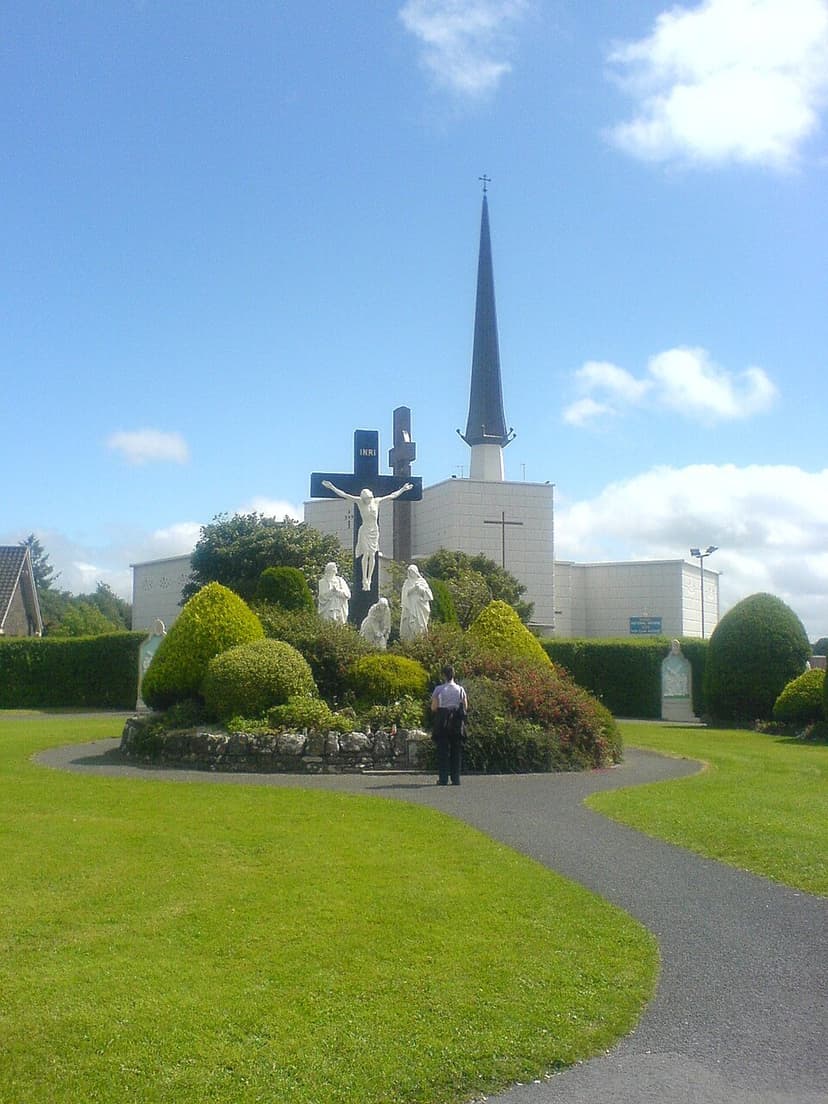
Basilica of St Patrick, Lough Derg (St Patrick's Purgatory)
Ireland·County Donegal·Clogher
St. Patrick's Purgatory, located on Station Island in Lough Derg, County Donegal, Ireland, is an ancient and significant pilgrimage site with legendary origins tracing back to St. Patrick in the fifth century. It gained considerable medieval prominence, appearing on European maps by the fifteenth century, and remains an active pilgrimage destination today, drawing visitors seeking spiritual reflection and penance.
Key Facts
- ›Legend attributes the site's origin to St. Patrick receiving a divine revelation of a cave leading to Purgatory.
- ›Medieval texts mention the site as early as 1185 and it was depicted on European maps by the fifteenth century.
- ›The "cave" at the site, now closed, was described as a narrow, enclosed pit with a short descent.
- ›The site was likely an ancient structure, possibly a sweat house used for physical or spiritual cleansing before its association with Purgatory.
- ›From around 1130, the monastery on the island was entrusted to Augustinian Canons Regular.
- ›The pilgrimage continues to this day, typically running from late May/early June to MID-August.

Saint Patrick
Augustinian Canons Regular, Franciscans
About Basilica of St Patrick, Lough Derg (St Patrick's Purgatory)
St. Patrick's Purgatory, situated on Station Island in Lough Derg, County Donegal, Ireland, stands as one of the island's most ancient and enduring pilgrimage sites. Legend firmly anchors its origins in the fifth century, positing that Christ revealed to Saint Patrick a cave on Station Island, described as a pit or well, which served as an entrance to Purgatory itself. This narrative, while legendary, has cemented the site's profound spiritual significance.
Historical Prominence and Medieval Significance
The importance of St. Patrick's Purgatory in medieval times is underscored by its appearance in texts dating as early as 1185 and its inclusion on maps from across Europe by the fifteenth century. Notably, it is the sole Irish site marked on Martin Behaim's world map of 1492. Its depiction on the Pinelli–Walckenaer Atlas, created between 1384 and 1410, further attests to its recognition and the reach of its fame.
The Cave and its Interpretations
The focal point of the pilgrimage, the "cave," has been closed since 1632. Surviving descriptions from early pilgrims portray it as a narrow, enclosed pit, approximately 0.6 meters wide and 0.9 meters high, with a descent of about six steps. While its precise original function remains a subject of scholarly discussion, plausible theories suggest it may have been an ancient souterrain or, more likely, a sweat house used for physical or spiritual cleansing. The term "purgatorium" could have initially referred to this cleansing function, aligning with its Latin meaning, before the later theological concept of purgatory gained wider currency in the thirteenth century.
Monastic Life and Pilgrimage Practices
A monastery likely existed on the Lough Derg islands from the fifth century, possibly housing anchorites in beehive cells, remnants of which may be preserved in the penitential beds still visible on Station Island. Around 1130, the monastery was placed under the administration of Augustinian Canons Regular. The monastery on Saints Island historically offered hospitality to pilgrims preparing for their journey to the Purgatory. Medieval pilgrims required episcopal permission and typically underwent fifteen days of fasting and prayer before entering the cave for twenty-four hours, followed by further penitential practices upon their release.
Modern Pilgrimage
The pilgrimage to St. Patrick's Purgatory continues uninterrupted into the present day, drawing thousands of participants annually. The main season runs from late May or early June to mid-August. The modern pilgrimage is a three-day experience open to individuals of all faiths or none, who must be at least fifteen years old and in good health. Pilgrims assemble on the mainland and are ferried to Station Island, where they engage in a continuous cycle of prayer and liturgies, often with minimal sustenance, before returning to the mainland. The site is currently under the stewardship of the Roman Catholic Diocese of Clogher.
Source: Wikipedia ↗
Frequently Asked Questions
What is St. Patrick's Purgatory?
St. Patrick's Purgatory is an ancient pilgrimage site on Station Island in Lough Derg, County Donegal, Ireland. Legend states it was revealed to St. Patrick as a cave leading to Purgatory, and it has been a significant site for penitential pilgrimage for centuries.
When did St. Patrick's Purgatory originate?
According to legend, the site dates back to the fifth century when Christ showed Saint Patrick a cave on Station Island that was an entrance to Purgatory. However, historical evidence suggests the legend itself is likely from the twelfth century.
Where is St. Patrick's Purgatory located?
St. Patrick's Purgatory is situated on Station Island in Lough Derg, County Donegal, Ireland. There was some confusion in the 19th century about its exact location, but tradition firmly places it on Station Island.
What was the 'cave' at St. Patrick's Purgatory like?
The cave, which has been closed since 1632, was described by early pilgrims as a narrow, enclosed pit, about 0.6 meters wide and 0.9 meters high. It involved a short descent of about six steps and was divided into two small sections.
What is the modern pilgrimage experience like at Lough Derg?
The modern pilgrimage is a three-day event open to people of all faiths or none, involving a cycle of prayer and liturgies at designated stations on Station Island. Pilgrims typically fast, pray barefoot, and have one simple meal per day.
Has the pilgrimage ever been interrupted?
There is no evidence that the pilgrimage to St. Patrick's Purgatory has ever been interrupted for a significant period. It continues in the present day, though it did not take place in 2020 and 2021 due to the COVID-19 pandemic.