
Basilica of St Peter the Apostle
Spain·Córdoba
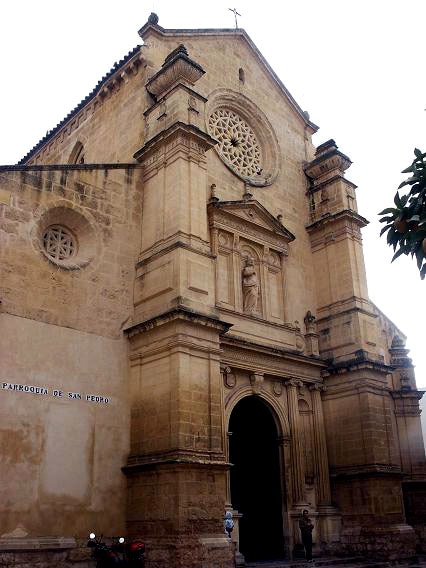
The Basilica of St Peter the Apostle in Córdoba, Spain, is a minor basilica believed to be built over an early Christian site housing the remains of Córdoban martyrs. Following the city's Christian reconquest, a church dedicated to St. Paul was constructed here in the late 13th century, later restored and elevated to minor basilica status by Pope Benedict XVI in 2006.
Key Facts
- ›Believed to be built over a 4th-century site honoring Córdoban martyrs Januarius, Martial, and Faustus.
- ›Construction of the church dedicated to St. Paul began in the late 13th century and concluded in the early 14th century.
- ›The current appearance largely dates from later restorations.
- ›A new gate was added by architect Hernán Ruiz II in 1542.
- ›Elevated to the status of minor basilica in 2006 by Pope Benedict XVI.
- ›Designated as a Bien de Interés Cultural monument.
- Remains of CóRdoban Martyrs Januarius, Martial, and Faustus
HernáN Ruiz Ii
About Basilica of St Peter the Apostle
The Basilica of St Peter the Apostle, known locally as San Pedro, is a minor basilica located in the heart of Córdoba, Spain. Situated in the square of the barrio that shares its name, this church holds a significant place in the city's religious and historical landscape. Its origins are believed to lie over an ancient edifice that once housed the remains of the Córdoban martyrs Januarius, Martial, and Faustus, dating as far back as the 4th century AD.
History and Construction
Following the conquest of Córdoba by King Ferdinand III of Castile in 1236, a concerted effort was made to imbue the city with a Christian identity. As part of this program, a church dedicated to St. Paul was constructed on this historically significant site. Construction commenced in the late 13th century and was largely completed by the early 14th century. While parts of the structure, such as the bell tower and two medieval gates, remain, the church's present appearance is predominantly the result of subsequent restorations. A notable addition from this period is a new gate designed by architect Hernán Ruiz II in 1542.
Basilica Status and Recognition
In 2006, the church received a significant elevation in its ecclesiastical status when Pope Benedict XVI designated it as a minor basilica. This honor underscores its importance within the Catholic Church. The Basilica of St Peter the Apostle is also officially recognized as a Bien de Interés Cultural monument, signifying its value as a protected cultural heritage site in Spain.
Source: Wikipedia ↗
Frequently Asked Questions
Where is the Basilica of St Peter the Apostle located?
The Basilica of St Peter the Apostle is situated in the barrio (quarter) of San Pedro in Córdoba, Spain. It is located in the square of its namesake neighborhood.
What is the historical significance of the site?
The site is believed to be located over a previous edifice that housed the remains of the Córdoban martyrs Januarius, Martial, and Faustus, dating back to the 4th century AD. This suggests a long history of religious importance at this location.
When was the current church built?
Following the conquest of Córdoba by King Ferdinand III of Castile in 1236, a church dedicated to St. Paul was built on the site. Construction began in the late 13th century and was completed in the early 14th century.
Has the basilica undergone significant renovations?
Yes, the edifice's current appearance largely dates to later restorations. Architect Hernán Ruiz II added a new gate in 1542, and parts of the bell tower and two medieval gates have survived.
When was it officially recognized as a basilica?
The church was elevated to the status of minor basilica in 2006 by Pope Benedict XVI. It is also recognized as a Bien de Interés Cultural monument.
Related Basilicas

Cathedral Basilica of St Peter of Vic
The Cathedral Basilica of St Peter of Vic, officially the Cathedral of St. Peter the Apostle, is a Roman Catholic cathedral in Vic, Catalonia, Spain, serving as the seat of the Diocese of Vic. Its architecture is a notable blend of Romanesque, Gothic, Baroque, and Neoclassical styles, reflecting centuries of construction and renovation. The cathedral is significant for its historical layers, including remnants of earlier structures and significant artworks like the paintings by Josep Maria Sert.
Cathedral Basilica of Saints Peter and Paul
The Cathedral Basilica of Saints Peter and Paul serves as the principal church of the Archdiocese of Philadelphia. This grand structure, completed in 1864, is the largest Catholic church in Pennsylvania and was designated a minor basilica by the Vatican in 1976. It is renowned for its impressive Roman-Corinthian architecture, featuring a dome and facade inspired by Italian Renaissance churches, and has hosted papal masses by Pope John Paul II and Pope Francis.
Cathedral Basilica of St Mary of the Meadow
The Holy Priory Church Cathedral Basilica of the Military Orders of Our Lady Saint Mary of the Prado, commonly known as the Cathedral of Saint Mary of the Prado, is a significant religious and architectural landmark in Ciudad Real, Spain. Its construction, spanning centuries and incorporating Gothic, Renaissance, and Baroque elements, makes it a rich historical monument. Since 1875, it has served as the priory for four of Spain's military orders, underscoring its enduring importance.