
Basilica of Our Lady of the Solitude
Mexico·Oaxaca de Juárez
The Basilica of Our Lady of Solitude, officially Basilica of Nuestra Señora de Soledad, is a Roman Catholic basilica located in Oaxaca de Juárez, Mexico. Constructed between 1682 and 1690, it serves as a significant sanctuary dedicated to Our Lady of Solitude, the patron saint of Oaxaca. Its Baroque architecture, designed to withstand earthquakes, contributes to its inclusion in the UNESCO World Heritage Site of the Historic Center of Oaxaca City.
Key Facts
- ›Construction began in 1682 and the basilica was consecrated in 1690 by Bishop Sariñana y Cuenca.
- ›The basilica is dedicated to our Lady of Solitude, who is the patron saint of Oaxaca.
- ›Its architectural style is Baroque, with intentional design choices for low spires and towers to resist earthquakes.
- ›The current facade was constructed between 1717 and 1718.
- ›The building is laid out in the shape of a Latin cross and constructed from green cantera stone.
- ›It is part of the Historic Center of Oaxaca City, a UNESCO World Heritage Site designated in 1987.

Baroque
Our Lady of Solitude
Father Fernando MéNdez
About Basilica of Our Lady of the Solitude
The Basilica of Our Lady of Solitude, known in Spanish as the Basilica of Nuestra Señora de Soledad, is a significant Roman Catholic basilica situated in Oaxaca de Juárez, Oaxaca, Mexico. Its construction commenced in 1682 and concluded with its consecration in 1690 by Bishop Sariñana y Cuenca. The basilica serves as a primary sanctuary dedicated to Our Lady of Solitude, revered as the patron saint of Oaxaca.
History and Architecture
The basilica's architectural style is predominantly Baroque. A notable feature of its design, overseen by Father Fernando Méndez, is the intentional construction of low spires and towers, a deliberate measure to enhance its resilience against earthquakes. The current facade was completed between 1717 and 1718, with the assistance of Bishop Angel Maldonado.
The structure is laid out in the traditional shape of a Latin cross and is constructed from green cantera, a stone characteristic of the Oaxaca region. Within its west gallery, a baroque pipe organ dating back to 1686 is housed, which was restored to full working condition in 2000.
World Heritage Status
The Basilica of Our Lady of Solitude holds an important place within the Historic Center of Oaxaca City. This historic area was recognized for its cultural and architectural significance and was declared a World Heritage Site by UNESCO in 1987, thereby including the basilica as part of this esteemed designation.
Source: Wikipedia ↗
Frequently Asked Questions
When was the Basilica of Our Lady of Solitude built?
Construction of the basilica began in 1682 and it was consecrated in 1690. The current facade was added between 1717 and 1718.
Who is the Basilica of Our Lady of Solitude dedicated to?
The basilica is dedicated to Our Lady of Solitude, who is recognized as the patron saint of Oaxaca.
What is the architectural style of the basilica?
The basilica features a Baroque architectural style. It was specifically designed with low spires and towers to better withstand earthquakes.
Is the Basilica of Our Lady of Solitude a UNESCO World Heritage Site?
The basilica is part of the Historic Center of Oaxaca City, which was declared a UNESCO World Heritage Site in 1987.
What materials were used in the construction of the basilica?
The building was constructed primarily from green cantera, a type of stone commonly found in the Oaxaca region.
Related Basilicas

"Old" Basilica of Our Lady of Guadalupe
The Insigne y Nacional Basílica de Santa María de Guadalupe, commonly known as the Basilica of Our Lady of Guadalupe, is a prominent Catholic church in Mexico City dedicated to the Virgin Mary under her invocation as Our Lady of Guadalupe. It is one of the most visited Marian shrines in the world, attracting an estimated twenty million pilgrims annually, with a significant portion visiting around December 12th, the feast day of Our Lady of Guadalupe. The sanctuary complex includes the older church, now referred to as the Old Basilica, built in the early 18th century, and the modern New Basilica constructed in the 1970s to accommodate the growing number of devotees.

Basilica of Our Lady of Ocotlán
The Basilica of Our Lady of Ocotlán in Tlaxcala, Mexico, is a significant Marian shrine dedicated to the Virgin of Ocotlán, the patroness saint of Tlaxcala and the neighboring state of Puebla. Its origins are traced to a miraculous apparition in 1541, leading to the discovery of a statue that became the focus of widespread devotion. The shrine has undergone several architectural and decorative phases, culminating in its present appearance and its canonical coronation by Pope Pius X in 1909.
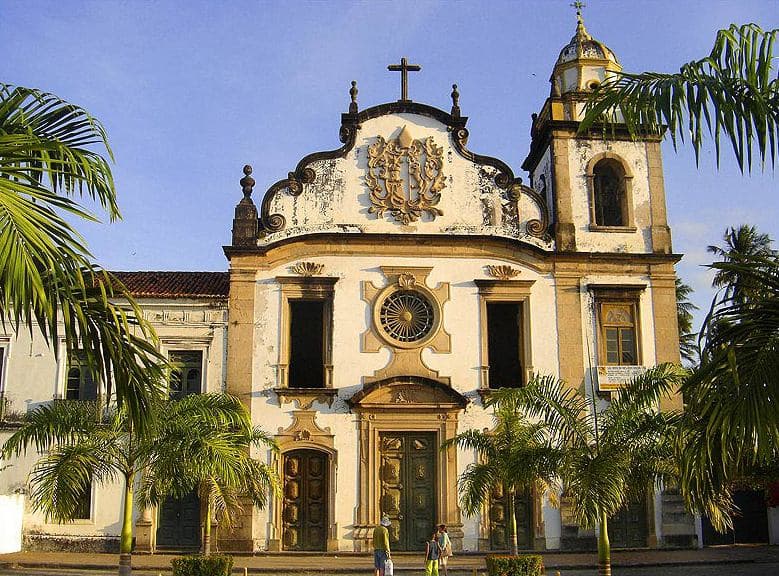
Abbatial Basilica of the Monastery of St Benedict
The Basilica and Monastery of St. Benedict is a significant Baroque architectural complex in Olinda, Pernambuco, Brazil. It is part of the historic center of the city, which is recognized as a UNESCO World Heritage Site. The basilica holds importance for its historical roots in Portuguese colonization and its elevated status as a Minor Basilica.