
Abaddon
Abaddon, a term originating from Hebrew meaning "destruction" and its Greek equivalent Apollyon meaning "Destroyer," initially referred to a place of destruction or the realm of the dead in the Hebrew Bible. In the New Testament's Book of Revelation, Abaddon is depicted as an angel of the abyss and the king of a locust army, though his identity and role have been subject to various interpretations across different Christian traditions.
Key Facts
- ›Abaddon is a Hebrew term meaning "destruction" or "doom."
- ›Apollyon is the Greek equivalent, meaning "Destroyer."
- ›In the Hebrew Bible, Abaddon refers to a place of destruction or the realm of the dead, often alongside Sheol.
- ›In the Book of Revelation, Abaddon is an angel described as the king of an army of locusts.
- ›Medieval Christian literature sometimes depicted Abaddon in fictional trinities with figures like Muhammad.
- ›Interpretations of Abaddon's identity vary, including the Antichrist, Satan, or an angel of God.
Apollyon, Exterminans
Destroyer, King of the Locusts
Destruction, Doom, Abyss
Locusts, Scorpion's Stinger
Job 26:6, Job 28:22, Job 31:12, Psalm 88:11, Proverbs 15:11, Proverbs 27:20, Revelation 9:11
Sheol, Death, Belial, Mahound, Termagant, Jesus Christ
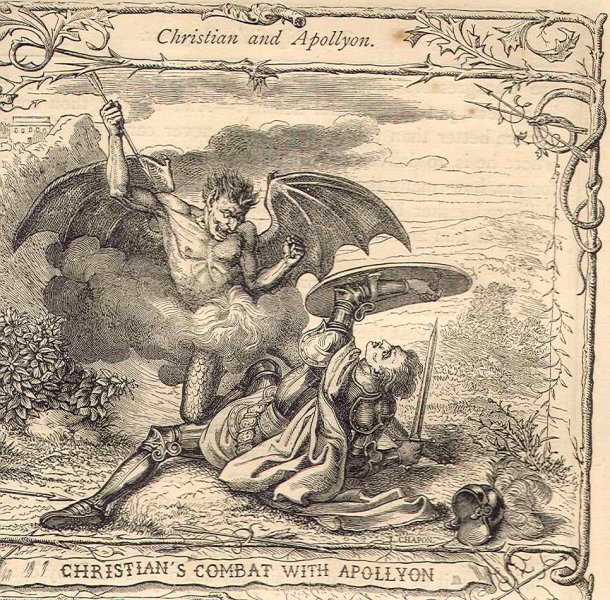
Song of Roland, the Pilgrim's Progress
Demon, Angel
Legendary Figure
About Abaddon
Abaddon is a significant figure in Abrahamic religions, primarily known through its Hebrew and Greek appellations signifying destruction. The term originates from Hebrew as 'Abaddon' (אֲבַדּוֹן), meaning "destruction" or "doom." Its Koine Greek equivalent is 'Apollyon' (Ἀπολλύων), translating to "Destroyer."
Scriptural Context
In the Hebrew Bible, 'abaddon' is consistently used as a noun referring to a place of destruction or the realm of the dead, frequently appearing in conjunction with Sheol. Passages in Job, Psalms, and Proverbs describe it as a deep pit or an abyss, often personified alongside Death.
The New Testament, specifically the Book of Revelation, introduces Abaddon as an individual entity, an angel. In Revelation 9:11, he is identified as the "angel of the bottomless pit," whose name in Hebrew is Abaddon and in Greek is Apollyon. He is depicted as the king over a plague of locusts, described with fearsome, hybrid features, tasked with tormenting those who lack the seal of God.
Interpretations and Traditions
The interpretation of Abaddon's nature varies across theological and literary traditions. In some Christian literature, particularly medieval works like the "Song of Roland," Abaddon is portrayed as part of a fictional trinity alongside figures such as Muhammad (Mahound) and Termagant, reflecting the religious polemics of the era.
Later interpretations offer differing views. Some Protestant commentators have identified Abaddon with the Antichrist or Satan, seeing him as a force of evil. Conversely, some Methodist and Jehovah's Witness interpretations suggest Abaddon is an angel acting under divine command or even another name for Jesus Christ after his resurrection, emphasizing his role in divine judgment or purpose.
Mandaean scriptures also mention entities called 'Abaddons' (ʿbdunia) as part of their cosmology, associated with the World of Darkness. In Gnostic texts like the Acts of Thomas, Abaddon can be depicted as a demon or the devil himself. Apocryphal texts, such as a homily by pseudo-Timothy of Alexandria, present Abaddon as an angel named Muriel, initially tasked with collecting earth for Adam's creation and later appointed as a fearsome guardian who will play a role in the Last Judgment.
Source: Wikipedia ↗
Frequently Asked Questions
What does the name Abaddon mean?
The Hebrew term Abaddon means "destruction" or "doom." Its Greek equivalent, Apollyon, translates to "Destroyer."
How is Abaddon described in the Hebrew Bible?
In the Hebrew Bible, 'abaddon' is used to refer to a place of destruction or the realm of the dead, often appearing alongside Sheol, the resting place of the dead.
What is Abaddon's role in the Book of Revelation?
In the Book of Revelation, Abaddon is described as an angel who is the king of an army of locusts and the angel of the abyss. His name is given in Hebrew as Abaddon and in Greek as Apollyon.
Are there different interpretations of Abaddon in Christian tradition?
Yes, interpretations vary. Some Protestant commentators, like Matthew Henry, believed Abaddon to be the Antichrist, while others identified the angel as Satan. The Methodist publication The Interpreter's Bible suggests Abaddon is an angel of God performing his work of destruction at God's bidding, and Jehovah's Witnesses consider "Abaddon" another name for Jesus after his resurrection.
How is Abaddon depicted in medieval Christian literature?
In medieval Christian literature, such as the "Song of Roland," Abaddon is sometimes depicted as part of a fictional trinity alongside figures like Muhammad (Mahound) and Termagant, attributed to the religious practices of Muslims.
Is Abaddon considered a fallen angel?
The text does not explicitly state Abaddon is a fallen angel. While some interpretations associate him with destructive forces or figures like Satan or the Antichrist, others view him as an agent of God's destruction.
Related Angels
Adriel
Adriel was a nobleman from the ancient kingdom of Israel, mentioned in the Bible. His name, derived from Hebrew, signifies "flock of God." He is primarily known through biblical accounts detailing his marital relationships with two of King Saul's daughters, Merab and potentially Michal.
Agiel
Agiel is identified as the Intelligence or beneficial spirit associated with the planet Saturn. He is mentioned in esoteric texts like the Key of Solomon, where he is described as a spirit that can be invoked. Agiel's role is often linked to the beneficial influences and operations connected to Saturn.
Ananiel
Ananiel is recognized as the 14th Watcher among the 20 leaders of the 200 fallen angels mentioned in the ancient Jewish text, the Book of Enoch. His name is often interpreted as "cloud of God" or "Rain of God," and he was entrusted by God with dominion over atmospheric phenomena and the trees of the earth. In some traditions, Ananiel is also revered as one of the seven holy archangels.