
Nandikeshwari Temple
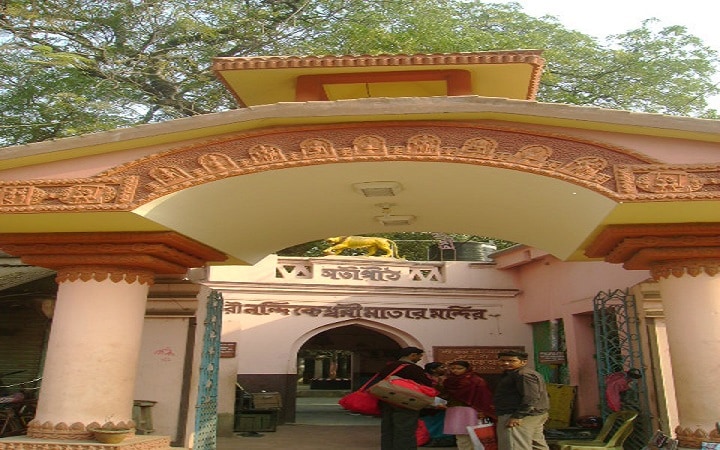
The Nandikeshwari Temple, also known as Nandikeshwari Tala, is a prominent Shakta pitha located in Sainthia City, West Bengal. Its history is deeply intertwined with the myth of Sati's sacrifice, with the temple believed to be the site where Sati's collarbone fell, forming a sacred pitha.
Key Facts
- ›The temple is considered a significant Shakta pitha in the Indian subcontinent.
- ›Its name is derived from 'Nandi' (Shiva's bull) and 'Ishwari' (Goddess), suggesting worship by Nandi.
- ›According to legend, the collarbone of Sati fell at this site during her self-immolation.
- ›The present temple structure was constructed in 1913.
- ›The main idol is a black stone, now appearing red due to devotees applying sindur.
- ›The idol is adorned with a silver crown and three golden eyes.
Nandikeshwari, Sati
Shakta Pitha, Mythological Site of Sati's Sacrifice
Stone, Sindur
About Nandikeshwari Temple
The Nandikeshwari Temple, also referred to as Nandikeshwari Tala, is a significant Hindu temple situated in Sainthia City, West Bengal, India. It holds a prominent place among the Shakta pitha sites across the Indian subcontinent, which are sacred places dedicated to the goddess Shakti.
Name and Mythology
The name 'Nandikeshwari' is understood to derive from 'Nandi', the divine bull and devoted follower of Lord Shiva, and 'Ishwari', meaning Goddess. This etymology suggests a connection to the worship of the Goddess by Nandi.
The temple's history is deeply entwined with the Hindu mythology of Sati, the consort of Lord Shiva. According to tradition, Sati immolated herself at a sacrifice organized by her father, Daksha, after he insulted her and Shiva. It is believed that Lord Vishnu's Sudarshan Chakra dismembered Sati's corpse, and her collarbone fell at this very spot, thus establishing it as a holy Shakta pitha.
Construction and Idol
The present structure of the Nandikeshwari Temple was erected in 1913, corresponding to the Bengali year 1320. The central idol within the temple is a stone, originally black, which has taken on a reddish hue due to the liberal application of sindur by devotees during worship. This sacred stone is adorned with a silver crown and three golden eyes.
Temple Complex
The temple complex encompasses several other shrines, including those dedicated to Ram-Sita, Shiva, Maha Saraswati, Maha Laxmi-Ganesha, Laxmi-Narayana, Radha Govinda, Bhairav Nandikeshwari, and Hanuman (Bajrangbali). A large, sacred banyan tree stands within the premises, where devotees tie red and yellow threads, making vows with the hope of their wishes being fulfilled.
Source: Wikipedia ↗
Frequently Asked Questions
What is the significance of the Nandikeshwari Temple's name?
The name 'Nandikeshwari' is derived from 'Nandi', the sacred bull and follower of Lord Shiva, and 'Ishwari', meaning Goddess. This suggests the Goddess is worshiped by Nandi.
What is the mythological origin of the Nandikeshwari Temple?
The temple's history is linked to the mythological event of Sati's self-sacrifice. It is believed that Sati's collarbone fell at this location when her body was dismembered by Lord Vishnu's Sudarshan Chakra, establishing it as a Shakta pitha.
When was the current structure of the Nandikeshwari Temple built?
The present temple structure was built in 1913, corresponding to the Bengali year 1320.
What is the main idol of the Nandikeshwari Temple made of?
The main idol is a black stone that has gradually turned red due to devotees applying sindur as part of their worship. The idol is further distinguished by a silver crown and three golden eyes.
Are there other temples within the Nandikeshwari Temple complex?
Yes, the temple premises contain several other shrines. Notable among these are temples dedicated to Ram-Sita, Shiva, Maha Saraswati, Maha Laxmi-Ganesha, Laxmi-Narayana, Radha Govinda, Bhairav Nandikeshwari, and Hanuman (Bajrangbali).
Related Temples (Hindu)

EME Temple
The Dakshinamoorthy and Navgraha EME Temple in Vadodara, Gujarat, is a unique Hindu temple dedicated to Lord Shiva, built in 1966 by the Indian Army's EME School. Its distinctive geodesic dome design, inspired by Buckminster Fuller, incorporates architectural elements from major world religions, symbolizing secularism.

Swaminarayan Akshardham (Gandhinagar)
Swaminarayan Akshardham in Gandhinagar, Gujarat, India, is a vast Hindu temple complex dedicated to Swaminarayan and his teachings, inspired by prominent spiritual successors of the Swaminarayan faith. Completed in 1992, the 23-acre complex features a central mandir crafted from pink sandstone, along with exhibition halls, a water show, and gardens that explore Hindu philosophy and history.

Maa Dewri Temple
Maa Dewri Temple is an ancient Hindu temple located in Diuri village, near Ranchi, Jharkhand, India. It is primarily dedicated to Maa Dewri Devi, a tribal deity, and is renowned for its 700-year-old idol of the 16-armed goddess. The temple is constructed using interlocking stones without any binding material and holds significant religious and cultural importance for local tribal communities.