
Mahakala-Mahakali Temple
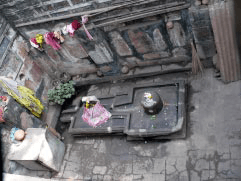
The Mahakala-Mahakali Temple, located in Bhubaneswar, India, is an 11th-century shrine notable for its unique architectural style and its subterranean sanctum. It houses two principal deities, Mahakala and Mahakali, which local tradition identifies as the parents of Lord Lingaraja.
Key Facts
- ›Built around the 11th century AD.
- ›Located in Bhubaneswar, Odisha, India, near the Lingaraja temple.
- ›Features a shrine without a superstructure, open to the sky.
- ›The deities are situated 4.00 meters below the current ground level.
- ›Constructed using sandstone with dry masonry techniques.
Shiva, Mahakali
- Local Tradition Identifies Deities As Parents of Lord Lingaraja
- Unique Subterranean Shrine Architecture
Sandstone
Four Armed Ganesa, Two Nayikas, Four Armed Female Deity, Udyota Simha, Amlaka
About Mahakala-Mahakali Temple
The Mahakala-Mahakali Temple is an ancient Hindu shrine located in Bhubaneswar, Odisha, India, believed to have been constructed around the 11th century AD. Situated near the prominent Lingaraja temple, this temple is distinguished by its unusual architectural design as it lacks a superstructure and features a sanctum that lies approximately 4.00 meters below the current ground level. Access to the deities is gained through a flight of fifteen steps leading down to the shrine, which is open to the sky.
Deities and Religious Significance
The primary deity enshrined within the temple is a Siva-lingam, known as Mahakala, housed within a square yonipitha. Adjacent to this central lingam is another smaller Siva lingam, referred to as Mahakali. According to local tradition and folklore, these two deities are revered as the parents of Lord Lingaraja, a widely worshipped form of Shiva in the region, adding a layer of familial significance to the temple's spiritual landscape.
Construction and Materials
The temple's construction is notable for its use of sandstone and employs dry masonry techniques, where stones are fitted together without the use of mortar. The shrine itself is enclosed by stone walls and remains open to the elements.
Conservation Challenges
A significant challenge faced by the Mahakala-Mahakali Temple is its subterranean location. The lack of an adequate outlet for water discharge means that offering water and rainwater directly enter the shrine, leading to stagnation, particularly during the monsoon season. This necessitates manual clearing of the accumulated water. Furthermore, several detached sculptures and architectural members found on the western side of the cella exhibit considerable weathering and erosion, indicating the need for ongoing conservation efforts to preserve these historical artifacts.
Source: Wikipedia ↗
Frequently Asked Questions
Where is the Mahakala-Mahakali Temple located?
The Mahakala-Mahakali Temple is situated in Bhubaneswar, Odisha, India. It is located beyond the eastern compound wall of the Lingaraja temple, on the right side of the temple road leading to Hatasahi in the Old Town.
What is the architectural style of the Mahakala-Mahakali Temple?
The temple is distinctive in that it has no superstructure and its sanctum is located about 4.00 meters below the present ground level. Access to the deities is provided by a flight of fifteen steps leading down to the open-to-the-sky shrine.
What deities are worshipped at the Mahakala-Mahakali Temple?
The presiding deity is a Siva-lingam within a square yonipitha, known as Mahakala. Close to this central lingam is another small Siva lingam, known as Mahakali. Local tradition holds that Mahakala and Mahakali are the parents of Lord Lingaraja.
What materials were used to build the Mahakala-Mahakali Temple?
The temple is constructed from sandstone. The building technique employed was dry masonry, meaning stones were fitted together without mortar.
What conservation issues does the Mahakala-Mahakali Temple face?
A significant conservation challenge is that the shrine's low elevation (4.00 m below road level) prevents proper drainage. Rainwater and offering water stagnate inside the shrine, requiring manual clearance. Additionally, detached sculptures and architectural members on the western side of the cella are severely weathered and eroded.
Related Temples (Hindu)

Srikalahasteeswara temple
The Srikalahasteeswara temple, located in Andhra Pradesh, India, is a significant Hindu temple dedicated to Shiva as Vayu Lingam. It is renowned as one of the Pancha Bhuta Sthalams and is considered the "Kailash of the South," attracting devotees for its unique Vayu Lingam and the Rahu-Ketu pooja.

Shamlaji
Shamlaji is a significant Hindu pilgrimage center located in Gujarat, India, primarily dedicated to Vishnu in his form as Shamlaji. The site boasts a rich history, with evidence of ancient Buddhist and Hindu monastic activity, and its main temple structure dates to the 15th-16th centuries, though older sculptures are present. It is renowned for its religious importance and the annual fair held during the Kartik Sud 15th.

Amarnath Cave Temple
Amarnath Cave Temple is a Hindu shrine located in the Indian Himalayas, renowned for its natural ice stalagmite Shiva Lingam. Situated at a high altitude, it is accessible to pilgrims only for a brief summer period and is considered one of the 51 Shakti Pithas. The temple's pilgrimage, known as the Amarnath Yatra, has ancient roots and attracts a significant number of devotees annually.