
Koniamman Temple, Coimbatore
The Arulmigu Koniamman Temple in Coimbatore, Tamil Nadu, India, is a historic Hindu temple dedicated to Goddess Koniamman, a form of Parvati. Situated on the northern bank of the Noyyal River and at the city's core, it is recognized as the guardian deity of Coimbatore and is considered one of the city's two primary historic temples.
Key Facts
- ›Dedicated to Goddess Koniamman, a manifestation of Parvati.
- ›Located in the heart of Coimbatore, Tamil Nadu, on the northern bank of the Noyyal River.
- ›Koniamman is revered as the 'Guardian Deity' of Coimbatore.
- ›Built in the 11th century by the descendants of chieftain Kovan.
- ›Features an 84-foot tall gopuram, the tallest in the region, completed in 2011.
- ›The annual car festival during the month of Panguni is a prominent local celebration.
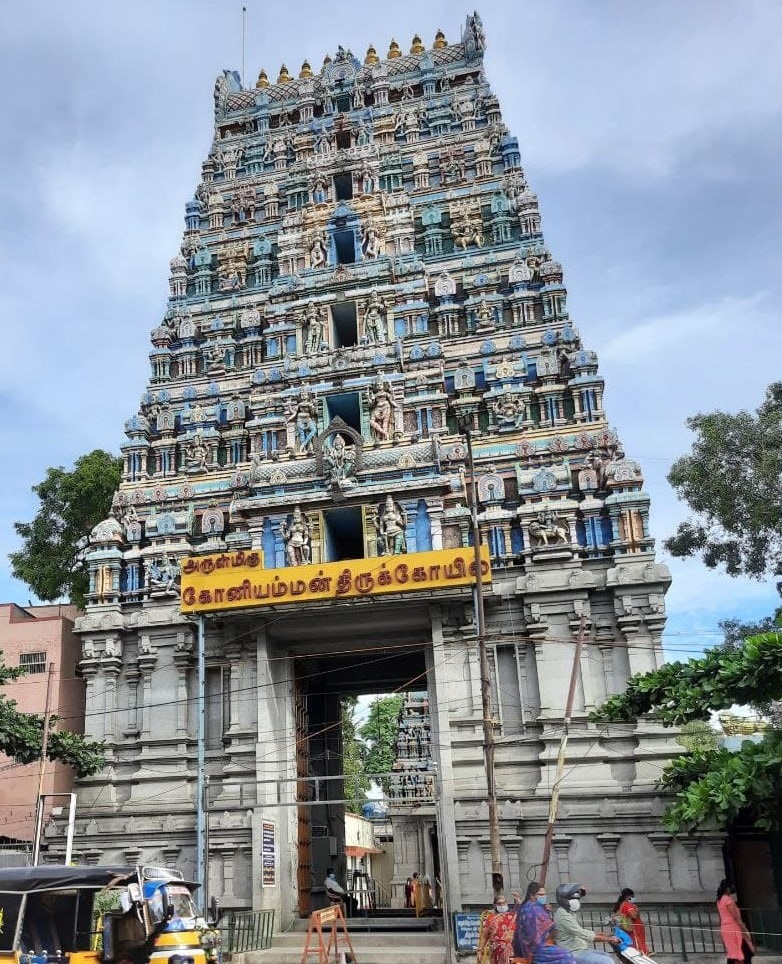
Koniamman, Parvati
Guardian Deity of Coimbatore, Historic Temple, Central City Location
Car Festival
Descendants of Chieftain Kovan
Noyyal River
About Koniamman Temple, Coimbatore
Arulmigu Koniamman Temple, Coimbatore
The Arulmigu Koniamman Temple is a significant historic Hindu temple located in Coimbatore, Tamil Nadu, India. Situated on the northern bank of the Noyyal River, the temple is dedicated to Goddess Koniamman, who is considered a form of the goddess Parvati and is revered as the "Guardian Deity" of Coimbatore. Its central location within the city makes it a focal point for both religious devotion and the city's identity, standing as one of the two major historic temples in Coimbatore, alongside the Perur Pateeswarar Temple.
History and Construction
The temple's origins trace back to the 11th century, with historical accounts suggesting it was built by the descendants of a chieftain named Kovan. The name of the city, Koyampuththoor, is believed by some to be derived from "Kovaiamma," referring to the goddess worshipped here.
Architectural Features
A notable architectural element of the temple is its gopuram, which stands at an impressive 84 feet (26 meters) tall, making it the tallest in the surrounding region. This towering structure was completed in 2011, funded by the Government of Tamil Nadu.
Festivals and Worship
The temple is most known for its annual "car festival" celebrated during the month of Panguni. This event is considered the most prominent local festival in Coimbatore and includes sacred ceremonies such as the "thirukalyana vaibogam" (the marriage ceremony of Koniamman) and the "Kudndam vizha" (temple float festival), drawing numerous devotees and participants.
Source: Wikipedia ↗
Frequently Asked Questions
Who is Goddess Koniamman?
Koniamman is a form of the Hindu goddess Parvati, who is worshipped at the Arulmigu Koniamman Temple in Coimbatore. She is revered as the guardian deity of the city.
When was the Koniamman Temple built?
The temple's construction dates back to the 11th century. It was built by the descendants of a chieftain named Kovan.
What is significant about the gopuram of Koniamman Temple?
The temple boasts an 84-foot tall gopuram, which is the tallest in the entire region. This impressive structure was completed in 2011.
What is the main festival celebrated at Koniamman Temple?
The most prominent local festival celebrated at Koniamman Temple is the car festival, which takes place during the month of Panguni. This festival includes ceremonies like the thirukalyana vaibogam (marriage ceremony) and Kudndam vizha (temple float festival).
Where is Koniamman Temple located within Coimbatore?
The temple is centrally located in the city of Coimbatore, specifically in the Town Hall area, on the northern bank of the Noyyal River. It is considered to be at the core of the city.
Related Temples (Hindu)

Srikalahasteeswara temple
The Srikalahasteeswara temple, located in Andhra Pradesh, India, is a significant Hindu temple dedicated to Shiva as Vayu Lingam. It is renowned as one of the Pancha Bhuta Sthalams and is considered the "Kailash of the South," attracting devotees for its unique Vayu Lingam and the Rahu-Ketu pooja.

Shamlaji
Shamlaji is a significant Hindu pilgrimage center located in Gujarat, India, primarily dedicated to Vishnu in his form as Shamlaji. The site boasts a rich history, with evidence of ancient Buddhist and Hindu monastic activity, and its main temple structure dates to the 15th-16th centuries, though older sculptures are present. It is renowned for its religious importance and the annual fair held during the Kartik Sud 15th.

Amarnath Cave Temple
Amarnath Cave Temple is a Hindu shrine located in the Indian Himalayas, renowned for its natural ice stalagmite Shiva Lingam. Situated at a high altitude, it is accessible to pilgrims only for a brief summer period and is considered one of the 51 Shakti Pithas. The temple's pilgrimage, known as the Amarnath Yatra, has ancient roots and attracts a significant number of devotees annually.