
Gurudwara Shri Hemkund Sahib
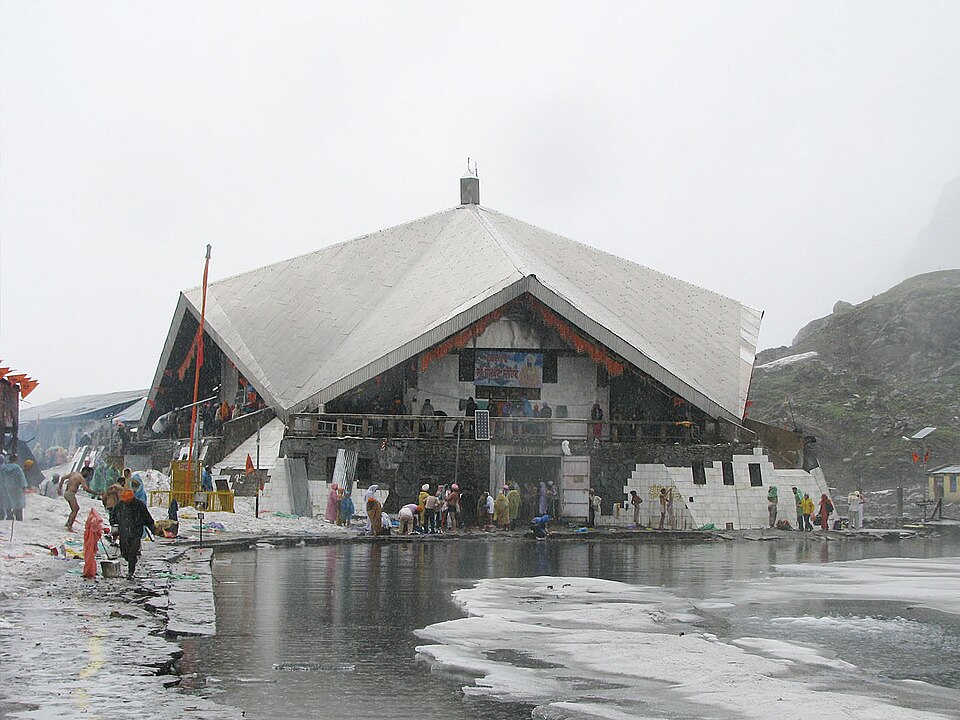
Gurdwara Hemkund Sahib is a prominent Sikh pilgrimage site located in the Chamoli district of Uttarakhand, India. Devoted to Guru Gobind Singh, the tenth Sikh Guru, it is situated at an altitude of 4,572 meters amidst the Garhwal Himalayas, surrounded by seven snow-capped peaks and a glacial lake. The gurdwara is a significant religious destination, attracting approximately 150,000 pilgrims annually.
Key Facts
- ›Located in the Garhwal Himalaya at an elevation of 4,572 meters (15,000 feet).
- ›Dedicated to Guru Gobind Singh, the tenth Sikh Guru, and mentioned in the Dasam Granth.
- ›Inaccessible from October to April due to snow; pilgrims repair paths in may as an act of 'kar seva'.
- ›The trek from Govindghat to the gurdwara is approximately 13 kilometers, with a final 6-kilometer climb.
- ›The present gurdwara's design and construction began in the MID-1960s under Major General Harkirat Singh.
- ›Pilgrims often visit the nearby Valley of Flowers National Park.
Guru Gobind Singh
- Sikh Pilgrimage Site
- Devoted To Guru Gobind Singh
- Significant Natural Beauty With Glacial Lake and Mountain Peaks
Guru Gobind Singh
Hemkund
About Gurudwara Shri Hemkund Sahib
Gurdwara Hemkund Sahib
Gurdwara Hemkund Sahib is a significant Sikh place of worship and a highly revered pilgrimage destination situated in the Chamoli district of Uttarakhand, India. Nestled in the Garhwal Himalayas at an elevation of approximately 4,572 meters (15,000 feet), it is set against a dramatic backdrop of a glacial lake encircled by seven majestic mountain peaks. Each peak is marked with a Nishan Sahib, the Sikh flag.
Religious Significance
The gurdwara is primarily devoted to Guru Gobind Singh, the tenth Sikh Guru, and its existence is recounted in the sacred text, the Dasam Granth. According to tradition, Guru Gobind Singh meditated intensely at this site in a previous incarnation. The name Hemkund itself is derived from Sanskrit words meaning 'Snow' and 'bowl', aptly describing its pristine, snow-laden environment.
Access and Pilgrimage
Hemkund Sahib is typically inaccessible from October through April due to heavy snowfall, with paths becoming snowbound. Sikh pilgrims undertake the journey during the warmer months, often participating in 'kar seva'—selfless service—to repair the paths damaged during the winter. The primary access point for the arduous trek is Govindghat, located on the Rishikesh-Badrinath highway. From Govindghat, pilgrims embark on a 13-kilometer trek to Ghangaria, followed by a challenging 6-kilometer ascent to the gurdwara. While a portion of the initial trek can be covered by taxi, the final stages require walking or pony rides.
Construction and Modern Development
The present structure of the gurdwara began its design and construction phase in the mid-1960s, spearheaded by Major General Harkirat Singh. Architect Manmohan Singh Siali of the Military Engineering Services led the complex construction efforts, overcoming significant logistical, altitude, and weather-related challenges. The architectural and engineering aspects of the gurdwara are recognized for their durability and resilience over the decades.
Nearby Attractions
Pilgrims often extend their journey to include a visit to the nearby Valley of Flowers National Park, a UNESCO World Heritage Site, which is approximately 3 kilometers from Ghangaria. This valley, known for its vibrant alpine flora, is a popular secondary destination for those visiting Hemkund Sahib.
Source: Wikipedia ↗
Frequently Asked Questions
What is the meaning of Hemkund?
Hemkund is a Sanskrit name derived from 'Hem' meaning 'Snow' and 'Kund' meaning 'bowl'. The name reflects its setting as a glacial lake surrounded by snowy peaks.
When is the best time to visit Hemkund Sahib?
Hemkund Sahib is accessible from May to October. It is inaccessible from October through April due to heavy snowfall. Pilgrims often arrive in May to undertake 'kar seva' to repair paths damaged by winter.
What is the trek to Hemkund Sahib like?
The trek from Govindghat to Ghangaria is about 13 kilometers, with a portion of this distance accessible by shared taxi. The remaining trek to Hemkund Sahib involves a 6-kilometer climb on a stone-paved path. Overnight stays are not permitted at Hemkund Sahib.
What are the travel options to reach Hemkund Sahib?
Travelers can take a train to Haridwar and then a bus to Govindghat, or drive directly to Govindghat. Recently, a helicopter service between Govindghat and Ghangaria has also been introduced.
What are the health considerations for pilgrims visiting Hemkund Sahib?
Due to the high altitude, a significant number of pilgrims experience Acute Mountain Sickness (AMS). Factors contributing to this include the difficult nature of the trek, limited water consumption, and a lack of awareness regarding altitude sickness.
Who was responsible for the design and construction of the present Gurudwara?
The design and construction of the present gurdwara were initiated in the mid-1960s. Major General Harkirat Singh led the project, selecting Architect Manmohan Singh Siali to head the design and construction efforts.
Related Temples (Hindu)

EME Temple
The Dakshinamoorthy and Navgraha EME Temple in Vadodara, Gujarat, is a unique Hindu temple dedicated to Lord Shiva, built in 1966 by the Indian Army's EME School. Its distinctive geodesic dome design, inspired by Buckminster Fuller, incorporates architectural elements from major world religions, symbolizing secularism.

Swaminarayan Akshardham (Gandhinagar)
Swaminarayan Akshardham in Gandhinagar, Gujarat, India, is a vast Hindu temple complex dedicated to Swaminarayan and his teachings, inspired by prominent spiritual successors of the Swaminarayan faith. Completed in 1992, the 23-acre complex features a central mandir crafted from pink sandstone, along with exhibition halls, a water show, and gardens that explore Hindu philosophy and history.

Maa Dewri Temple
Maa Dewri Temple is an ancient Hindu temple located in Diuri village, near Ranchi, Jharkhand, India. It is primarily dedicated to Maa Dewri Devi, a tribal deity, and is renowned for its 700-year-old idol of the 16-armed goddess. The temple is constructed using interlocking stones without any binding material and holds significant religious and cultural importance for local tribal communities.