
Anjaneya Temple, Nanganallur
The Anjaneya Temple in Nanganallur, Chennai, is a Hindu temple dedicated to Lord Hanuman, featuring a colossal 32-foot idol sculpted from a single piece of granite. Consecrated in 1995, the temple complex also houses shrines for Lord Rama, Lord Krishna, and Saint Raghavendra, among others. Its administration was taken over by the Hindu Religious and Charity Endowment Department in 2013 due to financial irregularities.
Key Facts
- ›The temple is dedicated to Lord Hanuman, with a principal idol measuring 32 feet in height.
- ›The main Hanuman idol is carved from a single block of granite.
- ›The idol's height makes it the second tallest Hanuman idol after Panchavatee near Puducherry.
- ›The temple was consecrated in 1995, with the idol installed in 1989.
- ›It features auxiliary shrines for Lord Rama (Kodanda Rama), Lord Krishna, and Saint Raghavendra.
- ›Administration of the temple was taken over by the Government of Tamil Nadu's HR&CE Department in 2013.
Hanuman, Rama, Krishna
- Home To One of the Tallest Hanuman Idols In India
- Unique Presence of A Lord Krishna Shrine In A Hanuman Temple
- Administrative Changes Reflect Governmental Oversight of Religious Institutions
Granite
Sri Maruthi Bhaktha Samajam Trust, Sri Chandrashekarendra Saraswati
32-Feet Hanuman Idol
About Anjaneya Temple, Nanganallur
The Anjaneya Temple located in Nanganallur, Chennai, is a prominent Hindu temple dedicated to Lord Hanuman, also known as Anjaneya. The temple is most renowned for its colossal 32-foot tall idol of Hanuman, which is a significant attraction for devotees and visitors alike. This principal idol is unique in that it was sculpted from a single piece of granite, making it the second tallest Hanuman idol in India, surpassed only by the one at Panchavatee near Puducherry.
History and Consecration
The installation of the Hanuman idol took place in 1989, with the temple's consecration ceremony, known as Kumbabishekam, held in 1995. The establishment of this temple was an initiative of the Sri Maruthi Bhaktha Samajam Trust, an organization comprising individuals with strong spiritual convictions. The esteemed Sri Chandrashekarendra Saraswati Swamigal of Kanchi Mutt played a role in the idol's installation in 1989 and the subsequent consecration.
Temple Structure and Deities
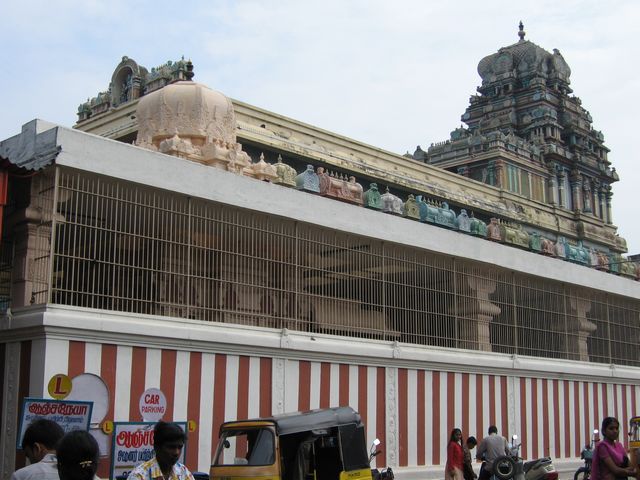
The main shrine features the 90-foot tall temple tower housing the Anjaneya idol, which faces west, aligning with the main entrance. An auxiliary entrance on the southern side is utilized during temple festivals. The temple building provides pathways around the sanctum sanctorum and a spacious covered area (mandapa) for devotees to gather and offer worship.
Beyond the primary deity, the temple complex is home to several other significant shrines. In the northwest corner, a full shrine is dedicated to Lord Rama, Sita, and Lakshmana, with Hanuman in attendance, collectively known as Kodanda Rama. To the southwest, a shrine for Lord Krishna, accompanied by Rukmini and Satyabhama, faces east. The inclusion of a Krishna shrine is notable, as it serves to remind devotees of Hanuman's presence in both the Ramayana and the Mahabharata. In the northeast, a small platform houses a Vinayaka idol, and nearby, a 'Naga' (serpent deity) is installed. Saint Raghavendra also has a shrine within the temple, facing Lord Krishna.
Administration and Governance
For many years following its consecration, the Anjaneya Temple was managed by the private Sri Maruthi Bhaktha Samajam Trust. However, in July 2013, the Hindu Religious and Charity Endowment Department of the Government of Tamil Nadu assumed administrative control. This action followed widespread allegations of financial irregularities within the trust's management, leading to government inquiries and petitions. The trust, formerly accused of financial improprieties, reportedly criticized the government's decision to take over the temple's administration.
Source: Wikipedia ↗
Frequently Asked Questions
What is the significance of the main idol at Anjaneya Temple, Nanganallur?
The main idol of Lord Hanuman is 32 feet tall and is notably sculpted from a single piece of granite. This makes it the second tallest Hanuman idol in India, after the one in Panchavatee near Puducherry.
When was the Anjaneya Temple in Nanganallur established?
The idol of Hanuman was installed in 1989, and the temple was consecrated in 1995. The consecration ceremony, known as Kumbabishekam, was performed in 1995.
What other deities are worshipped at this temple?
Besides the main shrine for Hanuman, the temple complex includes a shrine for Lord Rama, Sita, and Lakshmana, referred to as Kodanda Rama. There is also a shrine for Lord Krishna with Rukmini and Satyabhama, and a shrine for Saint Raghavendra.
Why is there a shrine to Lord Krishna in a Hanuman temple?
The presence of a Lord Krishna shrine is unusual for a Hanuman temple but is intended to remind devotees that Hanuman was present in both the Ramayana and the Mahabharata. He was a direct disciple of Rama and appeared on Arjuna's chariot flag in the Mahabharata.
What is the current administrative status of the temple?
The temple was initially managed by the Sri Maruthi Bhaktha Samajam Trust. However, due to allegations of financial irregularities, the Hindu Religious and Charity Endowment Department took over the administration in July 2013.
Related Temples (Hindu)

EME Temple
The Dakshinamoorthy and Navgraha EME Temple in Vadodara, Gujarat, is a unique Hindu temple dedicated to Lord Shiva, built in 1966 by the Indian Army's EME School. Its distinctive geodesic dome design, inspired by Buckminster Fuller, incorporates architectural elements from major world religions, symbolizing secularism.

Swaminarayan Akshardham (Gandhinagar)
Swaminarayan Akshardham in Gandhinagar, Gujarat, India, is a vast Hindu temple complex dedicated to Swaminarayan and his teachings, inspired by prominent spiritual successors of the Swaminarayan faith. Completed in 1992, the 23-acre complex features a central mandir crafted from pink sandstone, along with exhibition halls, a water show, and gardens that explore Hindu philosophy and history.

Maa Dewri Temple
Maa Dewri Temple is an ancient Hindu temple located in Diuri village, near Ranchi, Jharkhand, India. It is primarily dedicated to Maa Dewri Devi, a tribal deity, and is renowned for its 700-year-old idol of the 16-armed goddess. The temple is constructed using interlocking stones without any binding material and holds significant religious and cultural importance for local tribal communities.