
Sulayman Mountain
Kyrgyzstan·Asia
Sulayman Mountain, also known as Sulaiman-Too, is a UNESCO World Heritage Site located in Osh, Kyrgyzstan, and is considered a significant pre-Muslim pilgrimage site. It is believed by some to be the "Stone Tower" mentioned by Claudius Ptolemy, marking a crucial point on the ancient Silk Road. The mountain holds deep religious and cultural importance, particularly for Muslims, who believe it marks the grave of the prophet Sulayman (Solomon).
Key Facts
- ›Considered by some researchers to be the "Stone Tower" landmark from antiquity described by Claudius Ptolemy.
- ›A significant pre-Muslim pilgrimage site that has been worshipped for millennia.
- ›Contains a shrine believed to mark the grave of the prophet Sulayman (Solomon).
- ›Women crawling through an opening in a holy rock at the shrine are believed to be blessed with healthy children.
- ›Features numerous prayer flags tied to trees and bushes, a common practice in pilgrimage sites.
- ›The site includes a small mosque originally built in 1510 by Babur, with a reconstructed section from the late 20th century.

Sulaiman-Too, Sulayman Rock
Islam, Pre-Muslim Pilgrimage Traditions
- Believed To Be the "Stone Tower" Marking the Midpoint of the Ancient Silk Road.
- A Significant Site For Pilgrimage Across Millennia.
- Associated With the Prophet Sulayman and Believed To Be His Burial Site.
- Represents A Complete Example of A Sacred Mountain Worshipped Over Several Millennia In Central Asia.
- Ascending To the Shrine On the Highest Peak.
- Crawling Through An Opening In the Holy Rock .
- Tying Prayer Flags To Trees and Bushes.
Sulayman, Babur, Claudius Ptolemy
About Sulayman Mountain
Sulayman Mountain, known locally as Sulaiman-Too, is a profoundly significant sacred mountain situated entirely within Kyrgyzstan, holding the distinction of being the country's sole UNESCO World Heritage Site. Located in the city of Osh, this mountain has served as a major place of pilgrimage for many millennia, predating Islam and continuing to be a revered site for local Muslims today. Its cultural and spiritual importance is so profound that it is considered "the most complete example of a sacred mountain anywhere in Central Asia, worshipped over several millennia."
Historically, Sulayman Mountain is thought by some scholars to be the legendary "Stone Tower" mentioned by the ancient geographer Claudius Ptolemy in his work "Geography." This landmark was reputed to mark the precise midpoint of the ancient Silk Road, the vital overland trade route connecting Europe and Asia. This association underscores the mountain's historical role not just as a spiritual center but also as a geographical marker of immense trade and cultural exchange.
The mountain's name is derived from Sulayman, the Arabic name for the prophet Solomon, who is revered in the Qur'an. A shrine on the summit is traditionally believed to mark his grave. Among the many legends associated with the site, one notable belief is that women who ascend to the shrine and pass through a specific opening in the holy rock will be blessed with healthy children. This tradition contributes to the mountain's ongoing role as a pilgrimage destination. The landscape of Sulayman Mountain is adorned with numerous prayer flags, small pieces of cloth tied to trees and bushes, a common practice in many sacred sites across Asia.
The spiritual significance of Sulayman Mountain is complemented by its historical and archaeological heritage. Stairs lead to the highest peak, where a small mosque, originally constructed in 1510 by the Mughal emperor Babur, still stands, with much of it having been reconstructed in the late 20th century. Beneath the mountain's slopes lies a cemetery, and the site also encompasses the National Historical and Archaeological Museum Complex Sulayman. This museum, established during the Soviet era, showcases archaeological findings from the region, further illuminating the mountain's long and multifaceted history.
Source: Wikipedia ↗
Frequently Asked Questions
What is Sulayman Mountain's significance?
Sulayman Mountain is significant as a UNESCO World Heritage Site and a place of worship for millennia, particularly noted as a pre-Muslim pilgrimage destination. It is also believed by some to be an ancient landmark on the Silk Road.
What is the legend associated with the Sulayman shrine?
According to legend, women who ascend to the shrine on top of Sulayman Mountain and crawl through an opening in the holy rock will give birth to healthy children. The mountain also contains a shrine believed to be the grave of the prophet Sulayman (Solomon).
Is Sulayman Mountain a UNESCO World Heritage Site?
Yes, Sulayman Mountain is the only UNESCO World Heritage Site located entirely within Kyrgyzstan. It is recognized as a prime example of a sacred mountain worshipped over several millennia in Central Asia.
What historical landmark might Sulayman Mountain represent?
Some researchers and historians believe Sulayman Mountain is the "Stone Tower" mentioned by Claudius Ptolemy in his treatise Geography. This landmark was considered the midpoint on the ancient Silk Road.
What facilities are present on Sulayman Mountain?
The mountain features stairs leading to its highest peak, where a small mosque, originally built in 1510 by Babur, stands. Additionally, the National Historical and Archaeological Museum Complex Sulayman, built during the Soviet era, is located at the site.
Related Sacred Mountains

Mount Carmel
Mount Carmel is a coastal mountain range in northern Israel, significant for its rich history as a site of human evolution, ancient civilizations, and diverse religious traditions. Its name, likely meaning "garden-land" or "vineyard of God," reflects its lush vegetation and spiritual importance across Canaanite, Israelite, Christian, Baháʼí, and Druze faiths. The mountain is renowned for its caves, ancient altars, and association with the prophet Elijah, making it a focal point for pilgrimage and historical study.

Temple Mount
The Temple Mount, known by various names including Har habayit and al-Haram al-Sharif, is a hill in Jerusalem's Old City that has been venerated as a holy site for thousands of years across Judaism, Christianity, and Islam. It was the location of the two successive Temples in Jerusalem and now hosts the Islamic al-Aqsa compound, featuring the al-Aqsa Mosque and the Dome of the Rock. Its historical and religious significance makes it a central focus for pilgrimage and a point of contention in ongoing conflicts.
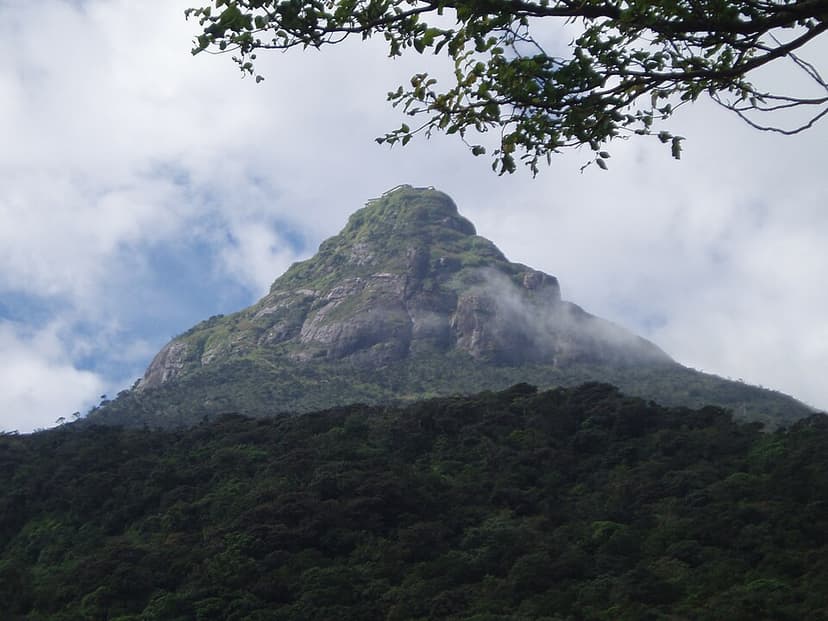
Adam's Peak
Adam's Peak, also known as Sri Pada, is a 2,243-meter-tall conical mountain in central Sri Lanka famed for a sacred footprint-shaped rock formation near its summit. This "sacred footprint" is revered by Buddhists as the Buddha's, by Hindus as Shiva's or Hanuman's, and by some Islamic and Christian traditions as Adam's or St. Thomas the Apostle's, making it a significant pilgrimage site for multiple faiths.