
Mount Sinjar
Iraq·Asia
The Sinjar Mountains, a significant mountain range in northwestern Iraq, are revered as sacred by the local Yazidi population. Historically serving as a natural frontier and a refuge, the mountains hold deep spiritual importance for the Yazidis, who consider the highest peak the resting place of Noah's Ark. The range has a complex geological structure and a long history of human habitation and conflict.
Key Facts
- ›The Sinjar Mountains are a 100-kilometer-long mountain range located in northwestern Iraq, extending into Syria.
- ›They are considered sacred by the Yazidi people, who view the highest point as where Noah's Ark landed.
- ›The mountains are a breached anticlinal structure composed of sedimentary strata dating from the Late Cretaceous to the Early Neogene.
- ›Historically, the range served as a border between empires, including the Assyrians, Hittites, Parthians, Romans, and Sasanians.
- ›The Yazidis have historically used the mountains as a place of refuge during periods of persecution.
- ›Sinjarite, a rare hygroscopic mineral, was discovered in the vicinity of the mountains.

çîYayê şEngalê, Jabal SinjāR, ṭUra D'Shingar, Saggar
Yazidism
- Regarded As Sacred By Yazidis
- Believed To Be Where Noah's Ark Settled
- Historical Refuge For Yazidis During Persecution
- Anciently Known As Saggar, Associated With A Deity
- Source of Basalt and Pistachios In Antiquity
Noah
About Mount Sinjar
The Sinjar Mountains are a significant mountain range located in northwestern Iraq, extending into Syria. This range, approximately 100 kilometers long, rises above the surrounding alluvial steppe plains and is particularly revered as sacred by the local Yazidi population. The highest segment of the mountains lies within Iraq's Nineveh Governorate, while a western and lower segment extends into Syria.
Geology and Natural Resources
Geologically, the Sinjar Mountains are a breached anticlinal structure, known as the 'Sinjar Anticline.' This formation exposes sedimentary strata dating from the Late Cretaceous to the Early Neogene periods. The mountains are a vital groundwater recharge area, providing good quality water, and are surrounded by exposures of Middle and Late Miocene sedimentary strata. Notably, the mineral sinjarite, a hygroscopic calcium chloride, was discovered in the vicinity of the mountains.
Historical Significance and Cultural Importance
The Sinjar Mountains have a long and complex history, appearing in records from the second and third millennium BCE under the name Saggar, which was also associated with a deity. Throughout history, the range has served as a border frontier for various empires, including the Assyrians, Hittites, Parthians, Romans, Byzantines, and Sasanians. Persian influence led to the introduction of Zoroastrianism, and Christian influences later became established.
For the Yazidi people, the Sinjar Mountains hold profound spiritual significance. They consider the highest peak to be the sacred place where Noah's Ark settled after the biblical flood. The mountains have historically served as a crucial place of refuge and escape for the Yazidis during periods of persecution. Despite periods of conflict and attempts at displacement, the Yazidi connection to the mountains remains a central aspect of their cultural identity.
Modern Era and Conflict
In the modern era, the Sinjar Mountains have been the site of significant political and social challenges. Following World War I, the area became part of the British Mandate of Iraq. Later, under the government of Saddam Hussein, many Yazidi villages were destroyed as part of a modernization drive aimed at preventing Yazidis from joining Kurdish nationalist movements, leading to forced resettlement. More recently, in August 2014, the mountains became a refuge for tens of thousands of Yazidis fleeing attacks by the Islamic State (IS). The Yazidi refugees faced severe humanitarian crises, with international forces providing aid. Kurdish forces later opened a corridor to allow some to escape, but the region suffered greatly from the IS conflict.
Source: Wikipedia ↗
Frequently Asked Questions
What is the geological formation of the Sinjar Mountains?
The Sinjar Mountains are characterized by a breached anticlinal structure, known as the 'Sinjar Anticline'. This formation features an asymmetrical, doubly plunging anticline with a steep northern limb and a gentle southern limb, revealing sedimentary strata from the Late Cretaceous to the Early Neogene periods.
What is the historical significance of the Sinjar Mountains?
The mountains have historically served as a border frontier for various empires, witnessing conflicts between the Assyrians and Hittites, and later occupied by the Parthians and Romans. They also marked the frontier between the Byzantine and Sasanian empires, leading to the introduction of Zoroastrianism, and later saw Christian and Arab Muslim influences.
Why are the Sinjar Mountains considered sacred?
The Sinjar Mountains are regarded as sacred by the local Yazidi population. They believe the highest peak of the mountains is the location where Noah's Ark settled after the biblical flood, and the mountains have historically served as a sanctuary for the Yazidis.
What role have the Sinjar Mountains played in recent conflicts?
In August 2014, the mountains became a refuge for thousands of Yazidis fleeing attacks by the Islamic State (IS). The refugees faced dire conditions, with some rescued by Kurdish forces, while others suffered violence and enslavement as part of IS's campaign.
Are there any unique geological discoveries associated with the Sinjar Mountains?
Yes, the mineral sinjarite, a hygroscopic calcium chloride, was discovered in wadi fill near the Sinjar Mountains. This discovery highlights the unique geological characteristics of the region.
Related Sacred Mountains
Adam's Peak
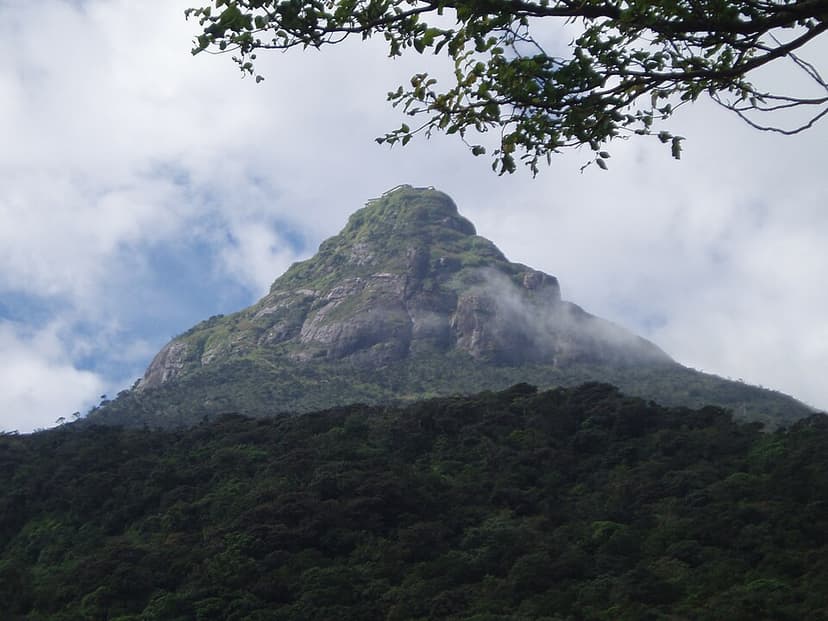
Adam's Peak, also known as Sri Pada, is a 2,243-meter-tall conical mountain in central Sri Lanka famed for a sacred footprint-shaped rock formation near its summit. This "sacred footprint" is revered by Buddhists as the Buddha's, by Hindus as Shiva's or Hanuman's, and by some Islamic and Christian traditions as Adam's or St. Thomas the Apostle's, making it a significant pilgrimage site for multiple faiths.
Arunachala
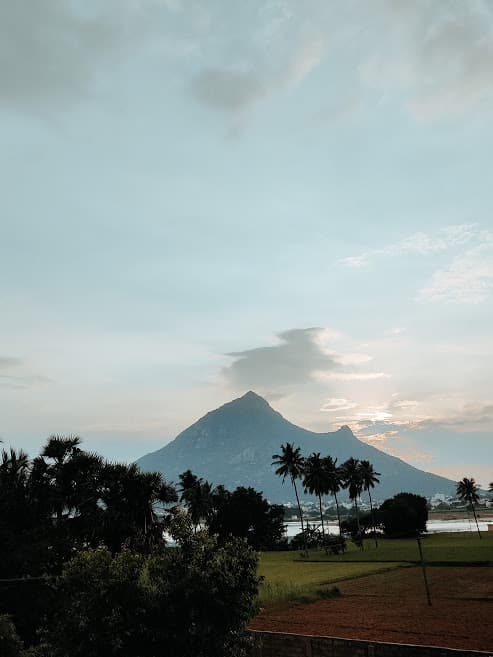
Arunachala is a sacred hill and one of the five main Shaiva holy places in South India, located in Tamil Nadu. It is revered as a manifestation of Lord Shiva and is the site of the Arunachalesvara Temple. The hill holds immense spiritual significance, particularly for devotees of Ramana Maharshi, and is a focal point for annual religious festivals and pilgrimage.

Ba Vì mountain range
The Ba Vì mountain range, also known as Tản Viên Sơn, is a significant soil-limestone mountain range in northern Vietnam, revered in Vietnamese folk religion as "the lord of mountains". While not the highest in the country, its most famous peak, Tản Viên Peak, is central to the mythology of the mountain god Tản Viên Sơn Thánh. The range is also a protected area, Ba Vì National Park, known for its primary forests and biodiversity.