
Abd Allah ibn al-Abbas Mosque
Taif·Saudi Arabia·7th century·The mosque was described as being in ruin in 1813, but has since undergone repairs and significant rebuilding.
The Abd Allah ibn al-Abbas Mosque is a historic mosque situated in Taif, western Saudi Arabia. Originally constructed in 630 C.E., it holds significance as being named after and containing the tomb of Ibn Abbas, a cousin of the Islamic prophet Muhammad and an early Islamic scholar. The mosque has undergone numerous reconstructions and renovations throughout various historical periods, reflecting its enduring importance.
Key Facts
- ›Original construction dates to approximately 630 C.E.
- ›Named after and contains the tomb of Abd Allah ibn al-Abbas, a prominent early Islamic scholar.
- ›Located on the site of a former shrine to the goddess Al-Lat.
- ›Has undergone significant rebuilding and renovation during the Abbasid, Mamluk, and Ottoman periods.
- ›The mosque and its mausoleum were rebuilt in 1958 after being demolished.

Tomb of Abd Allah Ibn Al-Abbas, Adjoining Cemetery
Religious, Historical, Cultural
About Abd Allah ibn al-Abbas Mosque
The Abd Allah ibn al-Abbas Mosque is a significant historical religious site located in the city of Taif, within the Mecca Province of western Saudi Arabia.
History and Construction
Its origins date back to approximately 630 C.E., a period contemporary with the life of the Islamic prophet Muhammad. The mosque was erected on a site previously occupied by a demolished temple, the shrine of the goddess Al-Lat, and is also traditionally believed to be built over a place where Muhammad himself prayed. In the same year of its construction, a cemetery for martyrs from the siege of Banu Thaqif was established on its eastern side.
The mosque is named in honor of Abd Allah ibn al-Abbas, a prominent early Islamic scholar and the youngest cousin of Muhammad. He was interred in the mosque's cemetery in 687 C.E., followed by the burial of Muhammad ibn al-Hanafiyya in 700 C.E.
Architectural Evolution and Renovations
Throughout its history, the mosque has undergone substantial transformations. During the Abbasid period, under Caliph Al-Mustadi, the mosque was rebuilt and formally named after Ibn Abbas, with a domed mausoleum constructed over his grave. Subsequent renovations during the Mamluk period saw the adjoining cemetery in use until 1661, when further burials were prohibited. A wall was erected in 1671 to separate the cemetery and Ibn Abbas's tomb from the main mosque building.
By 1813, the Swiss traveler Johann Ludwig Burckhardt noted the mosque was in a state of ruin, with the mausoleum over Ibn Abbas's tomb having been destroyed. Later repairs during the Ottoman era included a new wooden cenotaph and an iron zarih around the grave. Following the consolidation of Saudi Arabia, and in line with the demolition of mausoleums in Mecca and Medina, the mosque and its mausoleum were demolished and rebuilt in 1958. The reconstruction returned the grave to its original state, without a dome.
Contemporary Status
Despite its tumultuous history of destruction and reconstruction, the Abd Allah ibn al-Abbas Mosque remains an active place of worship and a vital historical monument in Taif.
Source: Wikipedia ↗
Frequently Asked Questions
When was the Abd Allah ibn al-Abbas Mosque originally built?
The original mosque was constructed in 630 C.E. It is dated to be contemporary with the life of the Islamic prophet Muhammad.
Who is buried at the Abd Allah ibn al-Abbas Mosque?
The mosque is named after and contains the tomb of Abd Allah ibn al-Abbas, a cousin of Muhammad and an early Islamic scholar. He was buried in the adjoining cemetery in 687 C.E.
What was the site of the mosque before its construction?
Before the mosque's construction, the site was occupied by a demolished temple that served as a Kaaba-type shrine to the goddess Al-Lat. Another tradition suggests the site was where Prophet Muhammad prayed.
What major historical periods influenced the mosque's development?
The mosque's history is marked by reconstructions and renovations during the Abbasid, Mamluk, and Ottoman periods. It was most recently rebuilt in 1958.
What happened to the mausoleum over Ibn Abbas's tomb?
The original domed mausoleum was destroyed by the Wahhabis. It was later repaired with a wooden cenotaph and an iron zarih, but after a later demolition, the grave was returned to its original state without a dome.
Related Mosques
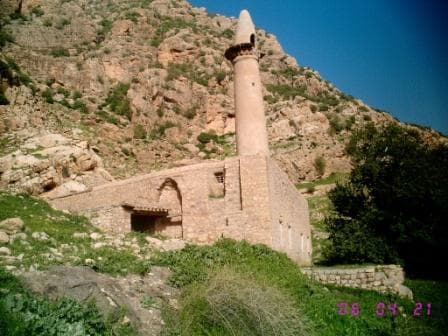
Abdullah ibn Umar Mosque
The Abdullah ibn Umar Mosque is a Sunni mosque located in Dalahu County, near Rijab, in the province of Kermanshah, Iran. Constructed in the 7th century during the Rashidun Caliphate era, it is recognized for its historical significance. The mosque was added to the Iran National Heritage List in 2006, highlighting its importance as a cultural and historical site.

Abu Bakr Mosque
The Abu Bakr Mosque is one of the oldest mosques located in Medina, Saudi Arabia, situated to the southwest of Al-Masjid an-Nabawi. It is traditionally believed to be the site where Prophet Muhammad performed Eid prayers, a practice continued by Abu Bakr, the first Caliph, after Muhammad's death. The mosque is named in his honor and is characterized by its simple, square floorplan, a single minaret, and a dome.

Abdulaziz Abdullah Sharbatly Mosque
The Abdulaziz Abdullah Sharbatly Mosque, located in Jeddah, Saudi Arabia, is a significant landmark as the world's first mosque constructed using 3D printing technology. Inaugurated in March 2024, it showcases Hejazi architectural styles and was commissioned by the widow of businessman Abdulaziz Abdullah Sharbatly, after whom it is named.