
Schnals
Schnals is a municipality located in the autonomous province of South Tyrol in northern Italy, bordering Austria. Its territory encompasses a significant portion of the Schnalstal valley. The area is characterized by its mountainous geography and a predominantly German-speaking population, with a history that includes the presence of the Carthusian Abbey of Allerengelberg.
Key Facts
- ›Located in the autonomous province of South Tyrol, northern Italy.
- ›Borders Austria, situated northwest of Bolzano.
- ›Covers a large part of the Schnalstal valley.
- ›Includes the subdivisions of Karthaus, Katharinaberg, Unser Frau, and Vernagt.
- ›Its coat-of-arms represents the patron saint of the Carthusian Abbey of Allerengelberg.
- ›As of 2010, it had a population of 1,345 and an area of 211.2 square kilometers.

Schnalstal Valley, Vernagt-Stausee Lake
Senales
Lords of Schandersberg
About Schnals
Schnals, also known by its Italian name Senales, is a municipality situated in the autonomous province of South Tyrol in northern Italy. It lies approximately 40 kilometers northwest of Bolzano and shares a border with Austria. The municipality's territory encompasses a significant portion of the Schnalstal valley, a region characterized by its mountainous landscape.
Geography and Demographics
As of November 30, 2010, Schnals had a population of 1,345 inhabitants and covered an area of 211.2 square kilometers. The municipality includes several subdivisions, mainly villages and hamlets, such as Karthaus (Certosa), Katharinaberg (Monte Santa Caterina), Unser Frau (Madonna), and Vernagt, which is adjacent to the Vernagt-Stausee lake. The linguistic distribution shows a strong prevalence of German speakers, with 97.89% of the population identifying German as their first language, while 2.11% speak Italian.
Historical Associations
The coat-of-arms of Schnals provides insight into its historical connections. The shield is divided, with one part representing Saint Gabriel holding a sword and scales, standing on a dragon, which signifies the patron saint of the Carthusian Abbey of Allerengelberg. The second part of the shield displays elements associated with the arms of the Lords of Schandersberg. This emblem was officially adopted in 1967, reflecting historical influences on the region.
Source: Wikipedia ↗
Frequently Asked Questions
Where is Schnals located?
Schnals is a municipality situated in the autonomous province of South Tyrol in northern Italy. It is located about 40 kilometers northwest of the city of Bolzano and shares a border with Austria.
What is the linguistic makeup of Schnals?
According to a 2024 census, the vast majority of Schnals' population speaks German as their first language, accounting for 97.89%. A smaller percentage, 2.11%, speaks Italian as their first language.
What are the main subdivisions within the municipality of Schnals?
The municipality of Schnals is divided into several subdivisions, primarily villages and hamlets. These include Karthaus (Certosa), Katharinaberg (Monte Santa Caterina), Unser Frau (Madonna), and Vernagt, which is near the Vernagt-Stausee lake.
What does the coat-of-arms of Schnals represent?
The coat-of-arms of Schnals features elements that represent the patron saint of the Carthusian Abbey of Allerengelberg and the arms of the Lords of Schandersberg. The emblem was officially adopted in 1967.
Related Monasteries

Busca
Busca is a municipality located in the Province of Cuneo, within the Piedmont region of Italy. It is situated southwest of Turin and northwest of Cuneo. A notable historical event for Busca was a cholera outbreak in the summer of 1884, and more recently, it merged with the neighboring comune of Valmala in 2019 following a referendum. The town is also recognized as the home of Castle Roccolo.

Amay
Amay is a municipality in the province of Liège, Belgium, situated on the Meuse River. Its origins trace back to a Gallo-Roman vicus, and it later developed around a medieval ford. The area is known for its historical sites, including the 16th-century Castle of Jehay-Bodegnée, and has been home to notable figures like mathematician François Walther de Sluze and inventor Zénobe Gramme.
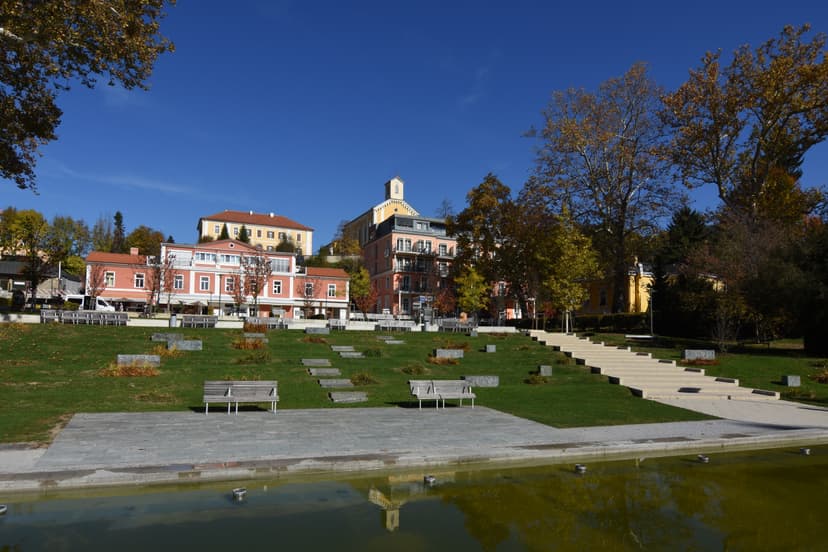
Bad Gleichenberg
Bad Gleichenberg is a municipality located in the Südoststeiermark district of the Austrian state of Styria. Its primary significance lies in its administrative and geographical context within the region. The municipality is noted for its location in the southeast of Styria.