
Le Canigou Abbey
The Abbey of Saint-Martin-du-Canigou, also known as Sant Martí del Canigó, is a historic Benedictine monastery situated in the Pyrenees of Northern Catalonia, France. Founded in 1009 by Guifred II, Count of Cerdanya, as an act of atonement, it served as a significant religious center for centuries. Despite suffering damage from an earthquake and undergoing secularization and abandonment, the abbey was extensively restored in the early 20th century and is now home to the Catholic Community of the Beatitudes.
Key Facts
- ›Founded in 1009 by Guifred II, Count of Cerdanya, in atonement for the murder of his son.
- ›Originally a Benedictine monastery, it was secularized in 1782 and abandoned by monks in the late 18th century.
- ›The abbey features two churches in the First Romanesque style: a lower church dedicated to St. Mary and an upper church dedicated to St. Martin.
- ›Suffered significant damage during the Catalan earthquake of 1428.
- ›Underwent radical restoration from 1902 to 1932.
- ›Currently occupied by the Catholic Community of the Beatitudes.
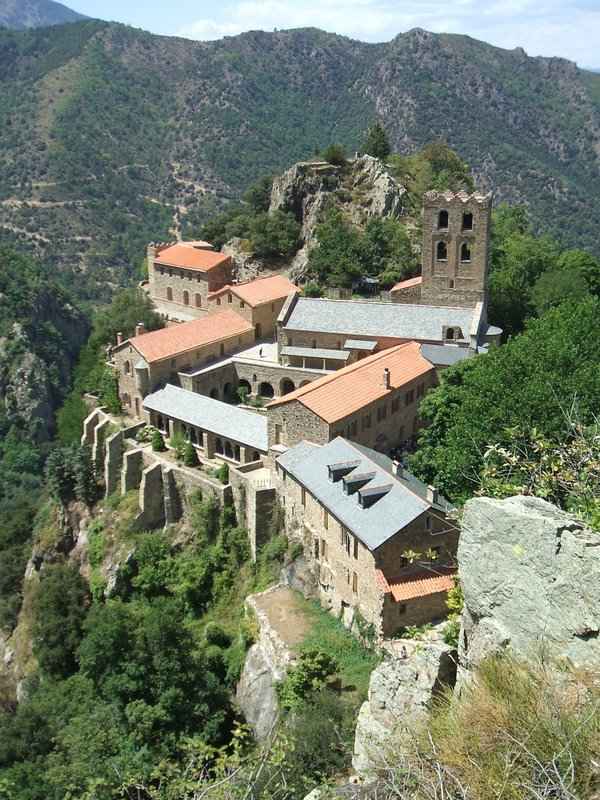
Romanesque
Two Churches In First Romanesque Style, Lower Church Dedicated To St. Mary, Upper Church Dedicated To St. Martin, Restored Cloister Galleries
Sant Martí Del Canigó
Guifred Ii, Count of Cerdanya, LéOpold Delisle
- Catalan Earthquake of 1428
- Secularization In 1782
- Abandonment By Monks In 1783-1785
- Closure and Scattering of Contents During the Reign of Terror
- Restoration From 1902 To 1932
About Le Canigou Abbey
The Abbey of Saint-Martin-du-Canigou, or Sant Martí del Canigó in Catalan, stands as a significant monastic site nestled within the Pyrenees mountains of Northern Catalonia, now part of southern France. Its construction began in 1005 and concluded in 1009, initiated by Guifred II, Count of Cerdanya. This endeavor was undertaken as an act of atonement for the murder of his son, and the abbey was subsequently populated by Benedictine monks.
History and Significance
The abbey played a notable role in medieval religious and cultural life. Guifred II himself became a monk at the monastery he founded and died there in 1050. A significant historical artifact associated with the abbey is a mortuary roll, a parchment soliciting prayers for Guifred II, which traveled to religious houses across Europe in 1051. Scholars have studied this document to understand cultural differences between northern and southern Europe during the period.
The abbey's history is marked by periods of both prosperity and destruction. It suffered damage from the Catalan earthquake in 1428. In 1782, it was secularized by Louis XVI, leading to its abandonment by the monks between 1783 and 1785, after which it fell into disrepair. During the tumultuous Reign of Terror (1793-1794), the abbey was closed, its contents dispersed, and the buildings were repurposed as a stone quarry, with architectural elements looted.
Restoration and Present Day
A pivotal moment in the abbey's modern history occurred with its radical restoration, initiated in 1902 by the bishop of Elne and Perpignan, who was of Catalan descent. This extensive work continued until 1932. Today, the Abbey of Saint-Martin-du-Canigou is occupied by the Catholic Community of the Beatitudes, continuing its legacy as a place of religious devotion and historical significance.
Architectural Features
The abbey complex is characterized by its First Romanesque style. It comprises two main churches: the lower church, dedicated to St. Mary, and the upper church, dedicated to St. Martin. The lower church, with its predominantly black stonework, features vaults that rarely exceed three meters in height and likely dates its eastern section to the 1009 consecration, with further construction in the following decade. The upper church was built concurrently, necessitating structural reinforcements to the lower church's columns. The cloister, though heavily restored and lacking its original character, once possessed two levels, with the upper level's marble capitals having been scattered during the French Revolution.
Source: Wikipedia ↗
Frequently Asked Questions
When was the Abbey of Saint-Martin-du-Canigou founded?
The monastery was founded in 1009 by Guifred II, Count of Cerdanya. He had begun its construction in 1005 as an act of penance.
Who originally inhabited the abbey?
The abbey was initially populated by Benedictine monks. Guifred II himself became a monk there 15 years before his death in 1050.
What significant historical events affected the abbey?
The abbey was damaged in the Catalan earthquake of 1428. It was secularized in 1782 and subsequently abandoned, leading to disrepair. During the Reign of Terror (1793-1794), the abbey was closed, its contents scattered, and the buildings used as a stone quarry.
What is the current status of the abbey?
After extensive restoration in the early 20th century, the abbey is now occupied by the Catholic Community of the Beatitudes. It is a functioning religious community.
What are the main architectural features of the abbey?
The abbey comprises two churches in the First Romanesque style: the lower church dedicated to St. Mary and the upper church dedicated to St. Martin. The buildings showcase Romanesque architectural elements, though some parts, like the gatehouse, were never fully restored after damage.
Related Monasteries

Carthusian
The Carthusians, or Order of Carthusians, are an enclosed contemplative religious order within the Catholic Church, founded by Bruno of Cologne in 1084. Their unique life integrates eremitical (solitary) and cenobitic (communal) monasticism, guided by their own Statutes and a motto emphasizing the steadfastness of the Cross amidst worldly change. The order is known for its distinctive Carthusian Rite and a profound emphasis on silence and solitude, with monks living in individual cells and engaging in manual labor and prayer.
Carthusians
The Carthusians, also known as the Order of Carthusians, are an enclosed religious order of the Catholic Church founded by Bruno of Cologne in 1084. Their life uniquely combines eremitical and cenobitic monasticism, governed by their own Statutes, and they are known for their distinctive Carthusian Rite and the motto "Stat crux dum volvitur orbis". Despite historical persecutions, the order continues to maintain a life of solitude and silence, with 23 charterhouses existing today.

Cistercian
The Cistercians, also known as the Order of Cistercians (OCist), are a Catholic religious order that originated as a reform movement within Benedictinism. Founded in 1098 at Cîteaux Abbey in France, they sought a return to the literal observance of the Rule of Saint Benedict, emphasizing austerity, manual labor, and simplicity. The order rapidly expanded across Europe by the end of the 12th century, significantly contributing to medieval culture and technology, particularly in agriculture and architecture.