
Jurklošter
Roman Catholic·Slovenia·partially extant ruins / historical site·12th century
Jurklošter is a settlement in Slovenia, historically significant as the site of a large Carthusian monastery founded in the 12th century. Although the monastery itself is largely gone, remnants like the parish church dedicated to Saint Maurice, a later mansion, and a defense tower still exist. The settlement's name, Jurklošter, directly translates to 'monastery of Saint George,' reflecting its religious past, and was officially changed from Mišji Dol in 1972.
Key Facts
- ›Site of a large Carthusian monastery founded in the 12th century.
- ›Remaining structures include the parish church of Saint Maurice, a mansion, and a defense tower.
- ›The name Jurklošter means 'monastery of Saint George'.
- ›The settlement was formerly known as MIšji Dol until 1972.
- ›Located in the Municipality of Laško, in eastern Slovenia.
- ›The area was historically part of Styria.

Parish Church of Saint Maurice, Mansion, Defense Tower
MišIdol, Gairach, Mischidol, Geyrowe, De Giurio, Gyriov, Geyrach, MišJi Dol
About Jurklošter
Jurklošter is a settlement situated in the Municipality of Laško in eastern Slovenia, historically significant as the site of a large Carthusian monastery. The area, traditionally part of Styria, is now included in the Savinja Statistical Region. The settlement's name, Jurklošter, directly translates to 'monastery of Saint George,' highlighting its religious heritage, and was officially changed from its former name, Mišji Dol, in 1972.
Historical Context and Remaining Heritage
The foundations of Jurklošter's historical identity lie in the charterhouse, a substantial Carthusian monastery, established in the 12th century. While the monastery complex itself is no longer fully intact, its legacy endures through several remaining structures. These include the parish church, dedicated to Saint Maurice, which belongs to the Roman Catholic Diocese of Celje, a manor house that was built later, and a defensive tower. These remnants offer a glimpse into the scale and importance of the monastic institution that once defined the settlement.
The name evolution of the settlement further underscores its monastic connection. Initially attested around 1145 with names like Geyrowe, later forms such as de Giurio and Gyriov all pointed to a dedication to Saint George. The former name, Mišji Dol, literally translates to 'monks' valley,' reinforcing the prevalence of monastic life in the area, though this name also had a more literal interpretation ('mouse valley') in other contexts. The official change to Jurklošter in 1972 solidified the name referencing its patron saint and monastic tradition.
Source: Wikipedia ↗
Frequently Asked Questions
What is Jurklošter known for historically?
Jurklošter is historically known as the location of a significant Carthusian monastery, which was founded in the 12th century. While the original monastery is no longer intact, its past is marked by remaining structures and its very name, which signifies a monastery dedicated to Saint George.
What remains of the original monastery at Jurklošter?
From the once large charterhouse at Jurklošter, the parish church dedicated to Saint Maurice, a later mansion, and a defense tower are still present. These structures serve as remnants of the monastery's historical presence in the area.
What does the name Jurklošter mean?
The name Jurklošter is derived from Slovenian words. 'Jur-' refers to Saint George, and '-klošter' means monastery. Therefore, Jurklošter literally signifies a monastery dedicated to Saint George.
When was the settlement of Jurklošter named as such?
The settlement was officially renamed from Mišji Dol to Jurklošter in 1972. Prior to this, it was known by names that also alluded to its monastic past.
In which statistical region of Slovenia is Jurklošter located?
Jurklošter is now included in the Savinja Statistical Region. Previously, the broader area was part of the traditional region of Styria.
Related Monasteries

Seiz Charterhouse
Seiz Charterhouse, also known as Žiče Charterhouse, was a significant Carthusian monastery founded between 1155 and 1165, notable as the first Carthusian house within the German sphere of influence and outside of France or Italy. It played a crucial role in the Carthusian order, serving as the seat for the prior general for nearly two decades and housing a substantial library, making it a center of culture and politics. Though dissolved in 1782, its ruins are now a cultural monument of national importance in Slovenia, attracting visitors and hosting events.

Stična Abbey
Stična Abbey is the oldest continuously operating monastery in Slovenia and the country's sole active Cistercian foundation. Established in 1136, it quickly grew into a significant religious, cultural, and economic hub. Despite periods of disruption, including dissolution in the late 18th century and wartime use as a prison, the abbey was resettled and continues its monastic traditions today, also serving as a center for cultural and educational activities.
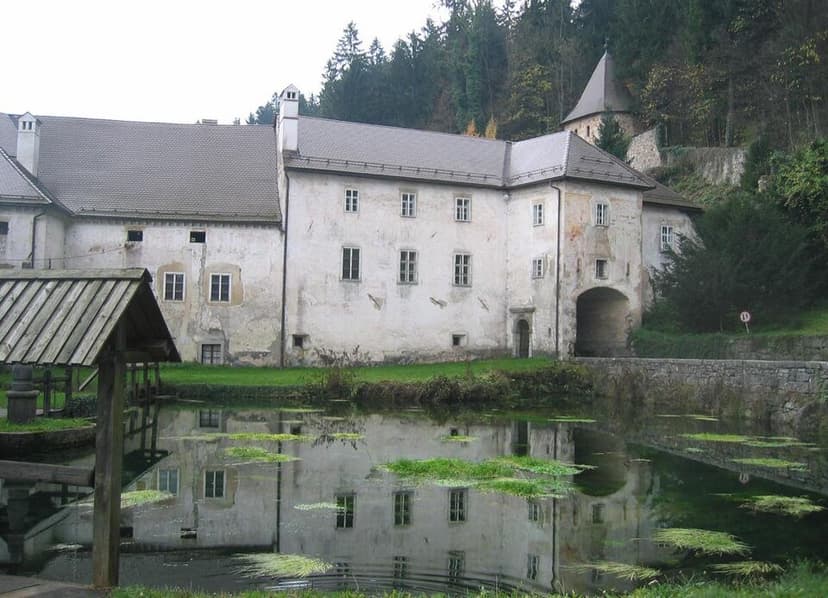
Bistra
Bistra is a settlement in Slovenia, best known for the Bistra Charterhouse, the first monastery in Carniola, founded in 1260. This complex, also referred to as "Bistra Castle," operated as a monastery until its dissolution in 1782. Today, the site houses the Technical Museum of Slovenia, featuring collections related to various technical fields and historical vehicles.