
Erlach Abbey
Christian·Switzerland·adjustment center for young men·11th century
Erlach Abbey, also known as St. Johannsen Abbey, was a Benedictine monastery founded between 1093 and 1103 by Kuno, Count of Fenis and Bishop of Lausanne. Situated on a former island in the river Thielle, it was later secularized in the 16th century and its buildings have since served various purposes, including industrial use and most recently, an adjustment center for young men.
Key Facts
- ›Founded between 1093 and 1103 by Kuno, Count of Fenis and Bishop of Lausanne.
- ›Settled by monks from Saint Blaise Abbey.
- ›The Vogtei of the abbey passed through the hands of the Counts of Fenis, Counts of Neuchâtel-Nidau, and eventually the city of Bern.
- ›Secularized between 1528 and 1529.
- ›The former abbey buildings were used for industrial purposes and later became a prison.
- ›Currently serves as an adjustment center for young men.
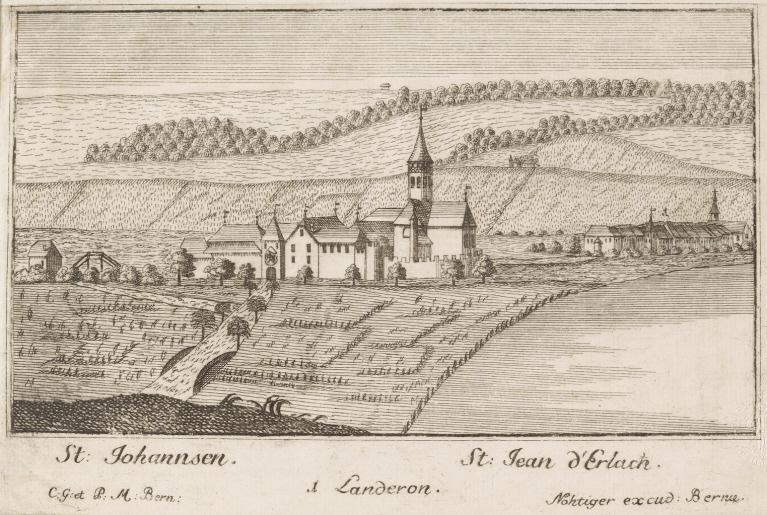
Former Island Location In the River Thielle
St. Johannsen Abbey, Kloster Erlach
Kuno, Count of Fenis, Burchard, Bishop of Basel
- Secularization Between 1528 and 1529
- Demolition of Abbey Church Nave
- Demolition of Choir and Transept In 1961
- Reconstruction of the Choir Between 1970 and 1971
- Acquisition By the Canton of Bern and Conversion To A Prison In 1883
About Erlach Abbey
Erlach Abbey, also known by the name St. Johannsen Abbey (German: Kloster Erlach, Abtei St. Johannsen), was a significant Benedictine monastery situated in Gals, within the Canton of Bern, Switzerland. Its establishment occurred between 1093 and 1103, initiated by Kuno, Count of Fenis, who was also serving as the Bishop of Lausanne. The monastery was strategically founded on land that was then an island in the river Thielle. Following Kuno's passing, the completion of the abbey church was overseen by his brother, Burchard, who held the position of bishop of Basel. The new monastic community was populated by monks from the Saint Blaise Abbey.
Historical Context and Transformation
The administrative rights, known as the Vogtei, initially belonged to the Counts of Fenis. This authority later transferred to the Counts of Neuchâtel-Nidau. By the late 14th century, the Vogtei had come under the control of the city of Bern, which formally acquired the domain of Erlach in 1476. A pivotal moment in the abbey's history was its secularization, which took place between 1528 and 1529. During this period, the nave of the abbey church was demolished. However, the choir and transept were preserved and utilized for grain storage. These remaining structures were eventually demolished in 1961 due to safety concerns, though the choir was subsequently rebuilt between 1970 and 1971.
The other buildings of the former abbey complex endured and were adapted for various industrial uses throughout the 19th century. In 1883, the Canton of Bern repurchased the site and transformed it into a prison. Since 1978, the former monastic grounds have been repurposed as an adjustment center for young men, continuing its long history of change and adaptation.
Source: Wikipedia ↗
Frequently Asked Questions
When was Erlach Abbey founded?
Erlach Abbey was founded between the years 1093 and 1103. It was established by Kuno, Count of Fenis, who also held the position of Bishop of Lausanne.
Who founded Erlach Abbey?
The monastery was founded by Kuno, Count of Fenis, who was also the Bishop of Lausanne. After his death, his brother, Burchard, bishop of Basel, completed the abbey church.
What happened to Erlach Abbey after it was secularized?
Following its secularization between 1528 and 1529, the nave of the abbey church was demolished. The choir and transept were used for grain storage before their demolition in 1961. The remaining buildings were repurposed for industrial uses in the 19th century.
What is the current use of the former Erlach Abbey site?
The Canton of Bern purchased the site in 1883 and converted it into a prison. Since 1978, the buildings have been utilized as an adjustment center for young men.
What religious order was associated with Erlach Abbey?
Erlach Abbey was a Benedictine monastery. It was settled by monks from Saint Blaise Abbey.
Related Monasteries

All Saints Abbey
All Saints Abbey was a former Benedictine monastery located in Schaffhausen, Switzerland, founded in 1049 by Eberhard von Nellenburg. It played a significant role in the region's history and development, eventually becoming the site for the Museum zu Allerheiligen. The abbey church, Münster Allerheiligen, is the oldest building in Schaffhausen.

Great St. Bernard Hospice
The Great St. Bernard Hospice, founded around 1050 by Saint Bernard of Menthon, is a historic hospice and hostel for travelers situated at the Great St. Bernard Pass in the Swiss Alps. Operated by a community of canons regular, it has a long tradition of aiding those crossing the treacherous mountain pass. The hospice is famously associated with the development of the St. Bernard dog breed, originally used for rescue operations.

Montheron Abbey
Montheron Abbey is a historic monastery located near Lausanne, Switzerland, originally established by the Cistercians in 1045. Although closed down in the 16th century, its abbey church continued to serve as a Reformed church and later saw its facade redesigned in the Baroque style in 1782. The site remains a significant historical landmark.