
Bezdin Monastery
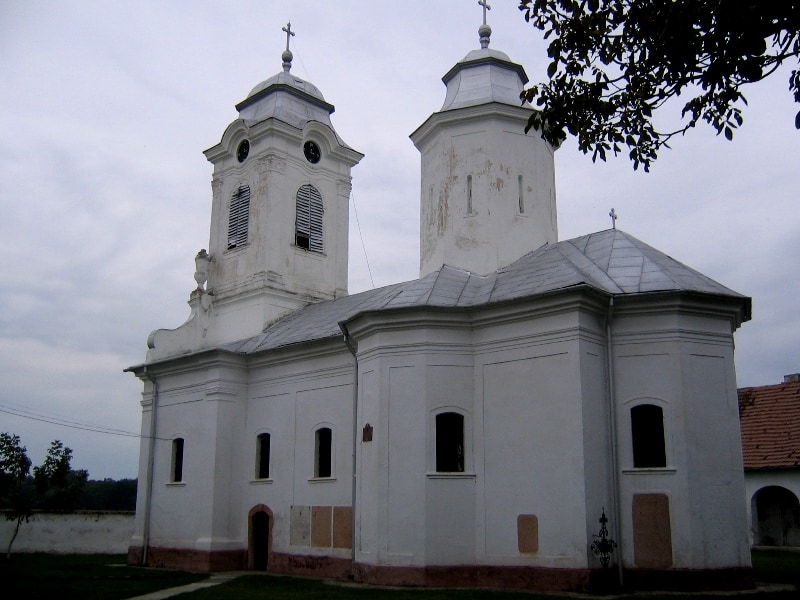
Bezdin Monastery is a Serbian Orthodox monastery established in 1539 near Secusigiu, Romania, dedicated to the Assumption of the Theotokos. Despite being burned by the Turks, the monks rebuilt it, preserving their faith and community cohesion. The monastery boasts significant artistic contributions, including iconostasis paintings by renowned artists and a substantial library.
Key Facts
- ›Founded in 1539 by Iovan Iaksici.
- ›Dedicated to the Assumption of the Theotokos.
- ›Rebuilt after being burned by the Turks, featuring a Byzantine-style brick church.
- ›Housed the miracle-working Icon of the Mother of God brought from Mount Athos.
- ›Iconostasis painted by notable artists Stefan Tenecki and Jakov Orfelin.
- ›A school was established at the monastery in 1921.
Byzantine
- Miracle-Working Icon of the Mother of God From Mount Athos
- Iconostasis Paintings By Stefan Tenecki and Jakov Orfelin
- Pictorial Compositions By Stevan Aleksić
- Extensive Monastery Library
- Picturesque Landscape With Swamps and Reeds
MăNăStirea Bezdin, манастир бездин
Iovan Iaksici, Ioasaf Milutinovici, Leontije Bogojević, Teodosie Veselinovici, Stefan Tenecki, Jakov Orfelin, Stevan Aleksić
- Construction Began In 1539.
- Burned By the Turks During Ottoman Occupation.
- Rebuilt After 1690.
- Development Period After 1740.
- Establishment of A School In 1921.
About Bezdin Monastery
Bezdin Monastery is a significant Serbian Orthodox monastic complex located in Romania, near the village of Secusigiu in Arad County. Situated on the right bank of the Mureș River, its construction commenced in 1539, with a dedication to the Assumption of the Theotokos.
History and Significance
The monastery's history is marked by resilience and a deep connection to its spiritual heritage. Initially concealed within dense forest, its location proved advantageous. The name "Bezdin" derives from a local stream that creates a picturesque marshy landscape. The foundational zeal of Iovan Iaksici initiated its construction, though earlier mentions suggest its existence prior to official records. Despite suffering destruction by the Turks, the monks persevered, rebuilding the monastery and maintaining the spiritual life of the Serbian community in the region. This continuity was vital for preserving the faith and cohesion of the ethnic group within the Austro-Hungarian Empire.
Artistic and Cultural Contributions
Bezdin Monastery has been a center for religious art and learning. During a period of development following 1740, the miracle-working Icon of the Mother of God, brought from Mount Athos, became a focal point of devotion. The monastery's iconostasis has been adorned by notable artists, including Stefan Tenecki in 1753 and Jakov Orfelin in 1802. Later, Stevan Aleksić created significant pictorial compositions, parts of which are now preserved for their protection. The monastery also maintained a substantial library, and a school was established on its grounds in 1921, underscoring its role in cultural and educational life.
Source: Wikipedia ↗
Frequently Asked Questions
When was Bezdin Monastery founded?
The construction of Bezdin Monastery began in 1539. However, an earlier mention of the monastery exists in an inscription from 1520.
What is the religious denomination of Bezdin Monastery?
Bezdin Monastery is a Serbian Orthodox monastery.
Where is Bezdin Monastery located?
It is situated near the village of Secusigiu in Arad County, Romania, on the right bank of the Mureș River.
What is the architectural style of the church?
The brick church, built after 1690, is in the Byzantine style and has a shape of a club with three apses.
What significant artistic works are housed at Bezdin Monastery?
The monastery is known for its iconostasis paintings by artists Stefan Tenecki and Jakov Orfelin, and pictorial compositions by Stevan Aleksić.
What happened to the monastery during the Ottoman occupation?
The monastery was set on fire by the Turks, but the monks did not abandon it and built a wooden church to continue their services.
Related Monasteries

Curtea de Argeș Monastery
The Curtea de Argeș Monastery, located in Romania, is a significant Romanian Orthodox religious site primarily comprising a cathedral built in the early 16th century. The cathedral, dedicated to the Dormition of the Mother of God, serves as the seat of the Archdiocese of Argeș and Muscel. It is renowned for its elaborate architecture, blending Byzantine styles with unique decorative elements, and has been the burial place for several Romanian royals.

Galata Monastery
The Galata Monastery is a Romanian Orthodox nunnery located on Galata Hill in Iași, Romania. Founded at the end of the 16th century by Voivode Petru Șchiopul, it was initially built as a fortified structure resembling a castle, serving defensive and royal purposes. The current church, dedicated to the Resurrection, dates from 1582-1583, with other significant structures like the bell tower and fortified walls dating to 1584.

Golia Monastery
The Golia Monastery is a Romanian Orthodox fortified monastery located in Iaşi, Romania, recognized for its historical significance and architectural features. Originally founded in the 16th century by boyar Ioan Golia, it was significantly rebuilt and expanded between 1650 and 1653 by Prince Vasile Lupu, becoming a prominent symbol of the city. The monastery is notable for its defensive walls, a tall tower, and its role in housing cultural institutions.