
Calbayog
Roman Catholic Diocese of Calbayog·Roman Catholic·Philippines
Calbayog is a component city located in the province of Samar, Philippines, and is a significant commercial trade center in Eastern Visayas. It is notable for its historical role in the Philippine Revolution and its establishment as the episcopal see of the Roman Catholic Diocese of Calbayog. The city is geographically extensive, encompassing diverse terrains and serving as a political and commercial hub for its districts.
Key Facts
- ›Calbayog was established as the episcopal see of the Roman Catholic Diocese of Calbayog on April 10, 1910.
- ›The city played a role in the Philippine Revolution, with Benedicto Nijaga serving as a collector of revolutionary funds and later being executed as one of the 'Thirteen Martyrs of Bagumbayan'.
- ›During World War II, Calbayog was occupied by the Japanese Army in 1942 and liberated in 1945.
- ›Calbayog was officially converted into a city by Republic Act no. 328, signed into law on July 15, 1948.
- ›The city is divided into three major districts: Calbayog, Tinambacan, and Oquendo.
- ›Calbayog is one of the largest cities in the Philippines in terms of land and water areas.
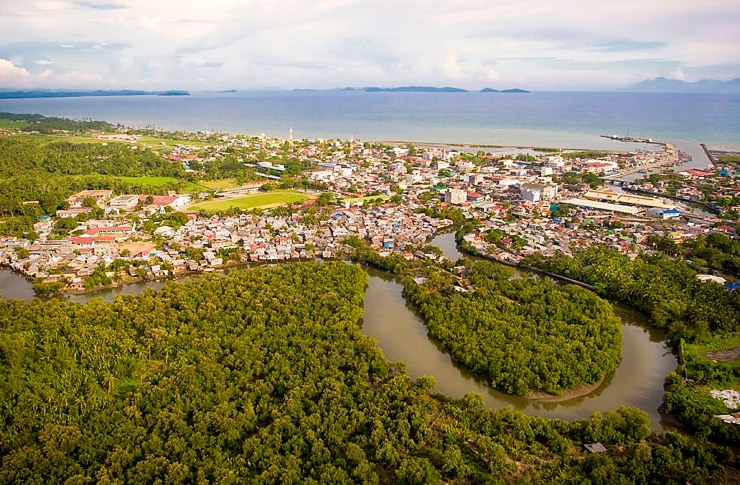
- Benedicto Nijaga Boulevard, Named After A Local Revolutionary Hero.
- the City's Role As the Episcopal See For Its Diocese.
About Calbayog
Calbayog, officially the City of Calbayog, is a significant component city located in the province of Samar, Philippines. It serves as a vital commercial trade center within the Eastern Visayas region and is recognized for its extensive land and water areas, ranking among the largest cities in the Philippines by these metrics. The city is politically divided into three major districts: Calbayog, Tinambacan, and Oquendo, each contributing to its overall character and population.
Historical Context
Calbayog holds a place in Philippine history, particularly during the late Spanish colonial period and the subsequent revolution. Benedicto Nijaga, a native of the area, was actively involved in the Katipunan, serving as a collector of revolutionary funds. His arrest and subsequent execution on January 11, 1897, alongside twelve other patriots, marked him as one of the "Thirteen Martyrs of Bagumbayan." Following the transfer of power from Spain to the United States, educational institutions like Colegio-Seminario de San Vicente de Paul were established. A pivotal moment in the city's religious history occurred on April 10, 1910, when the Roman Catholic Diocese of Calbayog was established by papal decree, with Calbayog designated as its episcopal see. The city also experienced occupation by the Japanese Army during World War II, before its liberation in 1945 by Philippine Commonwealth troops and local guerrillas.
Cityhood and Development
Calbayog's transition to a city was formalized with Republic Act No. 328, also known as the City Charter of Calbayog, signed into law on July 15, 1948. This act consolidated the territorial jurisdictions of the former municipalities of Calbayog, Oquendo, and Tinambacan into the present-day city. In recent times, the city has been a site of political developments, including the unsolved murder of a judge in 2008 and several high-profile political assassinations in 2011 and 2021. Proposals have also been made to upgrade its status from a component city to an independent component city.
Geography and Infrastructure
Geographically, Calbayog is characterized by a diverse landscape, with plains, hilly terrains, and rugged mountain ranges. Forty percent of its land area features elevations ranging from 5 to 20 meters above sea level, while the mountainous regions reach elevations of 300 to 700 meters. The city benefits from numerous natural water conveyors that help minimize flooding. Calbayog experiences a variety of wind types and receives well-distributed rainfall throughout the year, though it has dry spells during the summer months of February to May. Its infrastructure includes water utilities managed by Calbayog Water and energy supplied by Samar I Electric Cooperative, Inc. (SAMELCO I), which utilizes power from the Tongonan Geothermal Energy.
Source: Wikipedia ↗
Frequently Asked Questions
When was the Roman Catholic Diocese of Calbayog established?
The Roman Catholic Diocese of Calbayog was created on April 10, 1910, by a Papal Bull from Pope Pius X. It originally comprised the islands of Samar and Leyte, with Calbayog serving as its episcopal see.
What is Calbayog's significance in the Philippine Revolution?
Benedicto Nijaga, a native of Calbayog, was a collector of revolutionary funds for the Katipunan. He was arrested, convicted, and executed on January 11, 1897, becoming one of the 'Thirteen Martyrs of Bagumbayan'.
What happened in Calbayog during World War II?
The Japanese Army occupied Calbayog City in 1942. The city was liberated in 1945 by Philippine Commonwealth troops and guerrillas who had been fighting against the Japanese forces.
When did Calbayog officially become a city?
Calbayog was converted into a city by Republic Act No. 328, also known as the City Charter of Calbayog. This law was signed by President Elpidio Quirino on July 15, 1948.
How is Calbayog politically organized?
Calbayog is subdivided into 157 barangays, which are further grouped into three main districts: Calbayog District, Tinambacan District, and Oquendo District. Each district has its own specific geographical boundaries and population.
Related Cathedrals

Alaminos Cathedral
Saint Joseph the Patriarch Cathedral Parish, commonly known as Alaminos Cathedral, is a Roman Catholic cathedral in Alaminos, Pangasinan, Philippines. Dedicated to Saint Joseph the Patriarch, it has served as the episcopal seat of the Diocese of Alaminos since its founding in 1985. The cathedral has a long history of rebuilding and renovations dating back to the 18th century, reflecting the community's resilience and devotion.

Antipolo Cathedral
Antipolo Cathedral, officially the International Shrine of Our Lady of Peace and Good Voyage, is a prominent Roman Catholic cathedral in Antipolo, Philippines. It is renowned for enshrining a venerated Black Madonna image of the Blessed Virgin Mary and serves as the episcopal seat for the Bishop of Antipolo. The cathedral is a major pilgrimage destination, attracting millions of visitors annually, particularly during its peak season from May to July.

Bacolod Cathedral
San Sebastian Cathedral, located in Bacolod, Philippines, is the principal church of the Roman Catholic Diocese of Bacolod. Originally established as a parish church in the early 19th century, it underwent significant construction in stone during the late 19th century, evolving into its current form. The cathedral is dedicated to Saint Sebastian and holds historical and religious importance for the region.