
Wat Chaloem Phra Kiat
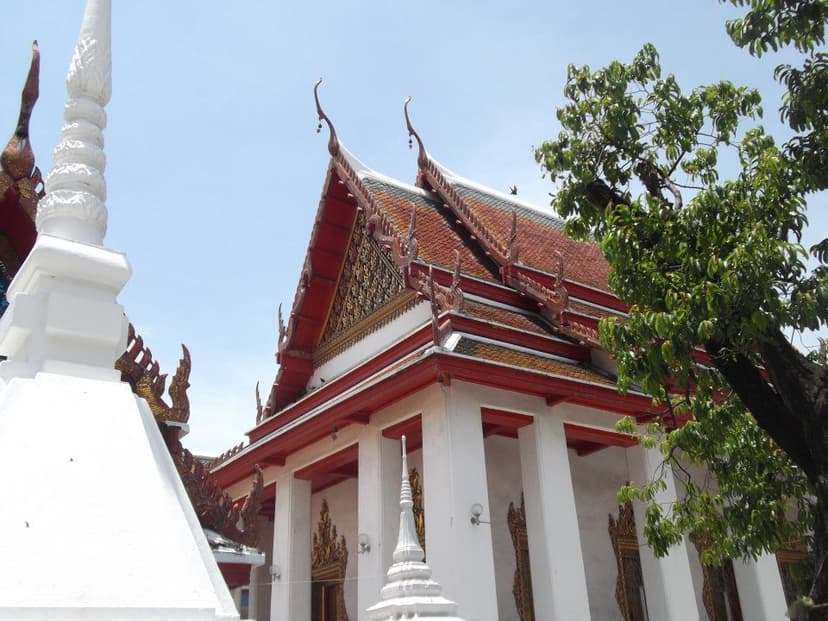
Wat Chaloem Phra Kiat Worawihan, commonly known as Wat Chaloem Phra Kiat, is an ancient Thai temple situated on the Chao Phraya River in Nonthaburi Province. Established in 1849 by King Nangklao to honor his mother, the temple is recognized as a second-rank royal temple and features unique architectural elements, including fortified walls reminiscent of the Grand Palace.
Key Facts
- ›Founded in 1849 by King Nangklao (Rama III) in dedication to his mother and grandparents.
- ›Construction was completed in 1858 under the patronage of King Mongkut (Rama IV).
- ›Features unique fortified border walls, similar to those of the Grand Palace, a remnant of the former 'Pom Thapthim' fort.
- ›The ordination hall showcases a blend of Thai-Chinese architectural styles.
- ›Houses the principal Buddha statue 'Phra Buddha Maha Logapinantapatima' and the 'Phra Sila Khao' statue.
- ›Includes a 45-meter-tall Lanka-style white pagoda containing Buddha relics.

Important Relationships
- King Nangklao (Rama III)
- Queen Consort Sri Sulalai
- Somdet Chao Phraya Borom Maha Prayurawongse (Tish Bunnag)
- King Mongkut (Rama IV)
- Chaophraya Thiphakorawong (Kham Bunnag)
- Fortified Border Walls
- Thai-Chinese Architectural Style Ordination Hall
- Phra Buddha Maha Logapinantapatima Statue
- Phra Sila Khao Statue
- Lanka-Style White Pagoda
- Monument of King Nangklao
Construction Began In 1849., Construction Completed In 1858., Temple Forts Restored In 1992.
Thai, Chinese
About Wat Chaloem Phra Kiat
Wat Chaloem Phra Kiat Worawihan: A Royal Temple of Unique Design
Wat Chaloem Phra Kiat Worawihan, often referred to simply as Wat Chaloem Phra Kiat, is a significant Thai Buddhist temple located in Nonthaburi Province, on the banks of the Chao Phraya River. Regarded as an ancient temple with a history spanning over 160 years, it holds the distinction of being a second-rank royal temple, a status shared with few other provincial temples.
Founding and Construction
The temple's origins date back to 1849 when it was commissioned by King Nangklao (Rama III). The purpose of its construction was to honor his mother, Queen Consort Sri Sulalai, and his grandparents, who had resided in the area. King Nangklao bestowed the name "Wat Chaloem Phra Kiat" even though the temple was not yet finished at the time of his passing. The initial construction was supervised by Somdet Chao Phraya Borom Maha Prayurawongse (Tish Bunnag). Responsibility for completing the project was later transferred to Prayurawongse's son, Chaophraya Thiphakorawong (Kham Bunnag), during the reign of King Mongkut (Rama IV). The temple's construction finally concluded in 1858.
Distinctive Architectural Features
Wat Chaloem Phra Kiat possesses several architectural characteristics that set it apart from other temples in Thailand. Notably, its border walls are fortified, an unusual feature that evokes the defensive structures of the Grand Palace. This design is a nod to the site's historical past, as it was once the location of the fort known as "Pom Thapthim"; these temple fortifications were later restored in 1992.
Furthermore, the temple's ordination hall is a striking example of a fusion between Thai and Chinese architectural styles, creating a majestic visual impact. Inside the ordination hall, the principal Buddha image enshrined is a Maravijaya-style statue named "Phra Buddha Maha Logapinantapatima." This statue was cast in the royal foundry, a process also used for the principal Buddha statue at Wat Ratchanatdaram in Bangkok.
On the southern side of the temple grounds lies the grand sanctuary, known as "Wihan Sila Khao." In 1858, King Mongkut ordered that another principal Buddha statue, "Phra Sila Khao," be placed here. Adjacent to this sanctuary is a chapel, also built in the Thai-Chinese art style, which houses the "Phra Buddha Patima Chaiwat," also called "Phra Chai Lang Chang." Dominating the rear of the chapel is a striking white pagoda of Lanka style, standing 45 meters tall and housing sacred Buddha relics.
Historical Context and Significance
The temple's connection to royalty is further emphasized by the monument of King Nangklao, which is situated along the Chao Phraya River behind the temple complex. As a second-rank royal temple, Wat Chaloem Phra Kiat is a site of historical and religious importance, reflecting the patronage of the Thai monarchy and showcasing a unique blend of cultural influences in its design and construction.
Source: Wikipedia ↗
Frequently Asked Questions
When was Wat Chaloem Phra Kiat founded?
Wat Chaloem Phra Kiat was founded in 1849 by King Nangklao (Rama III). Construction continued and was completed in 1858 during the reign of King Mongkut (Rama IV).
Who commissioned the construction of Wat Chaloem Phra Kiat?
The temple was commissioned by King Nangklao (Rama III) as a dedication to his mother, Queen Consort Sri Sulalai, and his grandparents. Somdet Chao Phraya Borom Maha Prayurawongse oversaw the project initially, with his son Chaophraya Thiphakorawong taking over later.
What is unique about the architecture of Wat Chaloem Phra Kiat?
A distinctive feature of Wat Chaloem Phra Kiat is its fortified border walls, which are unusual for Thai temples and resemble those of the Grand Palace. The ordination hall also combines Thai and Chinese architectural styles.
What significant structures are located within Wat Chaloem Phra Kiat?
Within the temple complex, visitors can find the ordination hall housing the 'Phra Buddha Maha Logapinantapatima' statue, the 'Wihan Sila Khao' with the 'Phra Sila Khao' Buddha statue, and a chapel with the 'Phra Buddha Patima Chaiwat'. A notable structure is the 45-meter-tall Lanka-style white pagoda containing Buddha relics.
Is Wat Chaloem Phra Kiat a royal temple?
Yes, Wat Chaloem Phra Kiat is classified as a second-rank royal temple of the province, similar to Wat Paramaiyikawat of Ko Kret.
Related Buddhist Temples
Wat Anongkharam
Wat Anongkharam Worawihan is a significant royal temple in Bangkok, Thailand, established in 1850 and later renamed by King Rama IV. It holds historical importance as a national historic monument and features traditional Thai architecture with a revered Buddha image.

Wat Benchamabophit
Wat Benchamabophit, also known as the Marble Temple, is a prominent Buddhist temple in Bangkok, Thailand, celebrated for its exquisite architecture that blends traditional Thai styles with subtle European influences. Commissioned by King Chulalongkorn and designed by Prince Naris, it is constructed primarily of Italian marble and features a distinguished ordination hall housing a revered Buddha image.
Wat Bowonniwet
Wat Bowonniwet Wihan Ratchaworawihan, a significant Buddhist temple in Bangkok, Thailand, holds historical importance as a royal temple and a center of the Thammayut Nikaya order. It served as the residence for the late Supreme Patriarch of Thailand and is the final resting place for two former Chakri Dynasty kings, notably King Bhumibol Adulyadej (Rama IX).