
Shwegugyi Temple
Shwegugyi Temple is a significant Theravadin Buddhist temple located in Bagan, Myanmar, recognized as Monument #1589 within the Bagan Archaeological Area, a UNESCO World Heritage Site. Commissioned by King Sithu I in 1131, the temple is notable for its impressive brick foundation, arched windows, and intricate interior decorations.
Key Facts
- ›The temple is a Theravadin Buddhist site in Bagan, Myanmar.
- ›It was built by King Sithu I of Pagan in 1131.
- ›Construction of the temple took place within the year 1131, from may to December.
- ›Shwegugyi Temple is recognized as Monument #1589 in the Bagan Archaeological Area, a UNESCO World Heritage Site.
- ›It is known for its extensive brick foundation, arched windows, and fine interior stucco and carved wooden doors.

Important Relationships
- King Sithu I of Pagan
- King Kyansittha
Arched Windows, Fine Stucco, Carved Wooden Doors, Expansive Brick Foundation
About Shwegugyi Temple
The Shwegugyi Temple, meaning "Great Golden Cave" in Burmese, is a significant Theravadin Buddhist temple situated in Bagan, Myanmar. It holds the designation of Monument #1589 within the Bagan Archaeological Area, which itself is recognized as a UNESCO World Heritage Site, underscoring its historical and cultural importance.
Founding and Construction
The temple was constructed by King Sithu I of the Pagan Kingdom in the year 1131. Historical records, including stone inscriptions found at the site dating to 1141, detail the construction period. Work commenced on May 17, 1331, and was completed by December 17 of the same year, indicating a remarkably swift construction process. The temple's location is noted as being just southeast of the former royal palace grounds established by King Kyansittha.
Architectural Features
Shwegugyi Temple is built upon a substantial brick foundation that stands approximately 3 meters (9.8 ft) tall. The temple is particularly admired for its distinctive arched windows, which contribute to its aesthetic appeal. Internally, visitors can appreciate the fine stucco work and intricately carved wooden doors, showcasing the craftsmanship of the era.
Source: Wikipedia ↗
Frequently Asked Questions
When was Shwegugyi Temple built?
Construction of Shwegugyi Temple began on May 17, 1131, and was completed on December 17, 1131. The temple was commissioned by King Sithu I of Pagan.
What is Shwegugyi Temple known for?
The temple is recognized for its expansive 3-meter tall brick foundation. It also features notable arched windows and fine stucco and carved wooden doors within its interior.
Is Shwegugyi Temple a UNESCO World Heritage Site?
Yes, Shwegugyi Temple is recognized as Monument #1589 within the Bagan Archaeological Area, which is designated as a UNESCO World Heritage Site.
Who built Shwegugyi Temple?
Shwegugyi Temple was built by King Sithu I of Pagan (Bagan). It is located near the ruins of a former royal palace founded by King Kyansittha.
Related Buddhist Temples
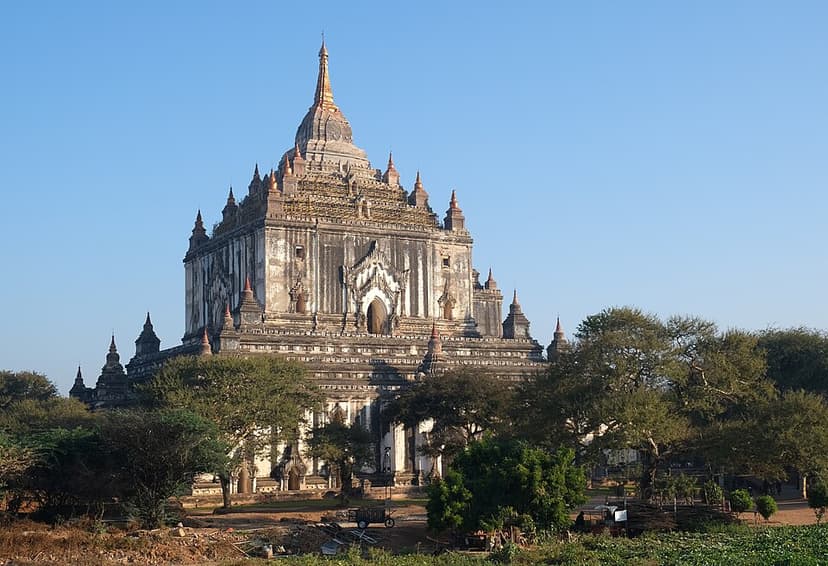
Thatbyinnyu Temple
The Thatbyinnyu Temple, located in Bagan, Myanmar, is a significant Theravadin Buddhist temple renowned for its impressive height and architectural innovation during the Bagan period. Completed in the mid-12th century, it served not only as a place of worship but also as a monastery and library, reflecting the era's religious scholarship and national pride. Despite suffering damage from earthquakes, it remains a key monument within the Bagan Archaeological Area, a UNESCO World Heritage Site undergoing restoration.

Preah Khan
Preah Khan is a significant Buddhist temple complex in Angkor, Cambodia, built in the 12th century by King Jayavarman VII as a memorial to his father. It served as a vast religious, administrative, and educational center, once housing nearly 100,000 people. The temple is notable for its largely unrestored state, with vegetation growing amongst its ruins, and its complex architectural design incorporating both Buddhist and Hindu elements.

Ta Prohm
Ta Prohm is a Mahayana Buddhist temple complex located near Siem Reap, Cambodia, originally named Rajavihara. Founded by King Jayavarman VII in 1186 AD as a monastery and center of learning dedicated to his mother, it is renowned for the massive trees that have grown amongst its ruins, creating a uniquely picturesque and popular tourist attraction. The temple is a UNESCO World Heritage Site and a significant example of the Bayon style.