
Cathedral of St Louis
Tunisia·Carthage·Archdiocese of Carthage
The Acropolium, also known as Saint Louis Cathedral, is a former Latin Catholic church situated on Byrsa Hill in Carthage, Tunisia. Built between 1884 and 1890, it was consecrated in honor of Saint Louis IX of France, who died nearby during the Eighth Crusade. No longer used for worship, it now serves as a venue for public events and concerts, hosting Tunisian and classical music.
Key Facts
- ›The cathedral is located on Byrsa Hill, near the ruins of ancient Carthage.
- ›Construction took place between 1884 and 1890 under the French protectorate.
- ›It was dedicated to Saint Louis IX of France, who died in the vicinity in 1270.
- ›The building's architecture is a composite of Byzantine, Gothic, and Moorish styles.
- ›Since 1993, it has been known as the Acropolium and functions as a cultural center.
- ›The cathedral was ceded to the Tunisian state in 1964.
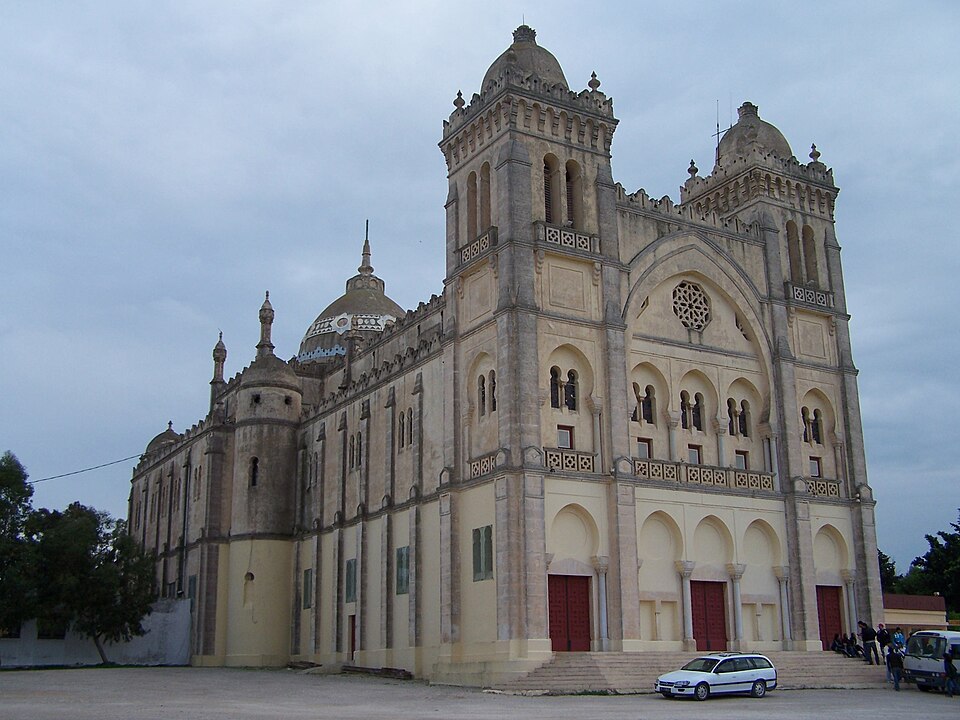
Byzantine, Gothic, Moorish
Saint Louis Ix
Reliquary of Saint Louis
Abbot Pougnet
About Cathedral of St Louis
What is Saint Louis Cathedral?
The Acropolium, commonly known as Saint Louis Cathedral, is a former Latin Catholic church located in Carthage, Tunisia. It stands prominently on the peak of Byrsa Hill, a site rich with the history of ancient Punic and Roman civilizations, and was built atop the ruins of an old temple dedicated to the Punic god of healing, Eshmun.
History and Significance
Construction of the cathedral commenced in 1884 and concluded in 1890, during the period of the French protectorate. The project was authorized by Hussein II Bey, who granted the French consul-general the land to erect a religious monument in honor of King Louis IX of France, who died in the vicinity during the Eighth Crusade in 1270. The cathedral was consecrated with considerable ceremony and dedicated to Saint Louis by Cardinal Lavigerie, who held the united titles of Archbishop of Algiers and Carthage, thereby restoring the title of primate of Africa. Cardinal Lavigerie himself was buried within the cathedral after his death in 1892, though his remains were later transferred to Rome.
In 1964, a treaty between Tunisia and the Catholic Church led to the transfer of most of the Church's real estate holdings, including the Acropolium, to the Tunisian state. Since 1992, the edifice has been repurposed as a cultural center.
Architecture and Features
The architectural design of the Saint Louis Cathedral, conceived by Abbot Pougnet, draws inspiration from Byzantine, Gothic, and Moorish styles, reflecting a common trend in late 19th-century French architecture to incorporate composite styles. The structure is laid out in the form of a Latin cross, measuring 65 meters in length and 30 meters in width. Its façade is flanked by two square towers, and the central crossing is crowned by a large cupola, further enhanced by eight short towers or spires. A smaller cupola caps the apse.
Internally, the church features a nave and two aisles separated by arches. The ceiling beams are adorned with intricate sculptures, paintings, and gilding, featuring arabesque designs. The interior is illuminated by 284 stained glass windows. Artifacts within the church include an onyx monument housing the reliquary of Saint Louis and mosaics depicting Saint Cyprien. The cathedral also possesses a substantial six-ton bell and a four-bell carillon. Notably, a cross atop the building was, at the time of its construction, the only one standing in Tunisia.
Source: Wikipedia ↗
Frequently Asked Questions
What is the Acropolium in Carthage?
The Acropolium, formerly Saint Louis Cathedral, is a former Catholic church located on Byrsa Hill in Carthage, Tunisia. It was built between 1884 and 1890 and is now used as a venue for public events and concerts.
Why was Saint Louis Cathedral built?
The cathedral was authorized by Hussein II Bey to honor King Louis IX of France, who died in the area during the Eighth Crusade. It was intended as a religious monument in his memory.
What is the architectural style of Saint Louis Cathedral?
The cathedral's architecture is a blend of Byzantine, Gothic, and Moorish styles. It is constructed in the shape of a Latin cross and features a large cupola at the crossing, surrounded by smaller towers.
Is Saint Louis Cathedral still used for religious services?
No, the Acropolium is no longer used for worship. Since 1993, it has been a cultural center hosting public events, concerts of Tunisian and classical music.
What significant relics or monuments are housed in the Acropolium?
The church contains a monument in onyx holding the reliquary of Saint Louis, and mosaics of Saint Cyprien. Cardinal Lavigerie, who was the primate of Africa and first archbishop of Carthage, was initially buried there.