
Basilica of the National Shrine of St Elizabeth Ann Seton
United States·Emmitsburg·Archdiocese of Baltimore
The National Shrine of Saint Elizabeth Ann Seton in Emmitsburg, Maryland, is a significant religious and educational center dedicated to the life and legacy of Elizabeth Ann Seton. As the first native-born American to be canonized, she established the Sisters of Charity of St. Joseph and the first free Catholic school for girls in the United States. The shrine complex includes a basilica, museum, and historical buildings, serving as a pilgrimage destination.
Key Facts
- ›Founded by Elizabeth Ann Seton, the first native-born American saint.
- ›Established the Sisters of Charity of St. Joseph in 1809.
- ›Home to the first free Catholic school for girls in the United States.
- ›The shrine complex incorporates historical buildings like the 'Stone House' and 'White House'.
- ›Designated a minor basilica by Pope John Paul II in 1991.
- ›Serves as a pilgrimage destination and honors Saint Elizabeth Ann Seton as Patroness for the Sea Services.

Elizabeth Ann Seton
Remains of Saint Elizabeth Ann Seton
Sisters of Charity of St. Joseph
About Basilica of the National Shrine of St Elizabeth Ann Seton
The National Shrine of Saint Elizabeth Ann Seton
The National Shrine of Saint Elizabeth Ann Seton, located in Emmitsburg, Maryland, stands as a significant religious and educational center dedicated to the life, mission, and legacy of Elizabeth Ann Seton. She holds the distinction of being the first native-born citizen of the United States to be canonized by the Roman Catholic Church. The shrine is recognized both as a minor basilica and a national shrine, attracting pilgrims and visitors seeking to learn about her profound influence.
History and Foundation
Elizabeth Ann Seton, born into a prominent Anglican family in New York City, converted to Roman Catholicism in 1805. In 1808, she was invited to Maryland, where she established a school. With the support of Samuel Sutherland Cooper, she acquired land near Emmitsburg in 1809, and according to tradition, named the area Saint Joseph's Valley. It was here that she founded the Sisters of Charity of St. Joseph, an order that would play a crucial role in American Catholic education and healthcare.
The early days were marked by hardship, with the community initially housed in the 'Stone House,' a former farmhouse built around 1750. This structure, though rudimentary, served as the first headquarters. Facing challenging conditions, Archbishop John Carroll directed the construction of a new log building, known as the 'White House,' in 1810. This new "Saint Joseph's House" became the site where Mother Seton established the first free Catholic school for girls in the United States, laying the groundwork for the Catholic parochial school system in the nation.
Following her death in 1821, Mother Seton was buried in Emmitsburg at a cemetery she called "God's Little Acre." The Sisters of Charity continued their service, notably as nurses during the Civil War, earning the title "angels of the battlefield." Saint Joseph's Chapel was consecrated on May 6, 1841. In 1846, her remains were moved to a mortuary chapel built within the Sisters' cemetery at the request of her son, William Seton.
The Shrine Complex and Basilica
The shrine complex has evolved to encompass the historical 'Stone House,' the 'White House,' and the cemetery, along with a dedicated basilica, a museum, the Mortuary Chapel, and a visitors center. It is an integral part of the Archdiocese of Baltimore and a significant pilgrimage site for Roman Catholics.
The shrine's basilica was dedicated in 1965, featuring interior artwork created by European artisans. After Saint Elizabeth Ann Seton's canonization in 1975, her remains were transferred from the cemetery to the basilica. In recognition of its importance, the shrine's chapel was officially designated as a minor basilica by Pope John Paul II in 1991, with the formal ceremony taking place on August 4th of that year.
The shrine also hosts an annual event celebrating Mother Seton, which honors all individuals named Elizabeth or Elizabeth Ann. Those bearing these names participate in a special procession and venerate Mother Seton at her tomb.
Patroness for the Sea Services
Saint Elizabeth Ann Seton is recognized as the Patroness for the Sea Services, a title stemming from her deep maternal concern for her sons, William and Richard, who served in the U.S. Navy. Her numerous letters to them during their time at sea attest to this devotion. The National Shrine holds an annual Pilgrimage for the Sea Services, bringing together members of the Navy, Marine Corps, Coast Guard, Merchant Marine, and the U.S. Public Health Service, along with their families and friends, to honor her intercession for all who serve in these branches.
Source: Wikipedia ↗
Frequently Asked Questions
Who was Saint Elizabeth Ann Seton?
Elizabeth Ann Seton (1774–1821) was the first native-born citizen of the United States to be canonized by the Roman Catholic Church. She founded the Sisters of Charity of St. Joseph and established the first free Catholic school for girls in the U.S.
What historical buildings are part of the National Shrine?
The shrine complex includes the former Fleming farmhouse, known as the 'Stone House,' built in 1750, and a log structure called the 'White House,' which served as Saint Joseph's House. Both were significant to Elizabeth Ann Seton and her community.
When was the basilica at the shrine dedicated?
The basilica at the National Shrine of Saint Elizabeth Ann Seton was dedicated in 1965. Her remains were moved to the basilica after her canonization in 1975.
What is the significance of Saint Elizabeth Ann Seton as Patroness for the Sea Services?
She is honored as Patroness for the Sea Services due to her deep concern for her sons who served in the U.S. Navy. The National Shrine hosts an annual event to honor her in this capacity.
When was the shrine officially designated as a minor basilica?
The shrine's chapel was designated as a minor basilica by Pope John Paul II in 1991. The formal designation ceremony took place on August 4, 1991.
Related Basilicas
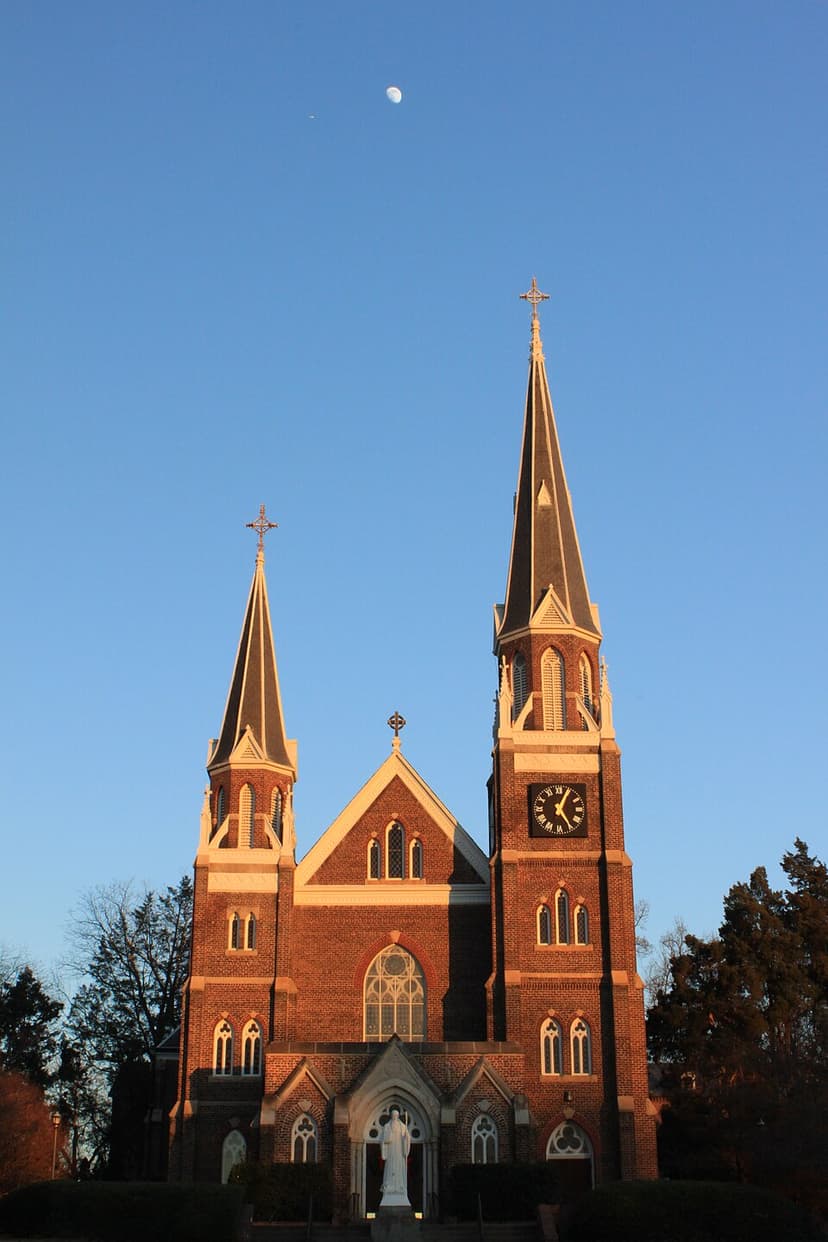
Abbey Basilica of Our Lady Help of Christians (Belmont Abbey)
The Abbey Basilica of Our Lady Help of Christians, located at Belmont Abbey in North Carolina, is a significant Catholic religious site. Originally established as a monastery and educational institution, it was elevated to the status of an abbey and later designated as a minor basilica. The basilica is notable for its Gothic Revival architecture and its historical role in education and religious administration in the region.
Basilica and National Shrine of Our Lady of Lebanon
The Basilica and National Shrine of Our Lady of Lebanon is a minor basilica of the Maronite Catholic Church situated in North Jackson, Ohio. It serves as a significant spiritual center for Maronites in the United States, mirroring the original shrine in Harissa, Lebanon. The basilica was dedicated in 1965 and later elevated to minor basilica status by Pope Francis in 2014.

Basilica and Shrine of Our Lady of Perpetual Help
The Basilica and Shrine of Our Lady of Perpetual Help, also known as The Mission Church, is a Roman Catholic basilica located in Boston, Massachusetts. It was elevated to the status of Minor Basilica in 1954 and is renowned for its shrine dedicated to Our Mother of Perpetual Help, which has been a site of reported miracles and votive offerings since its inception. The Redemptorist priests have ministered to the parish since its founding in 1870.