
Basilica of the Assumption of the Virgin Mary, Hostýn
Czech Republic·Chvalčov
The Basilica of the Assumption of the Virgin Mary, Hostýn, is a significant Marian place of pilgrimage located in the Czech Republic. Its importance stems from a 13th-century legend of a miraculous intervention by the Virgin Mary during a Tatar raid, which led to the discovery of a spring and the eventual construction of a basilica. The site draws both religious pilgrims and tourists, making it a vital spiritual and cultural landmark.
Key Facts
- ›Svatý Hostýn is a hill in the Zlín Region of the Czech Republic, part of the Hostýn-Vsetín Mountains.
- ›A traditional legend recounts a miracle by the Virgin Mary during a 13th-century Tatar raid, where a spring appeared and a storm repelled the invaders.
- ›The site features an ancient hill fort dating back to around 1200 BC, with later fortifications by cultures including the Celts.
- ›The first medieval chapel of the Virgin Mary was mentioned in 1544, predating the widespread popularization of the legend.
- ›A new basilica was constructed between 1721 and 1748, alongside the Via Crucis, a pilgrims' hospice, and other facilities.
- ›The basilica is often referred to as 'Moravian Lourdes' due to the believed healing properties of a nearby spring.
DušAn Jurkovič
About Basilica of the Assumption of the Virgin Mary, Hostýn
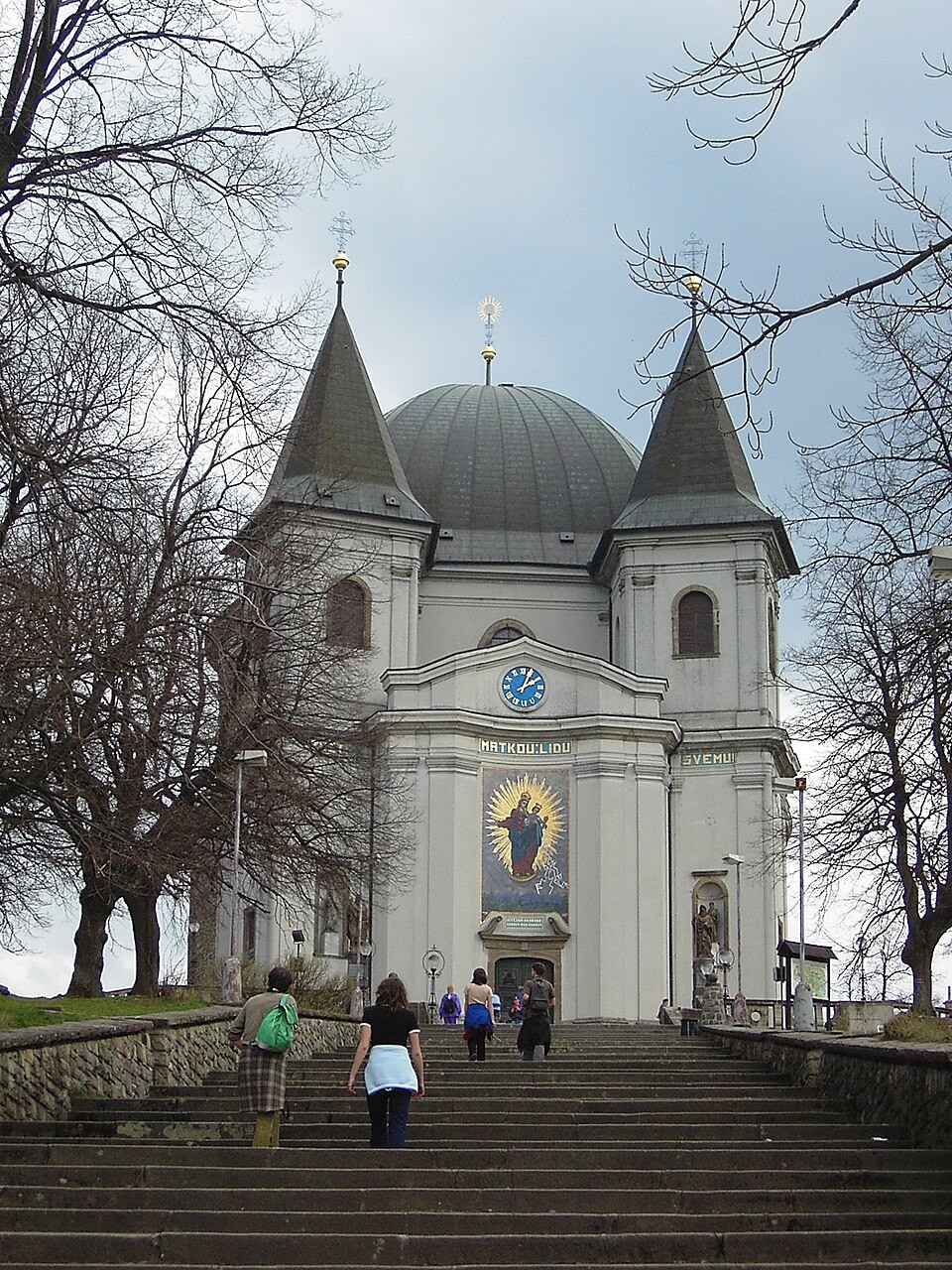
The Basilica of the Assumption of the Virgin Mary, Hostýn, is a prominent Marian pilgrimage site situated in the Zlín Region of the Czech Republic. The hill of Hostýn, with its elevation of 735 meters, is crowned by this significant religious edifice, which draws numerous pilgrims and tourists annually.
Legend and Origins
The spiritual importance of Hostýn is deeply rooted in a traditional legend, first documented in 1665. According to this narrative, during a devastating raid by "Tartars" in the 13th century, people seeking refuge on the hill were suffering from a lack of water. Their prayers to the Virgin Mary were answered; a spring is said to have emerged from the ground, and a powerful storm subsequently forced the attackers to retreat. This miraculous event is considered the genesis of the site's veneration.
Historical Development
Hostýn hill has a long history of human settlement, featuring an ancient hill fort with substantial earth and stone defensive walls, originally constructed by the Lusatian culture around 1200 BC. This fortification was later rebuilt and modified by various groups, including the Celts. The first medieval chapel dedicated to the Virgin Mary was mentioned in 1544, though its existence likely predates the widespread popularization of the legend, which may have been inspired by the presence of the massive walls, the chapel, and the spring.
Following the first recording of the legend and subsequent military successes against the Turks, pilgrim visits to Hostýn increased significantly. This growing devotion led to the construction of the current basilica between 1721 and 1748. The building project also encompassed the creation of the Via Crucis (Stations of the Cross), a pilgrims' hospice, and other essential facilities.
Spiritual Significance and Modern Appeal
Adjacent to the basilica, another chapel was built near the spring of "holy water," which was traditionally believed to possess healing properties. This association led to Hostýn being nicknamed the "Moravian Lourdes." In 1909, a 240-step stairway was constructed to connect the spring directly to the basilica, facilitating access for pilgrims.
In 1903, architect Dušan Jurkovič designed new open-air Stations of the Cross, which have become a major tourist attraction. The basilica itself, along with these Stations, draws not only Catholic pilgrims but also thousands of other tourists. The site experienced one of its largest gatherings in August 1912, when the main statue of the Virgin Mary was crowned with a golden crown blessed by Pope Pius X in Rome. Over a ten-day period, an estimated 200,000 pilgrims and visitors were present.
Source: Wikipedia ↗
Frequently Asked Questions
What is the origin of the pilgrimage to Hostýn?
The pilgrimage to Hostýn originates from a traditional legend recorded in 1665. It describes how the Virgin Mary intervened during a 13th-century Tatar raid, causing a stream of water to appear and a storm to drive the invaders away.
What is the history of the fortifications on Hostýn hill?
Hostýn hill features an ancient hill fort with a ditch and defensive wall made of earth and stone, standing 4–8 meters high. It was initially built by the Lusatian culture around 1200 BC and was subsequently destroyed and rebuilt multiple times by various peoples, including the Celts.
When was the current basilica built?
A new basilica was constructed on Hostýn hill between 1721 and 1748. This major construction project also included the establishment of the Via Crucis and a pilgrims' hospice.
Why is Hostýn called the 'Moravian Lourdes'?
Hostýn earned the nickname 'Moravian Lourdes' because of a nearby spring of 'holy water' that locals believed possessed healing effects. A significant stairway was later built connecting this spring to the basilica.
What is the significance of the Stations of the Cross at Hostýn?
New open-air Stations of the Cross were built in 1903 by architect Dušan Jurkovič. These are now a major tourist attraction that draws visitors alongside the basilica itself.
When was the main statue of the Virgin Mary crowned?
The main statue of the Virgin Mary at Hostýn was crowned in August 1912. The golden crown used for this ceremony had been blessed in Rome by Pope Pius X.
Related Basilicas

Basilica of the Assumption of Mary and Saints Cyril and Methodius
The Basilica of the Assumption of Mary and Saints Cyril and Methodius is the most renowned Christian pilgrimage destination in the Czech Republic, located in Velehrad. Originally part of a Cistercian monastery founded in 1205, the complex was later rebuilt in the Baroque style and has been managed by the Jesuits since 1890, attracting tens of thousands of pilgrims annually.

Basilica of St Margaret, Břevnov Monastery
The Basilica of St Margaret, Břevnov Monastery, is a Benedictine archabbey in Prague, Czech Republic, founded in 993 by Saint Adalbert and Duke Boleslaus II. It holds the distinction of being the first Benedictine male monastery in Bohemia and possesses the oldest tradition of beer brewing in the country. The complex has undergone significant Baroque reconstruction and was visited by Pope John Paul II in 1997, when it was elevated to the rank of an Archabbey.

Basilica of the Assumption, Strahov Monastery
The Basilica of the Assumption, Strahov Monastery is a significant religious and historical site located in Prague, Czech Republic. Founded in 1143, it has been a center of spiritual life for the Premonstratensian order and has undergone numerous reconstructions and expansions throughout its long history, notably including the renowned Strahov Library.