
Basilica of St Vincent de Paul
Poland·Bydgoszcz
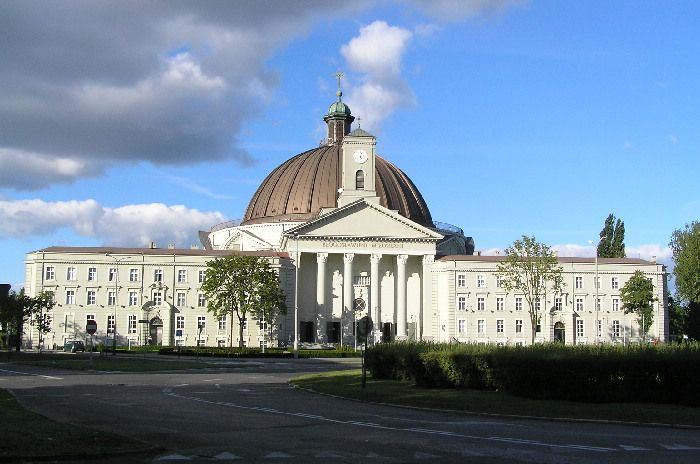
The Basilica of St. Vincent de Paul Minor is a significant Catholic church located in Bydgoszcz, Poland. Constructed between 1924 and 1945, it is dedicated to Saint Vincent de Paul and serves as a major religious and architectural landmark in the city. Its designation as a Minor Basilica in 1997 by Pope John Paul II underscores its importance within the Catholic Church.
Key Facts
- ›Construction began on May 1, 1924, with the foundation stone laid on September 27, 1925.
- ›The basilica was designed by Polish architect Adam Ballenstedt.
- ›It was officially consecrated on May 22, 1980, by Cardinal Stefan Wyszyński.
- ›Pope John Paul II elevated the church to the rank of Minor Basilica on October 7, 1997.
- ›The basilica is the largest church in Bydgoszcz and one of the largest in Poland, capable of holding approximately 12,000 people.
- ›It is registered on the Kuyavian-Pomeranian Voivodeship Heritage List.
Vincent De Paul
- Congregation of the Missionaries of St. Vincent De Paul
Adam Ballenstedt, Wiktor Zin
About Basilica of St Vincent de Paul
Basilica of St. Vincent de Paul
The Basilica of St. Vincent de Paul Minor is a prominent Catholic church situated in Bydgoszcz, Poland, located at Ossoliński Alley. Dedicated to Saint Vincent de Paul, the basilica complex also includes a monastery and a park.
History and Foundation
The initiative to establish a new pastoral facility and a small seminary in Bydgoszcz originated in 1923, when Priests of the Congregation of the Missionaries of St. Vincent de Paul were invited by Cardinal Edmund Dalbor. This request aimed to serve the Polish community in a developing area, counter German influence, and commemorate Poland's return to independence and the Congregation's 300th anniversary. The municipal authorities provided a plot of land, and architect Adam Ballenstedt began preparatory work in 1924. The church was elevated to parish status on May 1, 1924, and missionary priests commenced their pastoral duties in October 1925. The foundation stone was laid on September 27, 1925, with representatives from city authorities and the Polish armed forces present.
Construction progressed through the late 1920s and 1930s. Funding challenges led parish priests to seek donations from Polish Americans in the United States. A private high school operated by the priests from 1931 to 1933. The church structure, including wings, a rotunda, and a reinforced concrete dome, was largely completed by the end of 1938. The outbreak of World War II necessitated a swift completion of the dome with a roof.
World War II and Reconstruction
Following the German occupation in September 1939, the church was closed and used as a warehouse. The building suffered desecration and theft. Retreating German forces set fire to the edifice on January 19, 1945, causing extensive damage. Incoming Soviet troops further damaged the dome and residential areas with artillery fire.
Reconstruction efforts began immediately after the war, with the church reopening for worship in March 1945. The chapel of Our Lady of Czestochowa was rebuilt in 1949, and interior walls and altars were restored in the 1950s. In 1966, Polish authorities authorized the construction of the outer dome. From 1967, architect Wiktor Zin led the reconstruction, introducing marble pilasters, a choir, mirrored mosaic, ceiling mosaics, sanctuary decor, dome rosettes, and stained glass windows.
Consecration and Basilica Status
The consecration ceremony took place on May 22, 1980, during a mass celebrated by Cardinal Stefan Wyszyński. In 1996, "The Doors of the Beatitudes" were completed on the main frontage. Further enhancements included the installation of a marble floor and plastering of exterior walls with stucco details. On October 7, 1997, Pope John Paul II elevated the church to the rank of Minor Basilica during a mass held in Gniezno. Jubilee celebrations in 2000 marked the 350th anniversary of the Missionaries of St. Vincent de Paul's arrival in Poland.
Architecture and Notable Features
The Basilica of St. Vincent de Paul is the largest church in Bydgoszcz and one of the largest in Poland, with a capacity for around 12,000 people. Its dome stands at 65 meters, making it the second-highest building in the city. Notable interior features include the monumental dome with 108 coffers and stylized stucco flowers, a 22-voice pipe organ built in 1932 and later upgraded, a main altar depicting the Crucifixion and mosaics by Wiktor Zin, and side altars in eight chapels surrounding the rotunda. The western entrance features the "Doors of Blessings," adorned with 16 bronze bas-reliefs depicting the Beatitudes, as well as the crest of Bydgoszcz and the coat of arms of the Congregation. A mosaic titled "The Creation of the World" is situated above the entrance in the western church arcade.
Source: Wikipedia ↗
Frequently Asked Questions
When was the Basilica of St. Vincent de Paul built?
Construction of the Basilica of St. Vincent de Paul began in 1924 and was completed in 1945. The consecration ceremony took place much later, on May 22, 1980.
Who designed the Basilica of St. Vincent de Paul?
The basilica was designed by the Polish architect Adam Ballenstedt. Preparatory works for the design began in March 1924.
What is the significance of the Basilica of St. Vincent de Paul being a Minor Basilica?
The designation as a Minor Basilica signifies a special honor granted by the Pope. The Basilica of St. Vincent de Paul received this status on October 7, 1997, from Pope John Paul II.
What are some notable architectural features of the basilica?
The basilica features a large dome weighing 2,200 tons, with a cross standing at 65 meters, making it a prominent landmark. The interior includes a monumental main altar designed by Wiktor Zin, mosaics, and eight chapels with side altars.
Has the basilica undergone significant damage or reconstruction?
Yes, the church was closed by the German army in 1939, desecrated, and later set on fire by retreating German forces in 1945. Further damage occurred from Soviet artillery fire. Extensive reconstruction and renovation efforts have taken place since then, including work led by architect Wiktor Zin from 1967.
Related Basilicas
Basilica of the Visitation (Carmelite Church)
The Basilica of the Visitation (Carmelite Church) in Kraków, Poland, is the city's first Carmelite church, originally founded in the 11th century according to legend, though documented construction began in 1395. It is significant for its history, including its rebuilding in Baroque style after the Swedish Deluge and its role in Polish royal and military history, culminating in its elevation to a minor basilica by Pope John Paul II in 1997.
Archcathedral Basilica of the Holy Trinity, Oliwa
The Archcathedral Basilica of the Holy Trinity, Oliwa, is a significant Roman Catholic church located in Gdańsk, Poland. Originally founded as a Cistercian monastery, it evolved into a cathedral and later an archcathedral. It is renowned for its impressive architecture, incorporating Brick Gothic and Mannerist-Baroque elements, and houses one of the world's largest pipe organs.

Basilica of Our Lady Queen of Poland, Licheń (Sanctuary of Our Lady of Licheń)
The Basilica of Our Lady Queen of Poland, Licheń is a major Catholic pilgrimage site located in Licheń Stary, Poland. It holds the distinction of being the largest church in Poland and one of the largest church buildings globally, known for its immense scale and the venerated icon of Our Lady of Sorrows, Queen of Poland.