
Basilica of Our Lady, Star of the Sea, Stella Maris Carmelite Monastery
Israel·Haifa
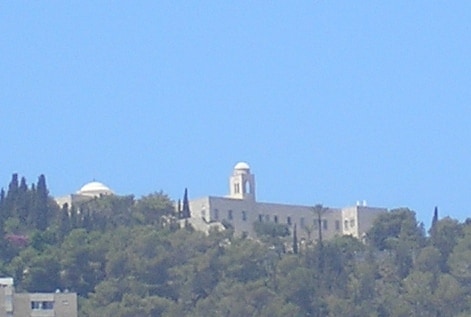
The Basilica of Our Lady, Star of the Sea, Stella Maris Carmelite Monastery, also known as the Monastery of Our Lady of Mount Carmel, is a significant Catholic pilgrimage site located on Mount Carmel in Haifa, Israel. It is renowned for housing the Cave of Elijah, a grotto traditionally associated with the prophet Elijah, and serves as a spiritual center for Discalced Carmelite friars.
Key Facts
- ›The monastery is built above a grotto believed to be where the prophet Elijah lived.
- ›The main church features a dome decorated with biblical motifs and Latin inscriptions.
- ›It is a destination for pilgrims of Jewish, Christian, Muslim, and Druze faiths.
- ›The church was granted the title of Minor Basilica by Pope Gregory XVI in 1839.
- ›An annual procession on the first Sunday after Easter is one of the largest Catholic processions in the Holy Land.
- ›The monastery's ground floor is constructed with thick walls for defense, reflecting historical assaults on the friars.
Cave of Elijah
Discalced Carmelites
About Basilica of Our Lady, Star of the Sea, Stella Maris Carmelite Monastery
The Basilica of Our Lady, Star of the Sea, Stella Maris Carmelite Monastery
The Basilica of Our Lady, Star of the Sea, Stella Maris Carmelite Monastery, also known as the Monastery of Our Lady of Mount Carmel, is a prominent Catholic religious site situated on the slopes of Mount Carmel in Haifa, Israel. This monastery serves as a significant pilgrimage destination, particularly for its association with the biblical prophet Elijah and its role as a spiritual center for the Discalced Carmelite friars.
Historical Context
The Carmelite Order traces its origins to the 12th century, when hermits began inhabiting the caves of Mount Carmel, inspired by Elijah the Prophet. The order received a written rule of life from Albert Avogadro, the Latin Patriarch of Jerusalem, in the early 13th century. The name "Our Lady, Star of the Sea" (Stella Maris in Latin) was adopted for an oratory dedicated to the Virgin Mary.
Following periods of displacement due to historical conflicts, the Discalced branch of the Order returned to the Holy Land in 1631. They established a monastery on the promontory of Mount Carmel, which was later demolished in 1761. The friars then relocated to the current site, directly above a grotto believed to be Elijah's dwelling. The present church and monastery were built starting in 1761, with the current structure completed in 1836.
Religious Significance and Description
The main church within the monastery is noted for its cruciform shape and a dome adorned with paintings depicting biblical scenes and Latin inscriptions. A central feature is the altar, elevated above a small cave associated with Elijah. Pilgrims can descend into this cave, which contains a stone altar and a statue of the Prophet Elijah. Above the cave, a statue of the Virgin Mary with the Child Jesus, known as Our Lady of the Scapular, is prominently displayed. The Virgin Mary is the patroness of the Carmelites, venerated as "Our Lady of Mount Carmel."
The monastery itself functions as a global center for Carmelite spirituality. Its ground floor is characterized by thick, defensible walls, a testament to historical challenges faced by the friars.
Annual Procession and Devotion
Since 1919, an annual procession has taken place on the first Sunday after Easter, honoring the statue of Our Lady of the Scapular. This event has grown to become the second-largest Catholic procession in the Holy Land, attracting large numbers of Catholic faithful who accompany the statue from downtown Haifa to Stella Maris.
In 1839, Pope Gregory XVI bestowed the title of Minor Basilica upon the sanctuary, further solidifying its importance. The monastery continues to be a vital site for religious devotion and a destination for pilgrims from diverse faith backgrounds.
Source: Wikipedia ↗
Frequently Asked Questions
What is the significance of the Stella Maris Monastery?
The Stella Maris Monastery is significant as a Catholic pilgrimage site housing the Cave of Elijah, a grotto associated with the biblical prophet. It also serves as a spiritual center for Discalced Carmelite friars and is known by the Latin name Stella Maris, meaning Star of the Sea.
What is the Cave of Elijah?
The Cave of Elijah is a grotto located within the Stella Maris Monastery on Mount Carmel, traditionally believed to be the dwelling place of the biblical prophet Elijah. It is a focal point for pilgrims of various faiths.
What is the history of the Stella Maris Monastery?
The origins trace back to the 12th century with hermits on Mount Carmel. The current monastery's church and structure were built starting in 1761, with the current building completed in 1836. It was granted the title of Minor Basilica in 1839.
What is the annual procession at Stella Maris?
The annual procession takes place on the first Sunday after Easter, commemorating a post-World War I event. It is the second-largest Catholic procession in the Holy Land, drawing large crowds from Haifa to the monastery.
What is the architectural style of the Stella Maris Monastery?
While specific architectural styles are not detailed, the description notes the main church's cross shape and its dome covered in biblical paintings. The ground floor is described as having thick walls with few openings, suggesting a fortified design.
Related Basilicas

Basilica of Our Lady of Tongre
The Basilica of Our Lady of Tongre is a Roman Catholic parish church and minor basilica located in Tongre-Notre-Dame, Belgium. It is a significant historical shrine, renowned for its medieval statue of the Madonna and Child, which was canonically crowned by Pope Leo XIII in 1881. The basilica also houses a collection of jewels donated by pilgrims, including royalty, and has been a site of Marian devotion and pilgrimage since the late 11th century.

Basilica of Our Lady of Zapopan
The Basilica of Our Lady of Zapopan is a significant 17th-century Franciscan sanctuary located in Zapopan, Jalisco, Mexico. It is renowned for housing a medieval wooden statue of the Virgin Mary, considered a valuable relic, and for being a major pilgrimage site, particularly the annual Romería which draws over a million participants. The basilica is a monumental example of colonial Baroque architecture and serves as a center for religious instruction.

Archcathedral Basilica of the Assumption and St Andrew the Apostle
The Archcathedral Basilica of the Assumption and St Andrew the Apostle, also known as Frombork Cathedral, is a significant Roman Catholic church located in Frombork, Poland. Constructed between 1329 and 1388, it replaced an earlier timber structure and is notable for its historical association with the astronomer Nicolaus Copernicus, who worked and is believed to be buried there. The basilica is recognized as a national Historic Monument in Poland.