
Basilica of Our Lady of Piat
Philippines·Piat·Archdiocese of Tuguegarao
The Basilica of Our Lady of Piat is a Roman Catholic minor basilica located in Piat, Cagayan, Philippines. It is a significant pilgrimage site, particularly known as the "Pilgrimage Center of Northeast Luzon," and is home to the venerated centuries-old brown Madonna, Our Lady of Piat. Pope John Paul II elevated the shrine to the status of Minor Basilica in 1997.
Key Facts
- ›The shrine is home to the centuries-old brown Madonna, our Lady of Piat.
- ›Pope John Paul II designated it a Minor Basilica on March 10, 1997.
- ›The original image of our Lady of Piat was brought from Macau by Dominican friars in 1604.
- ›A spacious church was built in the 1700s on a hill to avoid flooding, becoming the first basilica menor in the region.
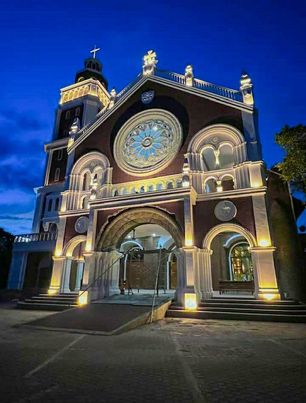
- ›The basilica is constructed primarily of red bricks, a common material for churches in Cagayan Valley.
- ›It features a unique entrance arch located at the back of the church.
Romanesque
Our Lady of Piat
Centuries-Old Brown Madonna, Our Lady of Piat
Dominican Friars
About Basilica of Our Lady of Piat
The Basilica of Our Lady of Piat is a significant Roman Catholic minor basilica located in Piat, Cagayan, Philippines. It is recognized as the "Pilgrimage Center of Northeast Luzon" and is venerated for housing the ancient brown Madonna, Our Lady of Piat. The shrine's importance was further cemented when Pope John Paul II elevated it to the status of a Minor Basilica on March 10, 1997.
History and Devotion
The history of Our Lady of Piat traces back to 1604 when Dominican friars brought an image of the Virgin Mary with the infant Jesus from Macau. Initially known as Nuestra Señora del Santísimo Rosario (Our Lady of the Holy Rosary), a modest sanctuary was constructed for the image in 1604. The image was moved between various churches in Cagayan before being enthroned in Piat. During a solemn procession in 1623, the image was brought to the Ermita, drawing an immense crowd, indicative of the burgeoning faith in the region.
A more substantial church, built with durable materials, was erected in the 1700s on a hill to protect it from the seasonal flooding of the Chico River. This structure, later restored, became the first basilica menor in the region and the fourth in the Philippines. The basilica's architectural features include a unique entrance arch at the rear, a simple facade flanked by a belfry, and a structure primarily constructed from red bricks, a characteristic of churches in the Cagayan Valley. The interiors boast a curved wooden ceiling and verandahs, with the Blessed Virgin Mary enshrined at the altar behind a glass case.
Pilgrimage and Cultural Significance
The Basilica of Our Lady of Piat is a major destination for devotees, particularly during the Sambali Festival celebrated from June 23 to 30 and the feast of Our Lady of Piat on July 1 and 2. Adjacent to the basilica is the Piat Basilica Museum, which preserves artifacts related to the shrine. The site also includes blessing areas for religious items, the parish convent, and Stations of the Cross sculptures, serving as a vibrant center for religious observance and cultural heritage.
Source: Wikipedia ↗
Frequently Asked Questions
When was the Basilica of Our Lady of Piat designated as a Minor Basilica?
The Basilica of Our Lady of Piat was elevated to the status of Minor Basilica by Pope John Paul II on March 10, 1997, through his decree Conspicuum Templum Hoc.
What is the historical significance of the image of Our Lady of Piat?
The image was brought to the Philippines from Macau by Dominican friars in 1604. Initially called Nuestra Señora del Santísimo Rosario, it became deeply revered by the local populace, leading to the establishment of a sanctuary.
Where is the Basilica of Our Lady of Piat located?
The basilica is located in Poblacion, Piat, within the province of Cagayan, Philippines. It is situated about 41 kilometers northwest of Tuguegarao City.
What makes the architectural design of the basilica unique?
The basilica has a distinctive entrance arch situated at the rear of the building, requiring visitors to circumnavigate to view the main facade. The structure is predominantly built from red bricks and is located on a hill to prevent flooding.
What are the main pilgrimage periods for the Basilica of Our Lady of Piat?
The pilgrimage site attracts a large number of devotees, especially during the Sambali Festival, which is celebrated from June 23 to 30, and for the feast of Our Lady of Piat on July 1 and 2.
What is housed in the Piat Basilica Museum?
Adjacent to the basilica, the Piat Basilica Museum contains various artifacts related to the history of the Basilica and Our Lady of Piat, offering visitors further insight into its heritage.
Related Basilicas

Basilica and Archdiocesan Shrine of Santo Niño de Tondo
The Minor Basilica of Santo Niño de Tondo, also known as the Archdiocesan Shrine of Santo Niño de Tondo Parish, is a significant Roman Catholic minor basilica located in Tondo, Manila, Philippines. Established by the Augustinian Order, it is dedicated to the Child Jesus and houses an ivory image of the Santo Niño that arrived from Acapulco, Mexico. Its elevation to minor basilica status by Pope Leo XIV in 2025 marks a key moment in its long history.
Basilica and Diocesan Shrine of Saint Paul of the Cross
The Minor Basilica and Diocesan Shrine of Saint Paul of the Cross in Marikina, Metro Manila, Philippines, is a significant Roman Catholic church. Established as a parish in 1975 and later elevated to a diocesan shrine in 2021, it holds the distinction of being the oldest church in the Philippines dedicated to Saint Paul of the Cross. Its elevation to the status of a Minor Basilica by Pope Leo XIV in 2025 further underscores its importance.

Basilica del Santo Niño
The Basilica Minore del Santo Niño de Cebú, commonly known as the Santo Niño Basilica, is a significant Catholic minor basilica located in Cebu City, Philippines. Founded in 1565 by Augustinian friars, it is recognized as the oldest church in the Philippines. The basilica holds immense religious importance as it is believed to be built on the site where the revered image of the Santo Niño de Cebú, the Child Jesus, was rediscovered.