
Basilica of Our Lady of Lanka
Sri Lanka·Tewatte·Roman Catholic Archdiocese of Colombo
The Basilica of Our Lady of Lanka is a Roman Catholic basilica located in Tewatte, Sri Lanka, serving as a significant pilgrimage site for Sri Lankan Catholics. It houses the venerated statue of Our Lady of Lanka and incorporates unique Asian architectural elements, reflecting a blend of religious and cultural influences.
Key Facts
- ›Originally a small chapel dedicated to our Lady of Lourdes, it was established in 1911.
- ›Archbishop Jean-Marie Masson vowed to build a Votive Basilica under the title our Lady of Lanka if Ceylon was spared from major World War II conflict.
- ›Pope Pius XII approved the construction of the basilica in 1946, and it was officially designated as the principal Roman Catholic patroness of the island in 1948.
- ›The cornerstone was laid in 1950, and the basilica was completed in 1974, the same year it was endowed with the title of Minor Basilica.
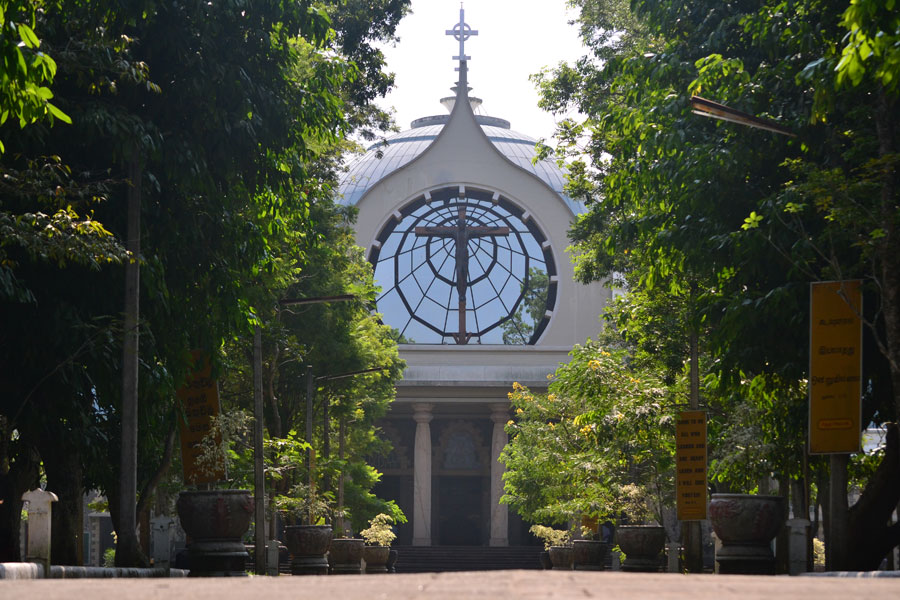
- ›The architecture incorporates Asian elements, including stupa-inspired frames, Hindu gopuram-like towers, and a design by Fr. Heras.
- ›It is a national basilica and a national shrine of Sri Lanka, with panoramic views of Adam's Peak visible from its grounds.
Asian Architectural Elements
Our Lady of Lanka
Statue of Our Lady of Lanka, Replica of the Ark of the Covenant, 17th-Century Ivory Cross
Fr. Heras
About Basilica of Our Lady of Lanka
The Basilica of Our Lady of Lanka is a significant Roman Catholic basilica located in Tewatte, a suburb of Colombo, Sri Lanka. It is a prominent pilgrimage destination for Sri Lankan Catholics and is dedicated to Our Lady of Lanka, housing a venerated statue of her.
History and Foundation
The site's religious history began in 1911 as a small chapel dedicated to Our Lady of Lourdes, built by local clergy and laymen. Over time, it grew in popularity, leading to its expansion into a church in the 1930s. The basilica's establishment was initiated by Archbishop Jean-Marie Masson, who made a vow during the Second World War to construct a votive basilica if Ceylon (now Sri Lanka) was protected from major conflict. Following the war's end and Ceylon's safety, Archbishop Masson received papal approval from Pope Pius XII in 1946 to build the basilica.
Archbishop Thomas Cooray succeeded Masson and took up the responsibility of fulfilling this vision. In 1948, Pope Pius XII officially declared the Immaculate Conception, known as Our Lady of Lanka, as the principal Roman Catholic patroness of the island. Archbishop Cooray then acquired land and commenced the construction of the basilica. The cornerstone was laid on February 4, 1950. The church was completed in 1974, a year after Pope Paul VI bestowed upon it the title of Minor Basilica. The consecration of the basilica and the crowning of the statue of Our Lady of Lanka took place on February 6, 1974, solidifying its status as the national basilica and shrine of Sri Lanka.
Architectural Design
Designed by Fr. Heras, the Basilica of Our Lady of Lanka features a unique blend of Asian architectural elements, intended to be appreciated by devotees of various faiths. The front porch is adorned with six pillars, symbolizing the six dioceses of Ceylon during World War II. A prominent feature is a cross with a bronze Christ figure by artist Leila Peiris, set within a spider web design against circular glass, encased in a stupa-inspired frame. The statue of Our Lady was crafted to resemble the face of Christ on the Shroud of Turin, as per the Cardinal's request.
The basilica's twin towers, topped with golden bell enclosures, draw inspiration from Hindu gopuram designs. Its cruciform structure includes a central dome surmounted by a cross of the Eastern Oriental Church. The walls are constructed of granite, and the wooden doorways feature Indian architraves. Inside, a life-sized statue of Our Lady of Lanka, carved by Thedim, holds the infant Jesus and a golden rosary. The altar is made of undressed white stone, with railings crafted from various local woods. The Holy of Holies contains a replica of the Ark of the Covenant, and an ivory cross from the 17th century hangs above.
The grounds surrounding the basilica are extensive and include four convents, a museum and Jubilee Hall, a Retreat House, grottos resembling Lourdes, a bathing pond and lake, and the original old church. The right side of the basilica offers panoramic views of Adam's Peak. The Kandyan-style museum showcases religious artifacts and vestments belonging to Cardinal Cooray.
Source: Wikipedia ↗
Frequently Asked Questions
When was the Basilica of Our Lady of Lanka built?
The cornerstone for the basilica was laid on February 4, 1950, and construction was completed in 1974. The consecration and crowning of the statue took place on February 6, 1974.
What is the significance of the Basilica of Our Lady of Lanka?
It is a major pilgrimage site for Sri Lankan Catholics and is designated as the national basilica and a national shrine of Sri Lanka. It is home to the venerated statue of Our Lady of Lanka.
What architectural styles can be seen at the Basilica of Our Lady of Lanka?
The basilica's design, by Fr. Heras, incorporates Asian architectural elements, including stupa-inspired frames, twin towers with golden bell enclosures reflecting Hindu gopuram designs, and a central dome with a cross of the Eastern Oriental Church.
What relics or important items are housed in the Basilica of Our Lady of Lanka?
The basilica houses a life-sized statue of Our Lady of Lanka carved by Thedim, a replica of the Ark of the Covenant in the Holy of Holies, and a historical 17th-century ivory cross from Puttlam.
Who was instrumental in the construction of the Basilica of Our Lady of Lanka?
Archbishop Jean-Marie Masson initiated the idea for the basilica during World War II. His successor, Archbishop Thomas Cooray, took on the responsibility of realizing this vision and oversaw its construction.
Related Basilicas

"Old" Basilica of Our Lady of Guadalupe
The Insigne y Nacional Basílica de Santa María de Guadalupe, commonly known as the Basilica of Our Lady of Guadalupe, is a prominent Catholic church in Mexico City dedicated to the Virgin Mary under her invocation as Our Lady of Guadalupe. It is one of the most visited Marian shrines in the world, attracting an estimated twenty million pilgrims annually, with a significant portion visiting around December 12th, the feast day of Our Lady of Guadalupe. The sanctuary complex includes the older church, now referred to as the Old Basilica, built in the early 18th century, and the modern New Basilica constructed in the 1970s to accommodate the growing number of devotees.

"Old" Basilica of Our Lady of La Vang
The "Old" Basilica of Our Lady of La Vang is a significant Marian shrine located in Quảng Trị Province, Vietnam, associated with a reported apparition of the Virgin Mary during a period of Christian persecution. Pope John XXIII elevated the shrine to the status of a Minor Basilica in 1961, making it a focal point for Catholic devotion in Vietnam.

Abbatial Basilica of SS Peter and Paul
The Abbatial Basilica of SS Peter and Paul, also known as Dendermonde Abbey, is a Benedictine monastery in Dendermonde, Belgium. It played a significant role in the Liturgical Movement in Belgium during the late 19th and early 20th centuries. The current basilica structure was consecrated in 1902 and designated a basilica in 1939.