
Destroying angels
Fungi Taxonomy
Destroying angels are a group of highly toxic, all-white mushrooms belonging to the genus Amanita. They are known for their deadly amatoxin content, which causes irreversible liver and kidney damage. These mushrooms are found globally, often near woodlands and in grassy meadows, and are notoriously difficult to distinguish from edible species.
Key Facts
- ›Destroying angels are characterized by their all-white appearance, white gills, and white stalks.
- ›They possess a partial veil (ring) on the stalk and a volva (cup-like structure) at the base, remnants of a universal veil.
- ›These mushrooms are among the most toxic known, containing amatoxins that inhibit RNA polymerase.
- ›Symptoms of poisoning can be delayed for 5 to 24 hours, by which time irreversible organ damage may have occurred.
- ›They form ectomycorrhizal relationships with trees and are found in or near woodlands, lawns, or meadows.
- ›Several species are referred to as destroying angels, including Amanita virosa, a. bisporigera, and a. ocreata.
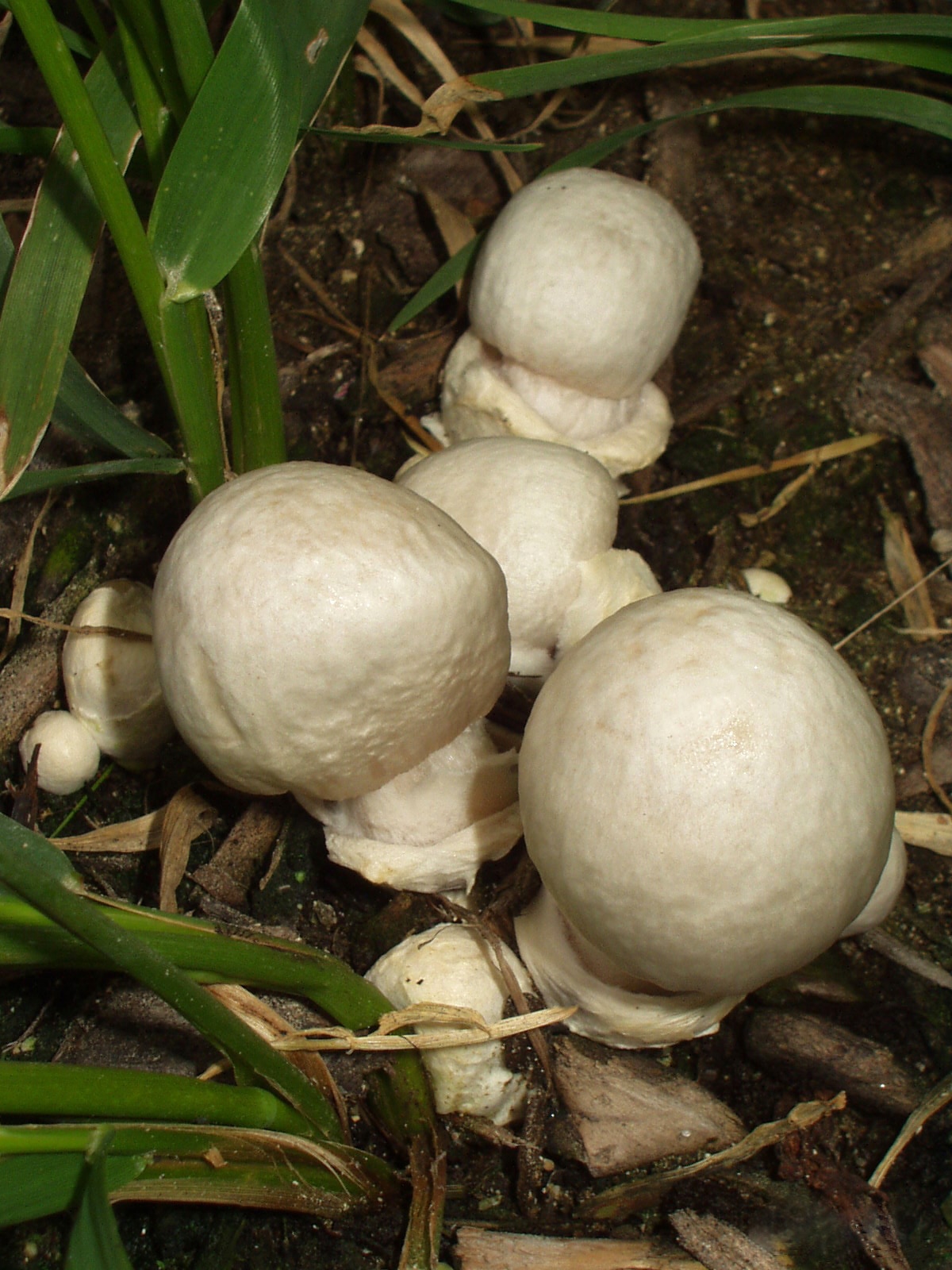
- Amanita verna (also referred to as 'fool's mushroom')
- Amanita virosa
- Amanita bisporigera
- Amanita ocreata
Poisonous Species
Amanita Phalloides, Amanita Species
About Destroying angels
The name "destroying angel" is applied to several closely related and highly toxic species of all-white mushrooms within the genus Amanita. These fungi are renowned for their extreme danger to humans, being among the most poisonous known mushrooms. The primary species bearing this name include Amanita virosa in Europe, and Amanita bisporigera and Amanita ocreata in North America. Another European species, Amanita verna, also known as the "fool's mushroom," is likewise referred to as a destroying angel.
Description and Identification
Destroying angels are characterized by their striking, uniformly white appearance, which includes white gills and white stalks. The cap can be entirely white or may exhibit a yellowish, pinkish, or tan hue towards the center. A distinctive feature is the presence of a partial veil, which forms a ring (annulus) around the upper part of the stalk. The gills are "free," meaning they do not attach to the stalk. Perhaps the most crucial identifying mark is the volva, or universal veil, a membrane that fully encloses the young mushroom like an egg. As the mushroom grows, this veil ruptoms, leaving behind a cup-like or boot-like structure at the base of the stalk, and sometimes patches of removable material on the cap's surface. This combination of features—white gills, a ring, and a volva—is a hallmark of the Amanita family and is critical for distinguishing them from other fungi.
Distribution and Habitat
These mushrooms form essential ectomycorrhizal relationships with the roots of various tree species. Consequently, destroying angels are typically found growing in or near the edges of woodlands, as well as on lawns or grassy meadows that are adjacent to trees or shrubs. Various species known as destroying angels are distributed globally, indicating their widespread ecological presence.
Toxicity and Danger
Destroying angels, along with the closely related death caps (Amanita phalloides), are responsible for the vast majority of fatal mushroom poisonings worldwide. The primary culprit is amatoxin, a potent toxin that effectively inhibits RNA polymerase, a vital enzyme for cellular function. The danger is compounded by a significant delay in the onset of symptoms, which can take between 5 to 24 hours to appear. By this time, the amatoxins may have already been absorbed, leading to irreversible damage to the liver and kidneys. Ingesting even half a mushroom cap can be fatal if prompt and intensive medical treatment is not administered. Symptoms of poisoning include severe vomiting, cramps, delirium, convulsions, and diarrhea. While intensive treatments involving fluid replacement, activated charcoal, and other medical interventions can be effective, the potential for fatality remains extremely high.
Misidentification Risks
Due to their appearance, destroying angels pose a significant risk of misidentification with edible fungi. Button mushrooms, meadow mushrooms, and horse mushrooms share some visual similarities, making accidental consumption a serious concern. Young, unexpanded destroying angels, still enclosed within their universal veil, can be mistaken for puffballs. However, slicing these suspected puffballs in half longitudinally will reveal the characteristic internal structures of a mushroom, which are absent in true puffballs. Experts strongly advise mushroom hunters to be thoroughly familiar with the identifying characteristics of both the death cap and the destroying angel in all their forms before collecting any white-gilled mushroom for consumption.
Source: Wikipedia ↗
Frequently Asked Questions
What are the main species of destroying angels?
The primary species referred to as destroying angels include Amanita virosa in Europe, and Amanita bisporigera and Amanita ocreata in North America. Amanita verna is another European species also known by this name.
What makes destroying angels so dangerous?
Destroying angels contain potent amatoxins, which are highly toxic to humans. These toxins interfere with essential cellular processes, leading to severe and often fatal damage to the liver and kidneys.
What are the symptoms of destroying angel poisoning?
Symptoms typically do not appear for 5 to 24 hours after ingestion, by which time significant organ damage may have occurred. Initial symptoms can include vomiting, cramps, delirium, convulsions, and diarrhea.
How can destroying angels be identified?
Key identifying features include their all-white color, white gills, a ring (annulus) on the stalk, and a volva or cup-like structure at the base of the stalk. Young specimens enclosed in a universal veil can resemble puffballs, but slicing them reveals internal mushroom structures.
Where do destroying angels typically grow?
Destroying angels are found in or near the edges of woodlands, as they form ectomycorrhizal relationships with the roots of certain trees. They can also be found on lawns or grassy meadows in proximity to trees or shrubs.
Can destroying angels be mistaken for edible mushrooms?
Yes, destroying angels can easily be mistaken for edible fungi such as button mushrooms, meadow mushrooms, or horse mushrooms. Their similarity to edible species, coupled with their extreme toxicity, makes them particularly hazardous.