
Cassiel
Cassiel is an angel venerated in extracanonical Jewish, Christian, and Islamic mystical traditions. He is often identified as one of the Seven Archangels and is associated with the planet Saturn. Cassiel's roles include guardian, angel of death, and presider over the deaths of young men, wielding powerful weapons against those unfit to behold the divine.
Key Facts
- ›Cassiel is identified as an angel in Jewish, Christian, and Islamic mystical and magical texts.
- ›He is frequently listed among the seven Archangels.
- ›Cassiel is commonly known as the angel of Saturn and Saturday.
- ›He is described as a guardian of heavenly palaces, armed with weapons like a lightning-dripping sword.
- ›In some traditions, Cassiel is considered an angel of death, overseeing the demise of young men.
- ›He is also associated with tears and temperance.
Kassiel, Qassiel, Caftsiel, Captsiel, Kasiel, Cassael, Kisfiyail
Guardian, Angel of Saturn, Angel of Death, Guardian of Heavenly Palaces
Saturn, North
Lightning-Dripping Sword, Bow, Tempests, Light, Winds
Temperance
Dumiel, Gabriel, Hizqiel, Zaphkiel
the Outcast Season Series By Rachel Caine, Wings of Desire, City of Angels, Faraway, So Close!, Terre D'Ange Novels By Jacqueline Carey
About Cassiel
Cassiel is an angel whose presence is recorded in extracanonical Jewish, Christian, and Islamic mystical and magical texts. He is often identified as one of the Seven Archangels and is strongly associated with the planet Saturn. Various spellings and phonetic translations of his name exist, including Kassiel, Qassiel, Caftsiel, Captsiel, Kasiel, and Cassael, with Arabic variations like Kasfiyail also noted.
Role in Jewish Mysticism
Within Jewish mystical literature, Cassiel appears in several significant contexts. He is invoked in ancient Hebrew charms used to determine if an enemy is fleeing. In texts like "3 Enoch" and "Hekhalot Rabbati," Cassiel is described as a guardian of the seventh heaven and the sixth palace, respectively. As a guardian, he is depicted as possessing formidable weapons, including a sword dripping with lightning, a bow, tempests, light, and powerful winds, which he employs against those deemed unworthy to approach God. He is also listed as a guardian of the second palace in "Ma'aseh Merkavah." The "Zohar" identifies Cassiel as one of two chief aides to the Archangel Gabriel, alongside Hizqiel. Furthermore, Cassiel is recognized in some Jewish traditions as an angel of death, specifically overseeing the passing of young men.
Associations in Western Occultism
Cassiel's presence extends into Western occult traditions, appearing in works such as "The Sworn Book of Honorius" and Pseudo-Pietro d'Abano's "Heptameron." These texts reiterate his role as the angel of Saturn and also identify him as the angel of the North. His inclusion in these grimoires, alongside his mention in the "Sigillum Dei," highlights his importance in ceremonial magic. Later texts like "Liber de Angelis" and various editions of "The Key of Solomon" continue to list Cassiel (or Cassael) as the angel of Saturn or Saturday. Francis Barrett's "The Magus" portrays him as a dragon-riding djinn with a beard, further solidifying his Saturnian connection.
Other Attributions and Cultural Portrayals
Beyond his planetary and guardian roles, Cassiel is sometimes referred to as the angel of tears and the angel of temperance. Some traditions, under the name Qafsiel, regard him as the ruler of the moon instead of Saturn. Islamic scholars like Averroes and Ibn Arabi also linked the archangel Kafziel to Saturn. Cassiel has also made notable appearances in popular culture, including as the central figure in Rachel Caine's "The Outcast Season" series and as a character in Wim Wenders's acclaimed films "Wings of Desire" and its sequel "Faraway, So Close!," where he explores the human condition. He is also a character in Jacqueline Carey's "Terre D'Ange" novels.
Source: Wikipedia ↗
Frequently Asked Questions
What are the different names for Cassiel?
Cassiel is known by several names and phonetic variations, including Kassiel, Qassiel, Caftsiel, Captsiel, Kasiel, and Cassael. Some Arabic transliterations include Kasfiyail.
What is Cassiel's primary association in mystical traditions?
Cassiel is most frequently associated with the planet Saturn and the day of Saturday in Western occult literature. He is also identified as the angel of the North in some texts.
What are Cassiel's roles in Jewish mystical literature?
In Jewish mystical texts, Cassiel is invoked in charms, described as a guardian of heavenly palaces (specifically the sixth and seventh), and listed as one of the angels of death who presides over the deaths of young men.
What weapons are attributed to Cassiel?
Cassiel is depicted as being armed with a lightning-dripping sword that shouts "Ruin!", as well as a bow, tempests, light, and powerful winds. These are used against those deemed unfit to see God.
Is Cassiel considered an archangel?
Yes, Cassiel is often listed as one of the Seven Archangels in various extracanonical Jewish, Christian, and Islamic mystical works. He is sometimes referred to as an archangel of Saturn.
Has Cassiel appeared in popular culture?
Cassiel has been featured in popular culture, notably as the protagonist in Rachel Caine's "The Outcast Season" series and as a character in Wim Wenders's films "Wings of Desire" and its sequel "Faraway, So Close!". He also appears in Jacqueline Carey's "Terre D'Ange" novels.
Related Angels
Barachiel
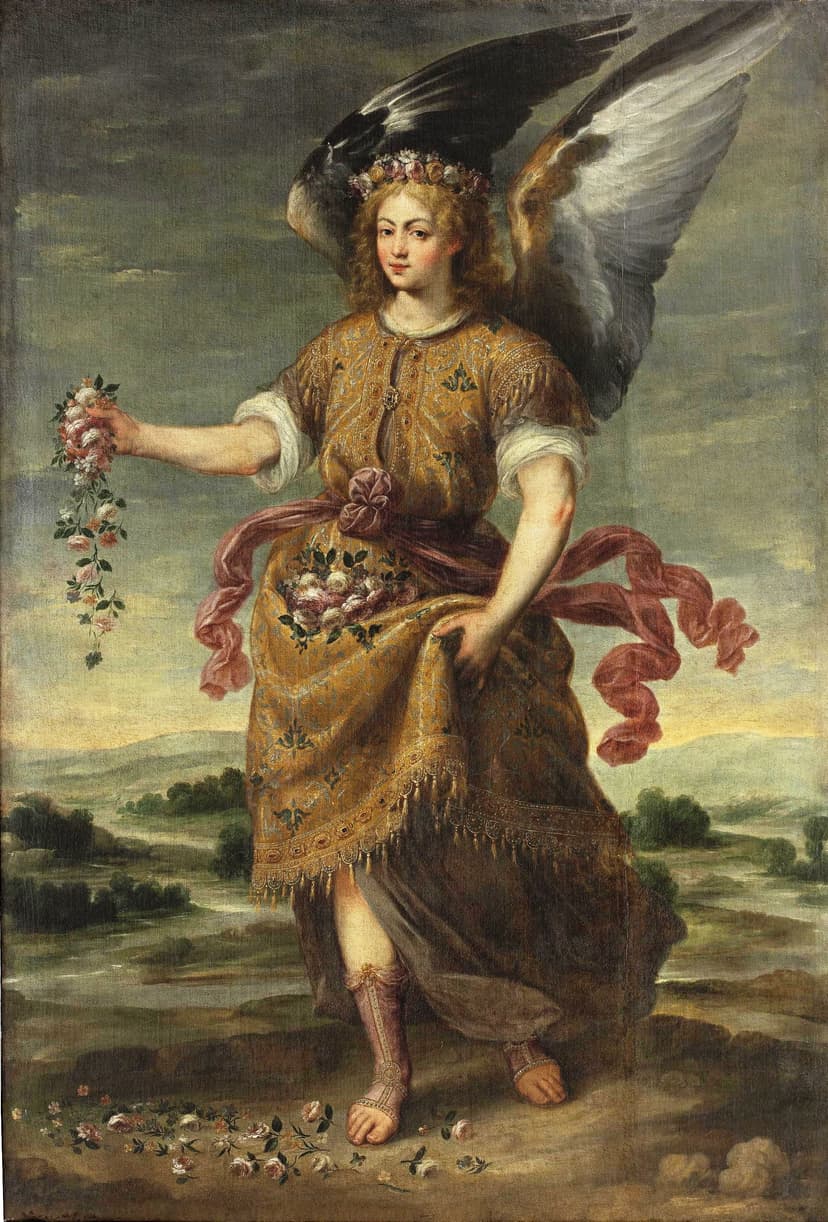
Barachiel, meaning "God has blessed," is an Archangel revered in Judaism, Byzantine Catholic, and Eastern Orthodox traditions. He is primarily known as the Archangel of Blessings and is associated with bestowing divine favor, particularly upon families and converts. Iconographically, he is often depicted with symbols of blessing, such as roses or a bread basket.
Nuriel
Nuriel is an angel in Jewish tradition, often associated with hailstorms and fire, whose name signifies "El/God is my fire" or "El/God is my light." He is considered an archangel, sometimes identified with Uriel, and is known for his role in judgment and as a powerful protective charm. Nuriel is depicted as a towering figure with an army of angelic beings.
Sahaquiel
Sahaquiel is identified as one of the seven great archangels within the Third Book of Enoch, an apocryphal text of the Hebrew Bible. He is described as the guardian of the fourth heaven and a prince of a heavenly host, attended by a vast number of ministering angels. The name Sahaquiel translates to "Ingenuity of God."